"The universe is made of stories, not of atoms."
—Muriel Rukeyser
____________________________
Showing posts with label associate. Show all posts

Russian Transport’ swoops into Steppenwolf, delivering dark cargo of corruption and terror

Review: “Russian Transport” by Erika Sheffer, at Steppenwolf Theatre through May 11. ★★★★

By Lawrence B. Johnson

Aaron Himelstein plays the driver, Melanie Neilan the passanger in 'Russian Transport.' (Michael Brosilow)

The young playwright Erika Sheffer’s stark and chilling tragedy-as-morality play “Russian Transport,” just opened in a hard-edged production at Steppenwolf Theatre, offers an unvarnished look at the immigrant experience recalling Arthur Miller’s “A View From the Bridge.”
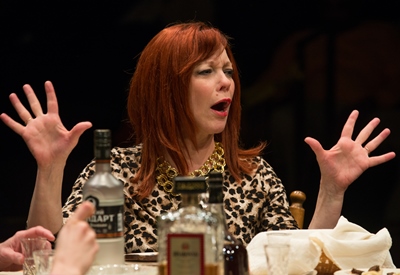
Diana (Mariann Mayberry) is the tough-as-nails matriarch in 'Russian Transport.' (Michael Brosilow)


Like Miller’s “View,” Sheffer’s 2012 drama – her first play — is set in the Brooklyn underbelly where life is hardscrabble, you do whatever it takes to get by and you extend a hand to family coming behind you. But where “View” centers on the obsessive and destructive impulses of one troubled soul, “Russian Transport” serves up an overtly corrupt and dangerous man prepared to exploit, even subjugate his own kin in pursuit of his horrific business.

Sheffer’s taut, concise play begins as family comedy, broad and earthy, in a Russian-American household ramrodded by the willful Diana (Mariann Mayberry in a performance as outrageously brassy as her mop of red hair). She gets little more than humorous pushback from husband Misha (Alan Wilder), who runs a taxi service out of a back room. Wilder lends Misha has a distinct aspect of anonymity.
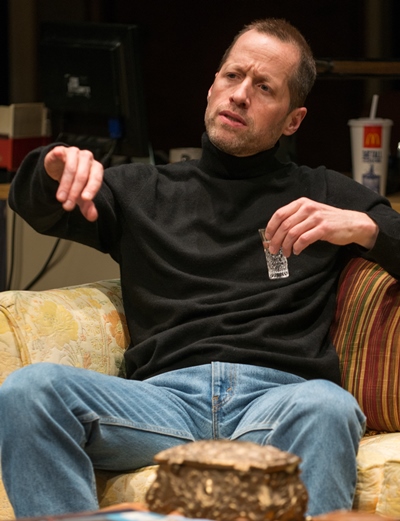
Boris (Tim Hopper) settles in with his sister's family in 'Russian Transport.' (Michael Brosilow)It is a spunky tribe, rounded out by two teenage children — Alex (Aaron Himelstein), who somehow makes more money than his job selling cell phones actually pays, and Mira (Melanie Neilan), who’s constantly at war with her mother and desperate to visit Italy. The parents are from Russia and often speak the mother tongue; the kids, thoroughly Americanized, understand the old language but stick to the parlance of their time and place.

Into this happily combative scene comes Diana’s brother Boris, a tall, strong, imposing man in his late thirties just arrived from the homeland. Diana, who hasn’t seen him in 20 years, says Boris always exuded virility. Even when he was young, she says, he could make a girl pregnant just by looking at her.

At first the new family addition is quiet and retiring, all gratitude and deference. But the truth is that Boris is into some serious – what’s the word? – stuff. You could call him the title character: the Russian transporter. And very soon he loops nephew Alex into his insidious game.
 
Tim Hopper is downright frightening as Boris. No one, not even his accommodating sister, is safe Misha (Alan Wilder) is the father, if not head of the household. (Michael Brosilow)around him. No one dares cross him or fail him. When young Alex loses his stomach for the job and leaves Boris in the lurch, the importuned uncle recounts an anecdote about a relative of Alex’s, back in the motherland, who once made a similar judgment error. In graphic detail, Boris spells out the amending lesson that poor fellow got.

It is Alex who stands at the moral wall of this very dark tale, and in Aaron Himelstein’s nuanced portrait of a potential criminal as a young man, he seems the unlikeliest such bulwark. He gets sucked in, overwhelmed, sickened. But in Boris’ world, there is no door marked Exit. You’re in for the long haul. And yet, when you look in the rear-view mirror and see your own humanity looking back at you — what then?

Moving on a parallel plane is the play’s most intriguing character and Erika Sheffer’s most imaginative structural component – daughter Mira. Young, beautiful and restive, she wants so much to travel, see the world beyond Brooklyn. Nyet, her mother replies, singularly and just as loudly as Mira pleads.
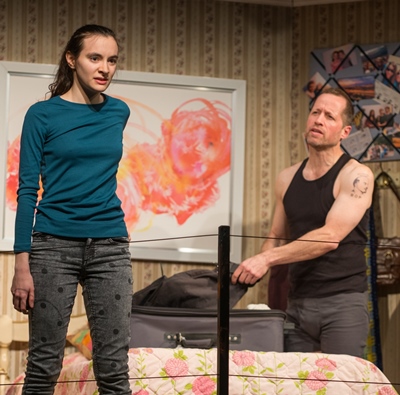
Mira (Melanie Neilan) and Boris (Tim Hopper) get to know each other. (Michael Brosilow)


Melanie Neilan’s Mira is a girl of many faces, headstrong and narcissistic and naïve. But also determined to prevail, as eventually she appears to do. There’s mother Diana, in half light, helping the girl into a warm jacket and sending her off. When a bright-eyed kid wants something that badly, how long can a mom say no?

Director Yasen Peyankov paces the play with an impeccable sense of flow and rest, urgency and tension. The reunion of sister and brother at the family’s welcoming dinner is expansive in its cheer, disturbing in its edge. Boris’ transformation from mellow uncle to terrifying criminal progresses by deftly measured steps.

Set designer Joey Wade has provided a homey environment that brings the viewer directly into Sheffer’s harrowing narrative. And costumer Ana Kuzmanic hits the peak of cool with a suit for Boris that says crime pays, and well.

Reposted From Chicago on the Aisle


Author 101 University event in Los Angeles March 6- 9, 2014


 Are you a bestseller yet? -

Is your book written yet?
If it is written, is it a bestseller yet?
If it is a bestseller, is it getting you the opportunities you'd dreamed of?

Let's make sure this is the year all of that happens for you.

For the last dozen years Rick Frishman has hosted an event called Author101University.

New and established authors from around the globe all come together for 4 amazing days to learn from some of the world's leading marketing and publishing experts so they can become bestselling authors, highly-paid speakers and coaches and respected authorities in their niche.

Everyone has a lot of fun and most importantly, everyone walks away with what
they need so they can grow their success as an author.

Come to the next Author 101 University. Here's what can happen for you there...In one weekend, you'll:

-- Connect with literary agents who want to represent you
-- Get your new book published or your old book revitalized
-- Make your book a bestseller
-- Learn how to turn your online promotions into huge exposure (and sales)
-- Transform your message into a mega success business
-- Meet and network with amazing people
-- And so much more...

Your dream doesn't have to be just a dream.

Come to the next Author 101 University event in Los Angeles March 6- 9, 2014.


GET ALL THE DETAILS HERE


You'll meet top publishing and marketing experts and discover their proven techniques to get your book published and double or even triple your income.

If you're an aspiring or accomplished author, speaker, entrepreneur, small business owner, or simply someone who wants to network with and learn from bestselling authors and experts in marketing...


Guest Post: Terry Southern: Mentoris Maximus

Terry Southern collage


by Nancy Nigrosh

 Some people debate the value of film school. I’m not one of them.

Terry Southern’s NYU master screenwriting class was held on Tuesday nights at Remington’s Bar, a basement dive on Waverly Place. Trudging through the ice-hardened sidewalk, I noticed his beat up Ford Mustang with the broken canvas top barely covering up the snow from the storm night before. I always wondered how he’d made it back to Connecticut in that thing.

Terry was one of a kind, a truly badass screenwriter. Even in the revolutionary times of the 1960’s and ‘70’s, the author of the geared to shock novel, Candy, also wrote screenplays for Dr. Strangelove, Easy Rider, Barbarella, and many other films that scored bull’s-eyes at shaking up the status quo.
I nodded to my classmates, who each nursed a coke or a beer at the counter. In turns, we sauntered over to Terry’s table, where he presided in kingly fashion, and gave insights into the magic of professional filmmaking. There were six of us, so we got roughly half an hour each. By ten o’clock, Terry was in a world of his own, yet still adept at letting us in on Stanley Kubrick insider stories and cool anecdotes about the scenes behind the scenes of Easy Rider.

His advice was punctuated by references to classical drama that he connected to anecdotes about the films he’d written. Referring to The Magic Christian, one of his own novels he’d adapted for the screen, he became incensed that Ringo Starr, Peter Sellers and “all these other limey pricks” didn’t see that “Hamlet and his problems” were an expression of emotional excess that couldn’t be exposed simply by indulging in excess on screen. It seemed what he was really teaching us was something else other than writing, something about the reality of being a writer. He actually adored these “pricks,” who were his comrades-in-arms. But only they could get away with behaving outrageously. As a writer, Terry found out there was a double standard when it came to being creative. He had to bear the architectural burden of responsibility without the advantage of being in control.

Each of us pitched a story to Terry. He seemed to be listening and weighing words on some invisible scale only he knew the value of, followed by oblique commentary until he finally dug out a golden nugget and tossed it with a knowing raised eyebrow reminiscent of Durand Durand from Barbarella.
I’d just seen Louis Malle’s Murmur of the Heart, so I pitched a forbidden love story between an immature actress in her twenties and a teenage boy actor, and framed it as a film-within-a-film. Fueled by pretentious schoolgirl logic I said, “I just worked on a feature and can see that filmmaking creates a heightened state where the rules just don’t apply…” He interrupted by exclaiming, ”I want to write this with you! I know all about what goes on on movie sets, so it’ll be authentic!” I was flattered and didn’t quite know how to respond. “You’ve never even been to California!” he concluded, shaking his head. It was odd that he was the one pitching me. I couldn’t quite believe it.
“How would it work?” I shrugged. He explained, “You write pages, send them to me in Connecticut and then I make comments and add to them, then mail them back, ‘Special Delivery’, wherever you are.” The plan was to collaborate through the post office, and of course, we’d write cutting edge, wild and subversive projections about how a girl in her 20’s – if left to her own dark devices, might behave. Little did I know this process would take nearly two years. Fat manila envelopes from Terry covered with red ink stamped “S.W.A.K.” and “Good Grief!” would ebb and flow. He also sent copies of his books, Red-Dirt Marijuana and Blue Movie, complete with scrawled notes I wasn’t sure were for me personally or well-thumbed copies he had lying around.
On our script’s pages, Terry vented all too real frustrations he’d had on the films he’d worked on with mind blowing insights into a screenwriter’s travails.
He created wonderfully bizarre characters, including the producer’s assistant cum girlfriend, Comancha, an Apache dominatrix who rids the set of the studio’s evil spirits with a down and dirty, pow-wowing striptease.

My contributions were more romantic and melodramatic, befitting my naïveté. Nevertheless, Terry gallantly told me how talented I was. He suggested I apply to UCLA’s MFA screenwriting program, move to L.A. and take my shot. He said he’d write a recommendation. He did. Within months I was on the road, traveling cross country.

Westwood seemed benign, even sleepy, but just as Terry hinted out loud, L.A.’s ‘70’s casual suburban façade was an intimidating mental construct even more self obsessed than the one he’d conjured in our script. His potent warnings about Hollywood made me fearful, and, at 22, I was still just a kid with a lot more living to do. It became clear I wasn’t destined to become a screenwriter after all.
Little did I realize at the time how well Terry had prepared me for the career I did end up having in Tinseltown years later as a literary agent. In spite of the supportive yet subversive film folks he’d worked for, Terry was well aware that he’d been lucky. With a killer smile he advised, “Court luck, keep your thumb out, and like D.H. Lawrence said, ‘when you’ve got something to say, say it hot.’ Somebody’s gonna want whatcha got.”


Reposted from Hollywood Journal


Nancy Nigrosh

About Nancy Nigrosh

Nancy Nigrosh is a former talent and literary agent at Innovative Artists and The Gersh Agency, who has represented many award winning writers and directors for film and television including Academy Award winner Kathryn Bigelow (The Hurt Locker) and Stuart Beattie (Collateral, Pirates Of The Caribbean). She teaches at UCLA Extension Writers’ Program and is a frequent contributor to Indiewire. Through her company, Literary Business, Nancy offers freelance developmental and consulting editing for authors and screenwriters. Follow Nancy on Twitter @nancynigrosh

“Birdbath”: Particles of Speech


Actor/Director Lila French speaking at the Prytania during the New Orleans Film Festival


Film Festivals should offer Lila French’s lovely adaption of “Birdbath” as a primer to filmmaking tyros.   “Birdbath” reminds me of a fine pen sketch by Sidney Paget or Edward Gorey.  You see the finished work and surprise yourself by realizing how few strokes went into such a deft creation.  It’s a short movie containing nothing but conversation enlivened with acting.  When the actors, director, DP, and rest of the crew are excellent, the result is better than most anything around. 

Ah, no, “Skook” had no business winning anything at NOFF.  “Birdbath” was, like, way better, Dude.  Fer sure! 


  At the time I caught the second screening of “Birdbath” at the New Orleans Film Festival, slacker films had swamped me.  Hours of flat characters with nothing to say to each other just drains the creative impulse.  I couldn’t think to review.  After seeing “Birdbath”, it occurred to me how crucial good dialogue is in any film.  Unfortunately, independent films shall remain saturated with too-cool losers who smoke, smoke weed, slouch, and detach themselves from everything, including those foolish enough to sit and watch all this.  

My next essay, “Speech Impediments”, will break that detachment with an overdue violent assault.  Now let’s focus on how Lila French uses dialogue to craft an excellent short film.

Craft shall be our operative word.  All dialogue is crafted conversation.  Remember that poetry and drama come from the same source: men (sorry ladies – but it’s true) standing alone reciting stories and histories in verse.  The dialogue in drama only became prose after the Restoration, after a period when Cromwell had banned plays and broken traditions.  While they work very differently, movies remain tied to plays in this regard.  You need poise and purpose in the fabric of every character’s speech, Bill and Ted included.   


Birdbath

In “Birdbath” we have the simplest of set-ups: two employees of a diner walk towards home after closing.  Unlike a play written by the horrid Neil Simon, we have conversation rather than one-liners.  Our characters are more realistic, but there’s a certain style in their speaking.  Some of this is time-sensitive.  Leonard Melfi wrote “Birdbath” in 1965, near the beginning of his career.  Some of this is conventional playwriting.  For those of us who have spent hundreds of hours watching drama, there’s an “Oh, Thank God!” sensation when we realize that there will be no “up-talk” cadence (say, “Dude, Totally!” to understand what I mean), and in fact we’ll spend time with serious people.  We hear the dialect of the footlights.

That dialect insists on backstory and scene setting in the early conversation.  Slacker films eschew this.  Those scripts need little mysteries to keep us from falling asleep.  The traditional pattern does require skill to keep the characters moving.  Here Melfi may have erred: Ms. French told me in an interview that she found things she could remove from the dialogue and incorporate into her acting.  A one-act should be all lean and no fat to cut.  Unlike Shakespeare, Melfi doesn’t trust his actors quite enough not to overegg his aural pudding.  Ms. French was quite right removing whatever passages she did.  “Birdbath” never lags . . . or, shall we say, slackens.

Velma Sparrow and her coworker Frankie, a better drinker than poet (a Melfi staple), are young people from the bottom of the social world.  In a play by a European or someone like Clifford Odets, we’d hear more about the societal injustices pushing these people downward.  Melfi worked more internally.  He deflected answers about his work using the term “encounter”, something of a marketing plug for two of his compilations.  The slant away from the external creates a more timeless intimacy, perhaps why this has been his most performed play.

What we see are actually two conversations: surface communication, often involving small talk or minor self-revelation, and the deeper conversation as a man and woman size each other up for a potential sexual liaison.  If you count the internal dialogue each actor skillfully displays, then we technically have four conversations going.  Instead of slacker detachment, we see the effort to sincerely bond and connect through the static.  Melfi’s later failures may have something to do with his continuing interest in sincerity and emotional exposure.  The post-70s world didn’t take kindly to such interest, a world following Nixon into covering-up.

Here Melfi gives his two actors a dynamic movement to build their performances around.  As gifted a director as she is an actor, Ms. French actually trusts us to watch carefully to see it all.    As Velma, she hesitates, obfuscates, and surrenders, only to reconsider.  Frankie stays interested, and goes from anticipation to frustration to resignation to acceptance.  Real traps exist for both actors: this could have easily been bad Tennessee Williams-lite (see: Jasmine, Blue). Ms. French and Chad McKnight create an illusion of genuinely repressed pain slowly revealed.  There are real chasms separating being on screen, acting, acting with finesse, and Al Pacino-scenery-gobbling.  Our two actors here work with finesse and in harmony with the rest of the production.  For a small, quiet movie, we have a lot going on if we know where to look.

The direction and shot selection really help point this out.  As opposed to European circles, where societal emphasis requires wider shots (Socialism poo-poos beauty shots), “Birdbath” focuses on the person.  We get a lot of close-ups. The historical setting is shown in small personal objects, like Frankie’s typewriter.  As the two characters become better acquainted, the shots change from lots of clean singles to “dirty singles” where the other character is in frame, but out of focus.  As “Birdbath” moves to denouement, you begin to really see the true beauty in each person.  Ms. French, the director, gives Ms. French, the actor, along with Mr. McKnight nowhere to hide.

As social apes, we respond to emotional intensity in others.  Again, the finesse comes into the play: we see emotion but not anger, which pushes the audience away.  As Velma dithers, the camera closes in.  We see her very blue eyes dart around trying to figure out what to do.  It’s a series of beautiful frames showing a character who is beautiful but clearly can’t relate to that concept.  She wants to be wanted, but finding herself wanted, finds herself frightened.  It’s a sequence someone should show to Olivia Wilde or Kate Beckinsale.  I’ve seen both sitting at tables in films talking and looking beautiful (Ms. Wilde shot just so in the awful “Rush”) but not having the scope to do this.  It’s the type of moment Cate Blanchett strived for just recently, but Woody got in her way (or whatever happened).  Mr. McKnight is a worthy counterbalance, matching Ms. French quite harmoniously.  It’s rare enough to really appreciate (see Jasmine, Blue. supra).

Proper dialogue gives actors a chance to build their characters.  Recall Shakespeare, an actor, offers his brethren almost solely dialogue. Actors need to trust that they can just flow out and the strength of the words will keep them from falling.  You can’t act if the dialogue makes you look ridiculous, no matter how great an actor you are (see the recent filmography of Hopkins, Sir Anthony).  But when the words on the page ring and sing, actors can find their personas in the smallest speech patterns or idiosyncrasies.  They sense little particles of movement (here hidden in  Melfi’s words) to add their voices to, which along with Lila French’s direction and the help of a talented crew have made 47 minutes of work worth seeing.


Reposted from Raymon on Film and Photography

Lila French's "Birdbath" NOFF in Review


Back in October, Lila French's "Birdbath" had its festival debut at the NEW ORLEANS FILM FESTIVAL. The film screened twice (at notable venues The CAC nd The Prytania), and each screening had a full, energetic audience who responded positively to the film. There was laughter during the screenings and great questions after.


Book Publisher Macmillan Bolsters Film Shingle Run By Brendan Deneen

Macmillan Publishers has strengthened its commitment to shepherding film and TV adaptations of its book titles by forming Macmillan Entertainment. The division will be run by executive editor Brendan Deneen, who has been an editor since 2010 at the St. Martin’s Press imprint Thomas Dunne Books. This isn’t exactly a big revelation, considering that Deneen has been setting up film projects for Macmillan since 2010, when book, magazine and newspaper publishers really started seeing the revenue potential of holding onto ancillary rights and sharing in the riches of option deals.


Deneen came to publishing from the film business, starting as a development/production executive for Scott Rudin and for Bob and Harvey Weinstein. The label already has projects at MGM, Legendary Pictures, Sony Pictures Television, BenderSpink, and The Weinstein Company, among others. Editors throughout Macmillan are generating original ideas in conjunction with Macmillan Entertainment, developing them first as books and then into multimedia ventures, especially film and television. Macmillan Entertainment also works with literary agencies, negotiating film and TV deals on their behalf and assisting the creative development of existing and forthcoming Macmillan books into feature films and/or television series.

Just last week, Deneen set the sci-fi novel Day One with We’re The Millers producer Benderspink.

“Macmillan Entertainment was originally launched as Macmillan Films from within Thomas Dunne Books,” Macmillan Publishers CEO John Sargent said. “After several early successes, we decided to expand this strategy across the group. While we will be selective in our projects, Macmillan Entertainment will allow us to actively pursue film and TV opportunities, and Brendan’s experience will prove valuable to both our authors and editors.”

Deneen said: “I’m excited to further build Macmillan Entertainment and extend our reach into Hollywood. We’re working on a number of amazing projects and think this is a win-win scenario for authors, agents, editors, producers, and studios.”

New YA Book By Kareem Abdul-Jabbar and Raymond Obstfeld in Bookstores and Amazon September 24th!

 Theo Rollins is starting eighth grade six inches taller, and his new height is making everyone expect more from him. Coach Mandrake wants to transform him from invisible science geek into star basketball player, even though Theo has little experience with the game. When Theo tries to hone his skills by playing pick-up ball in the park, kids are eager to include him at first; then they quickly see that he has no control of his gangly body. A girl named Rain even dubs him "Sasquatch." To make matters worse, all his time spent on training is starting to hurt his science club's chances of winning the "Aca-lympics," the school's trivia competition. Just when Theo thinks he can't handle any more pressure, he's accused of stealing. Can he find the real thief before he is kicked off the basketball and science club teams, or will his attempt at sleuthing be yet another air ball?

Penny Sansevieri - Online Book Tours


Penny Sansevieri, owner of Author Marketing Services, describes why online book tours are efficient, accessible, and effective. She also discusses how to conduct this kind of book tour.

Tech Consultant Kickstarts a Film Career


Lila French ’99, MNG ’99 lives an impressive double life; by night, she’s the lead actress, director, and producer of a Kickstarter-funded independent film adaptation of Leonard Melfi’s 1965 play Birdbath. By day, French puts her computer science master’s degree—which she earned alongside her bachelor’s in just four years—to work as a software development consultant.

How does French juggle her dual careers in tech and the arts? In a Huffington Post profile piece, she explains how her undergraduate years at MIT taught her resilience.
birdbath
“Every week we’d get some homework assignment or project that seemed impossible at first, but step by step it would be figured out,” says French. “The film was like that. I’d never made a film before, but I knew step by step I’d figure out what I needed to.”

Velma, the character French plays in Birdbath, shares that quality. “I always admired her resilience,” says French, who had planned at first to only act in the film and find a more experienced director. Soon, French realized she had her own vision of Melfi’s story about an encounter between two strangers, and she wanted to bring that interpretation to the screen herself.

This past weekend, Birdbath debuted at the Laemmle Royal Theater in Los Angeles, CA. The MIT Club of SoCal hosted one of the six screenings of French’s 40-minute film. Keep an eye on Birdbath‘s website or contact Lila French for information about future screenings and film festival plans.

Reposted From A Slice of MIT Alumni Association

Informant Media's Next Film ...


STUCK IN LOVE


Produced by Judy Cairo

Written and Directed by Josh Boone

Starring Greg Kinnear, Lily Collins, Jennifer Connelly, Kristen Bell, Nat Wolff, Logan Lerman


Three years past his divorce, veteran novelist Bill Borgens (Academy Award® nominee Greg Kinnear) can’t stop obsessing over, let alone spying on, his ex-wife Erica (Academy Award® winner Jennifer Connelly), who ignominiously left him for another man. Even as his neighbor-with-benefits, Tricia (Kristen Bell) tries to push him back into the dating pool, he remains blind to anyone else’s charms. Meanwhile, his fiercely independent collegiate daughter Samantha (Lily Collins) is publishing her first novel while recoiling at the very thought of first love with a diehard romantic (Logan Lerman); and his teen son Rusty (Nat Wolff) is trying to find his voice, both as a fantasy writer and as the unexpected boyfriend of a dream girl with unsettlingly real problems. As each of t hese situations mounts into a tangled trio of romantic holiday crises, it brings the Borgens to surprising revelations about how endings become beginnings.

Release Date: July 5, 2013
Running Time: 96 minutes
Rated R by the MPAA for language, teen drug and alcohol use and some sexual content.


Guest Post: Networking: a gift or a curse? by Nadine Maritz

Networking in general—whether via social groups, online or events—has always been critical to any business. These days, more and more articles emphasize networking—calling it the single most powerful marketing tactic in use today. So much so that most businesses claim that it’s one of the only ways to accelerate and sustain success.

Today I would like to discuss how networking has changed over time, give you some tips for successful marketing and talk about some of the pros and cons. I’m also going to share a few networking sites that have helped me grow as a writer and interact with others in this industry.

Previously, we had to physically go out and look for people to spread the word about the products we’re trying to sell, but nowadays we have these abilities at the tips of our fingers. This has turned the basic tenets of networking around. Today it’s not just about who you know but also who knows you, likes you and believes in your product. It’s all about how you come across, how passionate you are, how much you’re willing to give to fans and followers and how you deal with issues when you get little in return.

Networking today has many benefits, but it does come with its own set of problems:

Modern technology leads to faster and more widespread exposure. Writers now reach more readers in a day than most writers did in a lifetime a century ago. However, we also need to be aware that the greater exposure also exposes you to people who didn't like your work and are determined to let you (and everyone else) know about it.


Promoting yourself via online media has become an important requirement for acquiring an agent. Today it’s not just enough to just write the book, you have to be willing and able to flog it too.


Self-promotion is time consuming. Time which authors used to spend on writing now gets sucked up by marketing.


The relationships you establish on all the different social sites are an important tool for a writer, but it becomes increasingly difficult to meet the daily demands of such sites, which again leads to less writing.


If you don’t use your social media sites correctly or make mistakes, you run the risk of a public backlash which in return damages your brand.

Authors are now being judged not just by their writing but also by their actions and personalities online.

My tips for utilising all such sites to maximize the benefits and minimize the risks are therefore as follows:

Surround yourself with people who can help you achieve your goal whether it’s via online relationships, social groups or events, and make sure you maintain these relationships. These days publishing houses prefer you to already have a built-in following and an established online presence.


Be humble when it comes to dealing with fellow authors, publishers and agents. People are far more willing to help someone who wants help than someone who thinks he knows everything.  


Know that you will ultimately spend more time on marketing your product/book than you will in creating it.


Be approachable and honest, polite and professional. Remember that once it’s on the web it’s there forever.


Streamline your posts and comments. People don’t have time to read long explanations—they want to know in as few words as possible what it’s about and what makes it great.


Spellcheck. If you’re marketing your writing ability, make sure your posts are well-written and error free.


Don’t overexpose yourself. People get frustrated when you constantly bombard them with the same stuff.


Establish personal relationships. People invest in and support someone they know and trust, someone who can benefit them as a resource or help others succeed.


Try not to run your social media by using bots, this creates a distance between you and your followers that would more likely gain you a bad reputation.


Post content pertaining to your target audience; ensure that it is helpful, interesting and relevant.


Create a blog. This is fantastic exposure that allows your followers to get to know you and really feel connected.


Create a website. Publishers and agents require this in our time.


Attend writing and publishing courses if and when you can, talk to agents and publishing houses, participate in workshops, join writing organizations.


Bearing all this in mind, here are some good social networking sites that have helped me get to where I am today with my writing career: 

1. Google + was created to share details, photos etc. more like one would do in real life. There are circles, hangouts and other networking tools that enable me to get my stuff out there on an international scale. 
2. Facebook has become one of the modern ways to socialize and build relationships with people that are involved in the industry that I want to grow in. It’s imperative for me to spend time here assisting people with their goals and getting word out there about things I feel are important. 

3. Twitter has connected me with hundreds of people that are either on the same road as me, or further. 

4. GoodReads is a site specifically for lovers of books. You can comment and leave reviews on specific novels, create and join in chats about books and authors and, of course, add your book for review. 

5. Stage 32 focuses mainly on people in the film industry. I spend time on this site building relationships with the hope of getting my writing to screen one day.  

6. Figment hosts an online writing community where you can also connect with other readers and discover new authors.

7. YouwriteOn was established to assist new writers in developing their writing. It’s one of the UK's leading independent review exchange sites.  

8. Critters.org is an online critique group.

9. Fastpencil lets you self-publish and sell eBooks in various formats. 

10. #FridayFlash was designed to increase visibility for fiction writers. Post a piece of flash fiction (1000 words or less) onto your blog and tweet the link on Fridays. 

While these sites are all fantastic in their ability to build relationships and help fellow writers, they remain time consuming. It’s therefore important to set goals for yourself as a writer daily. Note what you want to achieve in that day—it’s the only way to stay sane and succeed. 


Nadine Maritz ( formerly known as Cloete) was born in 1981 in the heart of Johannesburg, South Africa’s City of Gold. A variety of influencing factors and individuals has helped shape her journey towards writing this her first novel. 

Nadine's Novel “My Addiction: My Gift; My Curse,” is a South African contemporary fiction novel that reflects on the relatable day to day livelihood of an Afrikaans vampire nurse that works in an old age home.  This is the first novel of a series.
http://my-addictionbooks.blogspot.com


Guest Post: 9 Things Every Publicist Does (Differently) That You Should Do, Too! by Penny C. Sansevieri

People will ask me all the time, "Why do I need a publicist?" If you have to ask the question, chances are you probably need one. Why? Because there are too many stories, too many angles, and too many opportunities you might miss by not knowing the rules of the game, so to speak. Authors, speakers, small business owners (turned authors) often launch headlong into their marketing campaign with little or no regard for the steps and the process of getting media. Some authors stumble into success after success, and that's great, but it's often not the norm. Why? Because in our zeal to tell the world about our story, we often stumble over our own efforts. We send pitches that are too long, or send them to the wrong person. Or we get a media person on the phone and fumble our elevator pitch. All of these things can rob authors of the chance to get some coverage for their book .

Over the years, a lot has changed in publicity. Players have come and gone, pitching windows have narrowed, and with so many stories vying for airtime, your 15 minutes of fame often seems like 15 seconds. To be successful, not just once but continually, you need to understand how publicity people view each facet of their job (and the pitch) and how they garner the media they do. Generally it's not one thing, it's a collection of tasks publicity people do over and over that gets them traction on a story.

Let's look at some of the things we do on an ongoing basis and how you might be able to apply them to your own marketing efforts:

Think like a journalist: This is probably the most important and the most difficult. When I say "think like a journalist" what I mean is thinking objectively and not thinking about yourself, your book, or your pitch because those don't matter. The only thing a journalist cares about is "Will this interest my readers." If you can work using that objectivity, you'll gain greater access to media, both online and off, than you could have ever imagined.

Know the rules: When I say rules, I mean not just the rules of your industry but the rules of pitching. When to pitch, who to pitch, how to pitch. A good publicist knows this, updates her information constantly (because media changes, moves, etc.) and lives and dies by these rules. Why? Get a reporter angry and you'll see what I mean. Turn in a story late and see how much media coverage you end up getting. A lot of authors think they are special and different, and the rules don't apply to them. Yes, you are special and different and yes, the rules still apply to you.

Read outside of your market: They say that, eventually, everything ties into everything. This may or may not be true for all industries, but when it comes to promotion you'd be surprised how much a ripple over there can affect what you're doing here. Reading outside of your market, mostly related to changes affecting other markets, serves a couple of purposes. First, the importance of creativity when you're pitching can't be overstated and sometimes to be creative, you have to look through your world using a different lens. By digging into and outside of your market, you'll be able to gain access to information that could affect your message long-term, or perhaps give your brain enough juice and insight to bring a new set of ideas that will create some great pitches.

Google Alerts: You can't possibly follow every thread of discussion around your topic, or know where and when it's being covered, but you do need to stay up on all of it; that's where Google Alerts comes in. Yes, there are more elaborate tracking services, but Google Alerts is a great way to know when and where your topic is being featured. Also important, you'll see who's getting quoted and which media is covering your industry.

Understand the importance of local media: Many times clients want to overlook local media. It's not as glamourous or as big as national media. Well, that may be true but there's gold in your back yard. We love local campaigns and local media loves their regional "celebrities." If you haven't done a local outreach you should. Additionally, network with local media by going to media events like Press Clubs (which anyone can register for). You never know where this will lead you, and you never know where your local contact may wind up on the media food chain. Years ago I worked with a producer for a local (small) Los Angeles station. We stayed in touch over the years and now she's one of the head producers at CNN.

Local vs. National: And speaking of local publicity -- local media loves a local angle on a national story. If you can hook your book into something that's going on nationally, then I suggest you pitch it to your local market. Good publicity people are always on the look-out for regional tie-ins, they make for great media!

Media leads: I subscribe to several media leads services and I scan them, not just for existing clients, but to note trends nationally. Doing a quick scan of leads is a fantastic way to see what's piquing the media interest. As you start doing that, you will also find that you're responding to more and more stories because you're starting to see tie-ins that you may not have seen previously (which is helped along by #3).

Realize the importance of a subject line: I know that the topic of subject lines in email pitching has been covered (a lot), but I can't state enough how important it is or how much time a good publicist can spend agonizing over it. Don't just willy-nilly point and click your way through your media pitching -- subject lines are extremely significant, and most publicity people I know spend a lot of time crafting, redrafting, editing and tweaking them. You should, too.

It's all about relationships: Once you start getting media, remember that staying in touch with the person who interviewed you is important. Find them on LinkedIn, thank them for the story they did on you (I still send hand-written thank you notes) and then stay in touch a few times a year. Perhaps you can comment on a story they did or send them a quick update or a copy of your latest book. If you can become a reliable media source for someone, you'll likely always be in their rolodex even when they move on. Just like the example I gave above, media can move, and if you're lucky, your information will keep moving with them.

Being a publicist is more than just knowing how to craft a snazzy email, it's a process and an ongoing effort. If done right, you can really pull in a lot of great mentions, features and even reviews. Building media relationships takes a while, and there are no shortcuts, but if done effectively, these relationships can grow and flourish throughout your career. And remember: Media loves media. The more you get, the more you'll get. Know the rules, honor the rules and perhaps if you're lucky, the media will beat a path to your door.

Brett Battle's New Novel Ashes Now Available!


Newsletter_Banner_1212
NOW OUT
Project Eden No. 4

ASHES

ASHES_cover_fin_300w
box_top.gif

ASHES | Project Eden No. 4

ASHES_cover_fin_200wThe Saga Continues...

The hammer has fallen. The deadly Sage Flu has been unleashed. The scramble for survival is in full force.

Martina Gable and her family escaped to a secluded mountain cabin in hopes of avoiding the death sweeping the desert valley below, but have they gone far enough?

Dominic Ray, manager of a tropical, private island resort, has a dream job. The weather, the food, the drinks, the people—life couldn't be better. What he didn’t expect—what no one could have expected—was that his good life was about to disappear.

In a sea of the sick and dying, Sanjay and Kusum desperately search for a place beyond Mumbai where they and the group they are leading can be safe, and where they can prepare for what the future may bring.

Brandon Ash wants nothing more than to be with his father and sister, but there is something waiting for him on a deserted, snow-covered highway. Something that may mean the reunion will never happen.

As Daniel Ash, Brandon's father, lies unconscious from the serious wounds he suffered while hunting for his son, his daughter Josie realizes it's up to her to find her brother and bring him home. But the search will be a dangerous one, that will take her far from home.

And then there is Project Eden, watching the plague kill as they had planned, even as they prepare to activate the next phase.

What will you do to survive?

Ashes is best read after completing volumes 1-3 (Sick, Exit 9, and Pale Horse)

Where to find ASHES:
Kindle US  •  Nook 

Check Amazon and Barnes & Noble in the 
next week or so for the trade paperback version.
box_bottom.gif