"The universe is made of stories, not of atoms."
—Muriel Rukeyser
____________________________
Showing posts with label filmmaker. Show all posts

To Jeddo with Love - Compelling tribute to her grandfather from a precocious young Lebanese filmmaker!

 Yara Melki's tribute to her grandfather from NYU Film School (TISCH).

 Yara Melki's tribute to her grandfather from NYU Film School (TISCH).

Denzel Washington On Dreams


“Don’t be afraid to go outside the box. Don’t be afraid to think outside the box. Don’t be afraid to fail big, to dream big, but remember, dreams without goals are just dreams. And they ultimately fuel disappointment.”

— Denzel Washington at the 2015 Dillard University graduation

Ava DuVernay on… Daring to Dream

As the first black woman nominated for a Golden Globe for Best Director, Ava DuVernay is ushering in a new era for black filmmakers.


“For me, it’s a question of the way we pursue our creative dreams. There is something in our culture that says your dream or the thing you’re pursuing has to happen immediately and all at once, and that is destructive to the creative spirit. I just embraced the idea that this was going to be a gradual exploration of the thing I was interested in – making films – and gave myself permission to go slowly.”


Producer Mark Ordesky on the joy of the 20th anniversary of Fellowship Of The Ring sharing stories with Eirik Bull


A Conversation with Mark Ordesky


As a part of this series, I have spoken with some of the people who were instrumental to the production of Peter Jackson’s trilogy. One of them is the American film and television producer, Mark Ordesky, who spent five years working on Peter Jackson’s trilogy.


In the Zoom conversations I’ve had with Mark earlier in 2021, we talked about everything from Dungeons & Dragons (we both started playing at the age of 13, and none of us ever stopped) to Hollywood politics. If there exists a cliché or archetypical Hollywood executive, Mark is anything but. And after having struggled a bit with my somewhat rusty English pronunciation and the kind of The Lord of the Rings fan’s confidence that comes when talking to one so instrumental in the making of the trilogy, I discovery a friendly, talkative, and deeply knowledgeable 57-year-old film producer (who I could have sworn was at least a decade younger!)

Early Career – From Low Budgets to the Oscars

Mark started his career in the film industry doing low-budget horror- and science fiction sequels for the VHS market. New Line Cinema, filling up the corners of their repertoire, assigned the young producer to make the low-budget Critters 3 and Critters 4 back-to-back. I was myself a fan of the Critters movies growing up, and of course, I had to ask him about it:

–No one, really, at New Line, on the production team, wanted to do those movies. They were going to be very inexpensive, and I think that no one thought they would be particularly sexy. So, they gave them to me. I was the most junior executive on the team. And they gave them to me and said “Listen, we’re going to need two movies, in nine months, and the combined budget of the two movies must be very low. And we need them, like, right now.”

So, I called a friend of mine who was a screenwriter and a novelist. His name is David J. Schow, and I said, “We need two scripts in four weeks.” And he said OK, and he hung up and called me back, and said “I got it. Critters go to the big city, and Critters go to outer space.” And I’m like “This is impossible, we have this very small budget.” He said, “No, they go to the big city, they’ll just be inside of an apartment building, and in outer space, they’ll just be inside of a spaceship.”

So, he wrote these two scripts, and we got a warehouse. It was almost a foreshadowing of The Lord of the Rings. For while we had two directors and two editors, the crew of both films was the same. And obviously two different casts. And we shot the interiors of the apartments and the interiors of the spaceship sort of back-to-back, and we made the two films. And those were the first films that got me from behind my desk and out into the actual making of things.

Mark enjoyed his new role as an on-set producer and moved on to bigger and better things. He became the head of Fine Line Features, which was New Line Cinema’s arthouse department, acquiring or executive producing more serious films like Saving Grace, State and Main and the Oscar winner Shine. Mark was also instrumental in getting Hong Kong actor Jackie Chan a household name in the 90s with Rumble in the Bronx.
A Guiding Hand

Our conversation continues, and I’m starting to realize that we might have more in common than I first realized. We were both enthusiastic Dungeon & Dragons nerds growing up, a hobby that would spark a passion for film, and a career in the film industry.

I often struggle with a less than optimal self-confidence and a sort of imposter syndrome that I suspect has made me avoid taking chances and grasp onto opportunities in the film industry as they appeared in the past. But how was it for Mark Ordesky then, to go from low-budget sequels to one the biggest and most unique productions in film history? Did he feel overwhelmed at some point? Did the imposter syndrome rear its ugly head? The answer would surprise and inspire me.

–Hmm, the way I see it… and I don’t know how spiritual of a person you are…

I quickly answer that I am not at all spiritual nor religious, and as a side note, the same goes for most Norwegians, really. He continues:

–You know I read the books when I was 12-13 years old, and then when I first started out in the film business I found my way to Peter Jackson through his early films. And then I started trying to work with him, unsuccessfully, trying to get his films distributed. And then I got involved with him at New Line.

So, in a weird sort of way, I found that all the threads seemed to be coming together. I’m a big fan of incrementalism. So, when they said that “you’re going to be the production executive for the trilogy”, that was a surprise, as it wasn’t my expectation, because I had only worked on lower-budgeted films.

But because there was so much work to do, and it just had to start. Every month, more and more work was required, of a more complex nature. So, I grew, as the work grew.

The question about spirituality stuck with me after the conversation. I’m not a spiritual person, but I felt bad for brushing aside Mark’s question as I did. I sent him an email a short time after the interview to ask about it. Mark elaborates:

-In the context of The Lord of the Rings, Tolkien often evokes providence, as Gandalf speaks of the Ring being found “by the most unlikely person imaginable”.

Gandalf says “Behind that there was something else at work, beyond any design of the Ring-maker. I can put it no plainer than by saying that Bilbo was meant to find the Ring and not by its maker.”

When I consider my own role in The Lord of the Rings, I can’t help but see the hand of providence – a parallel to Bilbo. I was meant to read and love Tolkien in the late 70s and then watch and love the early films by Peter Jackson in the mid-to-late 80s.

By 1998, when Peter’s vision of LOTR was in jeopardy, I was at New Line Cinema where I’d been a Jackson partisan for years. New Line was the ideal studio at the ideal moment to bet big on Peter – even one-upping expectations when founder/chairman Robert Shaye recommended making three films instead of two.

Mark’s positivity, idealism and yes, even spirituality inspires. How I would have loved to be there to see this idealism and positivity at work in film production. Imagine how he felt when the cameras first started rolling on Peter Jackson’s epic production.
Dwarf for a Day

We continued the conversation and got to the topic about the five-year production in New Zealand and Mark’s time there. In a production like this, if there even is such a thing anywhere else, there should be plenty of funny or quirky stories to share. I ask Mark if he has anything in mind, but before he can answer, my eagerness to hear more about something the British film journalist Ian Nathan describes in his book, “Anything You Can Imagine: Peter Jackson and the Making of Middle-Earth” takes over. I had to ask about his day as Gimli in Fangorn Forest. And as I do, memories from that day brighten up Mark’s face.

–It’s not only funny, but it speaks to Peter’s sense of humor, and of the role that I was playing. The dynamic that got set up is that all the various requests from the studio ended up sort of getting funneled through me to a very large degree. Which was efficient, because that way there weren’t 10 or 15 different departments trying to all interface with Peter at the same time. Peter had this sort of rule that I would prioritize these things and space them out.

But if I had something timely and I had to come to set, yeah, since I’ve known him for so long and he’s known me, he could see from my face that I was coming to ask him something that would be time-consuming. So, he basically grabbed me and said “Oh, it’s fantastic that you’re here. We need someone to do Gimli’s offlines here in the forest. So, you stand behind this tree…” And I was stuck behind that tree for two- or three hours doing Gimli off lines while Ian McKellen, Orlando Bloom and John Rhys Davies’ scale double (Brett Beattie) were trying to do this scene over again, and I was trapped there.

There are hardly any photographs of me on set. I tend to not make myself prominent in these kinds of situations. But the photographer, somehow, and maybe Peter directed him to do this, managed to get a photo of me standing on the set, against the bluescreen, with the fake trees, and the expression on my face tells you that I’m trapped in the forest, unable to ask my question.


Mark Ordesky, lost in Fangorn Forest


The Best of Days

We spend some time on the funny and quirky stories from the production before I asked if he got to keep any of the props after the production. And true enough, both one of the Rings used in the film, and a hand-forged version of Aragorn’s sword, Anduril, were among the gifts given to Mark.

And when I ask Mark about his one fondest memory from the production, it doesn’t take him long pick one from what I am sure would be a long list:

-Probably the fondest moment was relatively early in the process. It was in Cannes, in May, in 2001, when we showed the 26 minutes of footage to the world press, and to all the distributors who had pre-bought the trilogy. It spoke about the boldness of New Line as a company to bring that footage. We didn’t have to do that. We could have just waited until December and release the movie. But we took the footage, which is mostly built, as you know, around the Mines of Moria-sequence predominantly, and by bringing it there, and bringing the whole cast and the world press, we were going to give you a preview, a substantial preview. It was literally like pushing all your chips into the middle of the table for one hand of Blackjack. If that didn’t go well, you would still release the film in December, and if the film had been amazing, maybe the thing in May would have been forgotten.

But it was a very bold move to do. And for me personally, it validated to the world and to our distribution partners around the world that their faith in us had been well placed. And it validated Peter and the team in New Zealand. It was like the screening heard around the world. It was like a movie in the 30s where everyone rushes out of the courtroom to the payphones. It was pandemonium because people saw something so authentic and unlike anything they had expected.

And in that moment, I remember our French distributor Samuel Hadida, who’s sadly passed away, and who’s a big, barrel-chested guy, he literally got me in the lobby of the cinema, and he picked me up. I’m only 5′ 6”, so it was not hard to pick me up. He picked me up and he kissed me on the mouth, like in the classic French style. And he was smiling so big it was like his face would break open. He was so happy!

And I remember I went up to the projection room because I needed just a minute to process this. And I actually wept. Like wept with joy. For when you really take a huge risk, and it works, only then will you allow yourself to realize the magnitude of what was at stake. And that really set the tone for the whole thing.

There were still obviously heaps of work to do and all kinds of obstacles and hardships and problems to solve. And obviously, there was also much glory that followed: the Oscar nominations, the billions of dollars in box-office… But that moment was particularly special.

Even as Mark tells his story, I can almost see how he is transported back 20 years to that theatre in Cannes. Moved, I fumble with my words, trying to remember that we’re speaking English and we’re back in 2021.
The Quest

There can be no doubt that The Lord of the Rings will be a highlight of Mark Ordesky’s film career. How could one even try to top that production? But it has been 20 years, and I am curious about what Mark’s been up to after The Lord of the Rings. We spend some time talking about the other productions he has been involved in.

A quick look at IMDB.com reveals several titles I am familiar with, including The New World, The Golden Compass and Inkheart, the one with Andy Serkis, Paul Bettany, and that cute, horned ferret. But one title that piques my curiosity is The Quest. I ask Mark about it:

–The Quest ironically directly flowed from The Lord of the Rings. It is a hybrid scripted and non-scripted television show. We basically take eight real people, in this case, kids, 14–16-year-old kids. And we embed them in a fully immersive, 360-degree fantasy environment, built around a besieged castle. And it’s a real castle, not a set. And there are actors, prosthetic creatures, horses… there is a narrative, there is a storyline that weaves in and out of the kids’ experience. And they are prophesied heroes to help save the kingdom.

And part of the way it links to Lord of the Rings is, in the earliest days, after we cast everyone, Orlando Bloom, Elijah Wood, Sean Astin and Billy Boyd and Dominic Monaghan, a lot of the cast went down early to learn how to ride horses, swordfight and archery, so they would look very proficient when the time came. They went down six weeks or more early. And I remember seeing the footage and thinking just how exciting that was. And my producing partner in my company, Court Five, who also worked with me at New Line at that time, thought: “What if real people could have an experience like that? Like that would just be the best!”

So that was the kernel of the idea, and we made the show with the folks that make The Amazing Race and the folks that make Queer Eye and Legendary on Netflix and HBO Max.

And the key thing about it is we take these kids, and you drop them into this world, and the wonderment manifests. It’s like throwing a surprise party every day. Because things happen in the narrative, scripted things unfold in front of them, or with them. And things happen depending on how they behave, which trigger other things, like in a video game. It’s very ambitious. It is sort of like theatre; you can’t do multiple takes. You can only do it once because the kids are completely real.

When I hear Mark talk about The Quest, I can see his enthusiasm and joy for the project. I’m a role player myself, having played Dungeons & Dragons for decades, and I know several people involved in the LARPing community (Live Action Role Play). A scripted, elaborate LARP? Or something more? I will have to watch this.

Our conversation starts to dwindle down, and I’m almost out of questions. We talk a bit about other projects, about books he would love to put onto the screen, and my own plans for visiting New Zealand. So, we decide to meet up in Middle-Earth. How about a pint at The Green Dragon in The Shire?

Maybe one day, when the world is brighter and the borders are open again.

If you haven’t already, check out Part 1 of Journey to Middle-Earth.

Next time, we’ll meet the Wizard of WETA Workshop himself, Sir Richard Taylor.


Eirik Bull is a Norwegian film journalist and critic specializing in science fiction, fantasy and fandom. A self-described film nerd and “gonzo light”, Eirik got his start writing reviews on Letterboxd and later for Norway’s leading film and cinema website, Cinema Norway. He enjoys science fiction, fantasy and the occasional 80s cult classic, and his love for Peter Jackson’s The Lord of the Rings knows very few bounds.


Eirik holds degrees in film production, marketing, and brand management. He is a member of The International Federation of Film Critics (FIPRESCI) and was part of the FIPRESCI jury at the 55th Karlovy Vary International Film Festival in 2021.


See author's posts

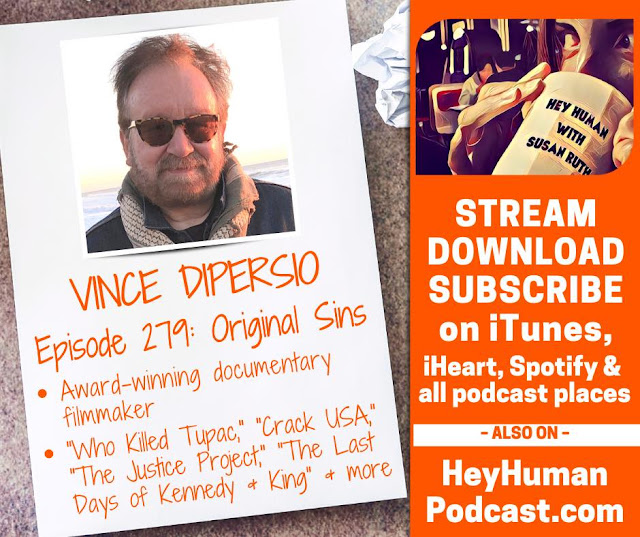
Vince DiPersio: Original Sins on Hey Humans with Susan Ruth


Vince DiPersio is a documentarian. His award-winning work in film and t.v. as an audio-visual storyteller has covered decades of events and humans, including; "The Kennedy Detail," “The Last Days of Kennedy and King,” “The Big Question,” “People of Earth,” “Hate. com,” “Who Killed Tupac,” and most recently, in partnership with Kim Kardashian West, “The Justice Project,” among others.


Listen here: https://heyhumanpodcast.com/?p=3989


R.I.P. Christopher Kühne


This is an interview Chris did with VoyageLA in March.


Hi Christopher, we’re thrilled to have a chance to learn your story today. So, before we get into specifics, maybe you can briefly walk us through how you got to where you are today?

Born and raised in Mexico City, I grew a strong interest in ancient texts, History, and the classics early on. At 18 years old, I adopted fitness training as a discipline, which I have kept ever since. I have successfully dabbled in several passions throughout my life (from being a professional magician to fitness coach to video editor), but deep inside I always knew I was born to become a storyteller. To tell you how I grew aware of my call, I’ll tell you a true story. In 2009, I was taken on a group tour to a rural community in Mexico to mentor children on writing over the course of two weeks. I was assigned to mentor a shy little girl wearing cotton gloves despite the 92-degree weather who was bullied by other kids. After catching a glimpse of a notable mole on the back of one of her hands before she hastily put the glove back on, I understood why. Despite futile attempts at trying to make the girl speak to begin the mentorship, I paused and set the agents of the power of story in motion. Inspired by the mythology of Eros or Cupid, I came up with a story of the time Eros felt sad after his victims, whom he would strike with pointy arrows infused with love, complained of the pain these caused. So people began disliking falling in love. Mocked by everyone and feeling purposeless, Eros quit his job and retired to a remote forest, and the world became loveless. But as Eros endlessly sobbed, he felt the warm touch of a hand on his back. He turned and saw the most beautiful girl he had ever seen: so beautiful, he wished he could be mortal. After Eros explained to her the reason of his calamity, the girl smiled, reached for his face, and gently wiped his tears off. “Love should always feel like that.” The little girl began. “Gentle.”

In an instant, Eros took her hand and kissed it, causing a blinding source of light to sprout from the back of the girl’s hand. “Little girl,” Eros began, “From now on, everything you touch will be filled with the power of love. Use your power wisely!” Once the bright light on the back of the girl’s hand faded, she glanced down and saw a heart-shaped mark on it. The End. When I had finished telling the story, the girl’s eyes were wide with astonishment. She took her right-hand glove off (secretly-not-so-secretly, like children do) and stared at the mole on the back of her hand, which was shaped like a heart. Two weeks after the mentorship ended, I learned from one of the community’s leaders that the girl wasn’t wearing gloves anymore. She was now one of the most outgoing and social kids in the community, and the kids who once laughed at her were now her friends. They invited her to play with them and even asked her to teach them how to write stories. She excelled at it. So it was that the transcendental power of storytelling worked its magic once more, changing two lives forever and igniting the spark of what was to become my path as a storyteller. A year later, in 2010, I went on a family summer trip to Los Angeles, where I visited the backlot at Universal Studios, home to iconic films. As our studio tour tram drove by a real ongoing production, something deep inside me clicked and encouraged me to imagine a life working there, in the middle of the entertainment industry. In 2012, shortly after having earned my BA in Communications and Mass Media, I suffered an accident while wakeboarding in Mexico, which left me out of commission for about four months. This was the catalyst that forced me to turn my life 180º and set on my hero’s journey. I knew since an early age that my life wasn’t in Mexico, so I took this as a wake up call to pursue my aspirations.

Three months later, in January 2013, I was shooting a project at the Universal Studios backlot: I moved to Los Angeles to pursue a degree in filmmaking and screenwriting at the New York Film Academy. When I caught sight of a studio tour tram full of people touring the backlot, I saw myself from three years before on it, now looking at me actually shooting a project there, where legendary films have been shot. I was looking at myself from the other side. It was a very strange and incredible experience, almost like peering at oneself from the past and future simultaneously. When the epiphany concluded and I came back to the present, I knew the feeling I had back in 2010 was now manifesting in front of my eyes, coming to a full circle. In 2016, shortly after graduating from NYFA, I had the opportunity to work on my first major project, serving as a story consultant on acclaimed Spanish filmmaker Emilio Ruiz Barrachina’s award-winning film, El Violín de Piedra (The Stone Violin). In the spring, I began working with Hollywood producer and literary manager Ken Atchity (Joe Somebody, The Kennedy Detail, The Meg) on story and film development, establishing a professional relationship that continues to grow to this day. Shortly after that, I teamed up with Mr. Barrachina once more, this time coming onboard as a co-writer on his romance drama feature film Yerma: Barren, a modern adaptation of Federico Garcia Lorca´s play Yerma, set in 21st century London.

In 2017, I divided my time and enrolled at UCLA to pursue two certificates: Film and TV Development and Business and Management of Entertainment, graduating in 2019. Today, my efforts to spread and share the power of story continue with Storyan, my psychoanalytical story development company, which focuses on helping writers find the story behind their stories to improve their craft and keep transforming the world through authentic storytelling. Storyan is a development company which offers writers specialized story development services with a psychoanalytical approach. Digging deeper and beyond screenwriting, I works with writers to shed light on the foundations behind their stories: from logic and psychology to marketability, content, and form. While academia primarily teaches writers how to write screenplays, Storyan helps them understand how to compose authentic stories to improve their craft and write better stories (and scripts) that resonate on both commercial and artistic levels. I’m also currently working as an Associate Manager on a project by Steve Alten (best-selling author of The Meg, on which the 2018 Warner Bros. blockbuster film is based) and serving as a co-executive producer on an upcoming animated series with Kevin Smith attached.

Alright, so let’s dig a little deeper into the story – has it been an easy path overall and if not, what were the challenges you’ve had to overcome?

The biggest challenge has been being an immigrant. You first manage to come here, and then you realize you’re sort of an outcast competing not only against people born here but also against other outsiders like you. There’s so much stuff going on and so many people doing the same thing, it’s easy to disappear within the pile. But once you discover your voice and the elements that make you stand out from the rest, it only takes believing, patience, and perseverance. Discover your personal mark or brand before you go out there. You have it deep within you.

Appreciate you sharing that. What else should we know about what you do?

I’m a recognized screenwriter working part-time as an associate manager and story consultant in the industry. My writing is characterized by a fusion of high concept and deep storytelling aimed at resonating with audiences of all backgrounds and beliefs through sound entertainment. Most high concept films nowadays rely solely on content to reach audiences; Form has been mostly relegated to projects dealing with social trends and issues — a good thing, given that it helps delivering the message to the audience efficiently. But we’re also witnessing a split of the craft into factory-made, cookie-cutter products. Content makes money, but content alone fails to deliver a good story. Enter Form. You have to think of Content as the King and of Form as the Queen, and the kingdom of story can’t thrive without both of them. I’m religious about this philosophy every time I write and mentor. But knowing this alone is not enough to understand storytelling (and writing). Reading and understanding the very foundations of storytelling, spanning from the beginning of mankind, has shaped most of my writing and perspective, and studying classic film has given me the cinematic vision to apply my views, ideas, and beliefs to my craft. You’ve got to read the classics, and you’ve got to watch classic cinema. You’ve got to know works like Aristotle’s Poetics by heart. You don’t build a strong house without building strong foundations first, no matter what you build on top of it. It applies to story, it applies to everything.

Are there any important lessons you’ve learned that you can share with us?

Just like your outer world in a dream reflects your inner world (i.e., the elements in your unconscious), so the outer world of the character reflects his or her inner world in the dream, which makes up the story. And this also applies to real life. Here’s why. The human psyche has been, is, and will always be the same, everywhere, independently from location, culture, race, era, laws, customs, etc. It’s universal and eternal. Therefore the same mental symbols will always be present. They only change in appearance but preserve the same function. There’s a magnificent quote by Schopenhauer that illustrates this meaning perfectly when he said, “The Universe is a dream dreamed by a single dreamer where all the dream characters dream too.” Thus we see that life is a story, and a story is life; two manifestations of the same creating power, mirroring and complementing one another.

As we read in the Vedas, “Truth is one. The sages speak of it by many names,” so the universal story is one. Writers tell of it by many ways. That’s why we are all storyans, we’re all born storytellers because we are walking stories ourselves just as everything around us is a story — namely, a manifestation of the one story. But now, what distinguishes “awakened” or conscious storytellers is the act of telling the story of the unconscious, consciously. It’s about knowing, recognizing, embracing, and telling the universal symbols of the psyche while remaining conscious throughout the process. In other words, you have to be a conscious creator of the unconscious. That’s what art is. Which perfectly mirrors the deed of the true hero who comes back from the journey transformed to heal and restore the world, kingdom, tribe, society, etc. Only the hero who remains conscious through the unconscious trials and ordeals of initiation into life will attain the wisdom and knowledge to heal the world.

In practical terms, what writers need to keep in mind is that that such transformation of the character doesn’t take place at the end of the story or journey. As Karl Graf Dürckheim said, “When you are on a journey, and the end keeps getting further and further away, then you realize that the real end is the journey.” In other words, we see the transformation of the character grow and develop throughout the story journey. It is only the realization and recognition of such transformation that we see at the end of the journey, given that the character learned to apply the attained wisdom and knowledge. Many writers confuse this and make the character change only at the very end of the story. But the changes in the character take place through the trials and ordeals along the journey, just as we attain growth from the trials and ordeals of our lives. It’s the infinite pattern of death and rebirth. So, as we follow the journey into the unconscious while remaining conscious throughout, we become aware of the elements of the psyche that make us human and resonate with us universally, which are responsible for making up the story, whether you are writing about living toys, talking cars, suffragettes in Victorian England, or hyper smart computers. The story is always human and universal.


Filmmaker Lila French's Birdbath and Da Parish are on the Louisiana Film Channel!


Birdbath

The film adaptation of Leonard Melfi´s 1965 play

A young, unsuccessful poet meets a young girl while they are both working at an all night cafeteria in Manhattan. It is obvious that she does not want to return home to the Bronx where she lives with her mother, so he convinces her to come to his place. He gets drunk and entices her to drink a little. He tries to seduce her in the mildest manner possible. She resists in the most devastating way imaginable, turning the evening into a nightmare for both of them. It is a boy meets girl love story unlike any other.


Da Parish

In 2005, St. Bernard Parish, a community on the Gulf Coast of Louisiana, was devastated by Hurricane Katrina. Through the personal stories of four long-time residents, we witness their loss, healing and rebuilding, their resilience, and what it is that connects people to the place they call home.


If you'd like to see them along w/ a smorgasbord of other shorts, features, docs, & podcasts in categories like "Louisiana Historicals", "Who do the Voodoo?", and "Films as Scary as The Myrtles Plantation Ghosts", you can sign up for FREE for 6 MONTHS at louisianafilmchannel.com w/ code FRENCHTIKTOK through May 31st.


Lila French Interview for the Louisiana Film Channel.