"The universe is made of stories, not of atoms."
—Muriel Rukeyser
____________________________
Showing posts with label marketing. Show all posts

Jeffrey Gitomer's “Little Black Book of Connections” On Bob Litell's Netweaving Concept

Bob Littell, CEO of Littell Consulting Services, Chief Netweaver and author of The Heart and Art of Netweaving talks about the concept of Netweaving to help you build relationship capital with others. Netweaving is a unique form of networking that is ideal for women as it allows them to be a connector of others, for the benefit of others, knowing that eventually there will be payback in return for them.


As an impressionable youth, I watched my dad bring people together that

he thought could "do business together."

"What do you make, Pop?" I asked.
"Nothing and everything, son. They don't pay me, but I will often be
rewarded by them or others in many ways."

"I don't get it, Pop."

"If you give to others without measuring, you get repaid without ever
asking for it." He stated as though it were a law of the universe.

"Oh," I said without really understanding.

"You'll get it later, son." He promised.

My dad repeated his philosophy for years. Helping others at every turn,
and bringing people together.

By osmosis, I have done the same thing. Never really thought about the
right or wrong of it. Never even questioned the validity of it.

Then I came to find that someone had named the process: NetWeaving.
Bob Littell from Atlanta has even written a book about it. Cool.

Bob invited me to be the guest of honor at two NetWeaving events. One
sort of public one held after one of my seminars. And a more private,
smaller event held the next evening at a more upscale location.
At the first event, about 150 people were putting a spin on the traditional
"networking"process. "What can I do for you," rather than, "what can you
do for me." Great concept.

And it worked. After a brief lesson and introduction to the concept of Net
Weaving, people were engrossed so deeply that no one wanted to leave.

The second, smaller event was held at the fabulous SPA Sydell. An
incredible day spa in mid-town Atlanta that puts a new meaning to the
word pamper. It's scientific combined with SPA.

About 50 people of some influence and character (I guess that includes
me) came together to see what they could do for one another.

The results were fantastic.

Wanna NetWeave? Start with your BEST. Your best friends, your best
contacts, your best influencers, and even your best prospects. Throw a
party. Doesn't have to be big. More like a social gathering with a message
and a mission: help others first.

The good new is that people who think it's a crazi idea won't show. The
better news is that everyone who does show will be eager to participate.
The best news is that you will have business and opportunities being thrown
at you left and right.

Like anything else, you have to practice the process outside the event in
order to master it. Bob Littell is the current master. He's an insurance guy
who doesn't sell insurance. He creates opportunities for other people to
succeed, and then people buy from Bob.

Proof? I've seen it personally. And in two NetWeaving events, I've never
seen so much power in a room. Not necessarily powerful people, rather
people with the power to help others. It's a business sight to see. And
when someone offers their help, you can't help but want to help others.

My philosophy of business has always been "give value first." People
read my article and want more. Been doing that for eleven extremely
successful years. Plan to continue that process for the next twenty-five
years or so, and then I'll quit.


Jeffrey Gitomer's The Little Black Book of Connections is based on the power of give value first. It's about how you can climb the ladder without stepping on people's backs. It's about how to earn the respect of a powerful mentor without begging.


Newtown screenwriter creates her own path to success, markets her own work


Daina Ann Smith, of Newtown, is a screenwriter who got her start right from her kitchen table. Most recently, she had two of her original feature scripts brought into development. Smith also is working as a creative lead at an audio storytelling company. Photographed on Wednesday, July 16, 2025, in Newtown, Conn.  H John Voorhees III/Hearst Connecticut Media


NEWTOWN — When Daina Ann Smith first sat down at her kitchen table nearly a decade ago to work on screenplays, she said she was in “steep student loan debt.”

And now, the first screenplay she completed, called “Student Loans,” is in development to be made into a full-length feature film with the producers of “Sonic the Hedgehog” and “Magic Mike.”

“Student Loans” will hit theaters sometimes in 2026. “It’s been an eight-year-long journey,” said Smith, who works from home as a creative lead at Pocket FM, an audio storytelling company.

In 2018, she began working with “The Meg” producer Kenneth Atchity, who took one of her scripts into development. In 2021, Smith signed a contract for another original feature screenplay.

To get noticed by Hollywood producers, Smith said she looks for those involved in similar types of projects as the one she’s pitching, and emails them her queries.

Over the years, Smith said she has sent out thousands of emails and built an “amazing network.”

Her advice to fellow writers? Don't become obsessed with getting someone to represent your work.

“It’s very hard to get an agent,” Smith said. “You have to have a proven track record of selling work.


“Instead of focusing so much on that, I will continue to write and continue to build relationships," she said. "Don’t think that it can’t be you.”

How to Turn a Book Into a Movie with Ken Atchity


Kenneth Atchity began writing stories as a child under his mother’s supervision. By the age of 16 he was a book reviewer for the Kansas City Star (no one at the newspaper realized how old he was when they hired him over the phone).

Ken started in the film industry after working as a professor for 17 years because he wanted to work on the creative side of story rather than the critical side. He came up with an idea that turned into 16 films and never looked back. His company has developed over 30 films and published over 150 novels. Ken has a reverence for stories and the art of storytelling that shines through in this interview.

Listen to interview


  • The way to sell a story to its largest audience is to write a book and make a movie out of it. You can also do it the other way, and write a book based on a movie.
  • The power of having a story that is both a movie or TV show and a book is that you have two separate audiences that discover the story and each of them will seek out the story in the other medium.
  • People who read the book first will watch the movie or TV show, and people who watch the TV show first will buy the book.
  • To make your story into a movie or television show, it has to be highly dramatic and have a universal message that a large audience can connect with.
  • A good treatment can sell them with the idea of your novel even if your novel is missing some basic elements of a good Hollywood screenplay.
  • A treatment is a brief written pitch that shows the movie that exists in the story. Ken’s book on treatments can be found in the Links and Resources section below.
  • After you’ve written your treatment you should reach out to a contact in Hollywood.
  • If you don’t know anyone directly to you don’t have any friends who might be able to connect with someone one place to look is writers conferences. You can go to writers conferences and sign up for a lecture from somebody who is connected in Hollywood and that will give you a point of contact.
  • When you meet your point of contact simply ask them for their advice. Don’t ask them to buy your story idea. Give them the elevator pitch of your story. If they’re excited by that give them a copy of your treatment and they’ll look at it seriously. Often if they aren’t interested for some reason they may be able to point you in the direction of somebody who might be.
  • Don’t offer to buy them lunch. Just ask for five minutes of their time.
  • You should be able to tell people what your story is about one or two sentences. If it takes longer something is wrong with your story.
  • The pitch for under siege starring Stephen Seagal was Die Hard on a boat.
  • the pitch for Splash starring Tom Hanks and Daryl Hannah was: It’s a fish out of water story only she’s a mermaid.
  • The secret to a good pitch is to make it short. Make it something that leads the person you’re talking to to ask questions.
  • If you’re in a producer’s office in Hollywood and they ask you five questions about your story, they virtually invested in your story already.
  • The most important character in every story is the audience. Always pay attention to the audience. Always be thinking about where the audience’s attention is at.
  • Structure your story for your audience.
  • How to engage your audience when they aren’t responding to the story you’re telling.
  • After you’ve sold your story stop talking.
  • Never bring notes to a pitch meeting.
  • Stories are about humanity.
  • Storytelling is about capturing the audience in a relationship with you that leaves the rest of the world out.
  • The audience lives inside your story. That’s why it’s so important to not have anything in the story that takes them out of the story.
  • The most important thing when selling your story is to keep the audience on the edge of their seat all the way through the pitch. If you can do that chances are very good story will sell.
  • Ideas themselves don’t make movies. Good storytelling makes movies. Writing a good story shows that you’re a good storyteller.
  • There are no new stories. It’s how you tell the story that makes the difference.
  • An idea can’t be protected. Only written documents can be protected. If you have a good story idea at least write a treatment of it so it can be protected.
  • The human race runs on stories.
  • Storytelling is a sacred vocation.
  • Before the written word storytelling was how civilization got passed down from generation to generation.
  • Storytellers were a protected class of citizen in ancient times.
  • Storytelling is our primary way of holding reality together.
  • The myth of the starving artist is just another destructive story we tell ourselves. It’s a story rooted in victimhood, and no good protagonist is ever a victim for long. Western culture prefers stories of heroes who overcome their obstacles.
  • Salvador Dali once said: The difference between a madman and myself is I am not mad.
  • The only difference between an artist who is seen as crazy and an artist who is seen as a genius in success.
  • The only way to combat the naysayers in your life is simply keep writing.
  • As a writer always remember that your calling is writing. Keep a sense of perspective when people try to tear you down.
  • Start writing more it will get rid of all these moods you’re having.— Ray Bradbury
  • You have to have the story you’re telling nailed down, but you also have to have your personal story nailed down as well.
  • Writers write. That’s what they do.
  • The only way to be sure they will succeed as a storyteller is to keep telling stories until you succeed. You have to persist as long as it takes.
  • The only way to fail is to give up. If you don’t give up you will eventually succeed, or die trying.
  • As a writer you’re living a dream life. Millions of people dream of having the courage to do what you’re doing. If you die without any external success, you still died in the middle of living a dream life. Is there anything better than that?
  • The sure fire cure for writers block: never sit down to write until you know what you’re going to write about.
  • The good thing about writing is that it’s a democratic art form. Anyone can write. It’s not limited to a specific social class or morality.

Basic Elements of a Hollywood Story

  • A protagonist we root for and identify with.
  • An antagonist for the protagonist to struggle against.
  • A visible goal that the protagonist wants to achieve.
  • Obstacles for the protagonist to overcome.
  • Follow the three act structure. Make sure your story has a beginning, middle and end.
  • Make sure that your story has a big climax. Hollywood movies need big climaxes.
  • Make sure your story has a satisfying ending. 


Read more

Matt Atchity Joins SoCal Approach to Head Up New Media and Entertainment Division

Boutique agency adds industry veteran to spearhead relationships with studios, filmmakers, industry powerbrokers and multi-media outlets.

January 17, 2023, Los Angeles – SoCal Approach Marketing and Consulting Group today announced the appointment of Matt Atchity to lead their newly established media and entertainment division. The last five years have created massive changes in consumer behavior related to how they search for, access, and consume entertainment content. As we enter a new year, SoCal Approach is poised to bring their data-driven approach to help content creators, studios, and distributors develop precision marketing strategies and maximize their opportunity for engagement with the audiences they hope to reach.

Atchity’s background includes being the long-time Editor-in-Chief of Rotten Tomatoes, GM of Moviefone and Head of Programming at TYT Network (the largest online news network in the world for millennials). He will lead the team applying SoCal Approach’s suite of solutions to help the entertainment industry understand the environment through consumer measurement and insights, audience targeting, marketing strategy, segmentation, content marketing, branding, and new program development.

“Matt was at the helm in establishing Rotten Tomatoes as the industry standard for film and TV reaction and the quality of entertainment content,” said George Owens, President of SoCal Approach. “Our clients desperately need those insights as they attempt to harness the complicated matrix of modern media, and Matt’s experience will greatly benefit producers, filmmakers, studios, streaming services, and content creators seeking to understand their audiences and set content direction.”

Atchity has hosted and produced videos, radio shows, and podcasts related to various aspects of the entertainment industry, and brings decades of experience inside the entertainment industry, helping define the way we use insights and measurement into the world we know today. His experience across media channels will create value at a time where content creation has been revolutionized and the definition of entertainment and how we consume it continues to evolve.

“The entertainment industry landscape is evolving faster than ever, as both audiences and creatives discover new platforms while simultaneously reevaluating their relationships with traditional entities,” said Atchity. “I’m very excited to join the SoCal Approach team and work with creators to find the best ways to reach their audiences.”

About SoCal Approach Marketing and Consulting Group

SoCal Approach Marketing and Consulting Group is a full-service marketing and research agency founded to measure and deliver data-driven market insights businesses can use to understand and reach their target audiences. For additional information on SoCal Approach, visit www.socalapproach.com.

#FREE December 19 - December 23! Write: Why? Marketing for Writers


A clear and concise and is a blueprint for successful marketing.


Author of Write Time (A Writer's Time), Writing Treatments That Sell, How to Publish Your Novel Dr. Kenneth Atchity joins with internet marketing guru Ridgely Goldsborough to bring you this breakthrough program for expanding your reach as a free-lance writer through communicating your WHY? instead of your HOW?

What they're saying about Why? Marketing for Writers


Straight to what's real!

There are hundreds (or thousands) of how-to books for writers, this book cuts through the chaff and get's down to what's real. Why we write, why we want to communicate. It helped me - as a writer - get down to the core of who I am, why I write, and it connected me with my deeper purpose. Best of all? It's practical and it's real - not one of the all too common airy fairy, new age, get in touch with your emotions and discover your unconscious forces. NO, this is practical, sound advice that made sense to me and helped me connect and clarify my why - Why I do the things I do, and what I am here to contribute. In short, it connected me with my true purpose, with my true calling and it gave me practical advice about sharing it effectively - so other's pay attention. As a ghost writer of 5 titles, this book has inspired me to publish under my own name. (Truthfully, I had always felt there was nothing else I could contribute). This book and the teachings it instills - showed me different!

Thank You! Ken and Ridgely


A great easy read

While this book is primarily geared toward writers, I found it to be a great blue print for anyone--regardless what industry or profession--who needs help navigating that social media slippery slope. An excellent primer for those like me who have for the most part avoided it because it seems so overwhelmingly intimidating. But so packed full of tips and strategies that I'm sure even the most social media savvy can learn something new that can be applied to their business.

CMC Pictures Announces Future Movie Projects Featuring The Meg 2


 CMC Pictures, a film company specializing in the production and foreign distribution of Chinese films, showcased its future projects including the upcoming "The Meg 2."

"The Meg 2" is the sequel to the successful 2018 Chinese-American co-production "The Meg." The original installment was directed by Jon Turteltaub, starred Jason Statham and Li Bingbing, and grossed 1.05 billion yuan in China, $143 million in America, and $530 million worldwide.

The follow-up will be directed by Ben Wheatley and may see the original cast reunited. CMC Pictures included the film in its annual showcase of upcoming movies as its key project, and will partner with Discovery to produce merchandise, develop animated content and conduct marketing for "The Meg 2."

You made a movie. Now what?


1. Making a good film isn’t enough.

Congrats! You made a good film. Sorry to say, that isn’t enough. “Of course, we want good films, but we are looking for a combination of elements that make it really stand out and give it a clear path to market. Having a film selected by a prestige festival gives a film an obvious path to market That’s part of the role of festivals, sales agents, marketing professionals and entertainment attorneys.” That said, sometimes films off the beaten track find their way to audiences. Just to say ‘it’s a good film’ is almost a meaningless description at this point. It’s totally subjective. If it's an advocacy documentary, is there a core audience or organizational value that will bring people out who will, in effect, vote their politics by buying a movie ticket? With a narrative film, there should be some approach to genre that makes it stand out stylistically. How is it unique?"

2. Determine your goals.

Before you set out to make your film, decide what your distribution goals are. “It’s really important to think about who you’re making the movie for and familiarize yourself with the marketplace. Do you care how your film is seen? On the big screen or at home? Socially or in isolation? Do you want a small, rabid group of people to see and love it or would you rather reach as many people as possible regardless of whether or not they appreciate it? Do you want to persuade a group of people to change their minds about an issue, or preach to your choir? Any and all of these are worthy goals in my view. It’s just important to decide upfront what’s important to you and then align your collaborators (and budget) accordingly. What are the goals and what do we want to accomplish? For most filmmakers, she said “the goals are to reach as wide an audience as possible, to pay back investors and to be in the position of making another film. When you're working with a distributor the goal is going to be money for the most part, but some want prestige or an awards campaign or visibility. When it comes to making those decisions, it's important that filmmakers have a holistic view and what are the sacrifices you're willing to make. If you want visibility, that may stand in the way of making money.

3. It’s never too early to start thinking about your distribution strategy.

Filmmakers should be considering festival and distribution strategy before they shoot. What kind of film are you making?

There are other steps filmmakers can take in pre-production that could benefit them when it’s time to seek distribution. “What can you do to enhance the marketability of your film? Maybe find someone with a social media following and put them in your film. During production, in addition to hiring a photographer to take set photos, you might consider additional original content that will help with marketing.

Research the market and develop a plan early in the process. Know what movies like yours have been doing in the market for the last five years and have a plan that you put in place before you start shooting. Distribution is work and time and planning and some money and it’s not going to be done for you. You don’t have a God-given right to make a movie and have it distributed, so be prepared for that not to happen and have a game plan.”

5. There is no “one size fits all” in distribution.

One film might benefit from a grassroots campaign with live events and another might do better going directly to VOD. Distribution is a strategy, not a formula.What works for a horror film is not necessarily going to work the same as a romantic comedy. Bbuild distribution campaigns that are specific to the film. Each film follows a unique path to distribution and it's up to the filmmaker to lead the way. Filmmakers have to understand that every film is different.The new equation is 50/50. 50 percent of your time, money and resources should go into making the film and 50% should go to connecting your film to an audience.

Read more


Liz Manashil & Rebecca Green - This is What Distributors Want in a Film

recommended image width: 1088px

There is nowhere for filmmakers to go to learn the protocol for selling your film. No one tells you who is supposed to reach out to whom—do you call the distributors or do they call you? Liz Manashil and  Rebecca Green joined forces to  create a distribution resource for filmmakers that could help break down the walls between artists and gatekeepers.

To create this resource, they reached out to the distributors who are currently acquiring and releasing independent films and asked them a series of questions:

How long has your company been in business? HISTORY

How many titles do you acquire a year? TITLES PER YEAR

Of these titles, can you break down (even if a rough estimate) how many are theatrical vs how many are just digital? TYPES OF RELEASES

Do you take all rights? All territories? RIGHTS

Would you be willing to share a rough range for term length your contracts i.e. 1-5 years, 10-15 years. TERM

What do you look for when acquiring titles? WHAT WE’RE LOOKING FOR

How important is having name cast? CAST

Do existing social media numbers impact your decision? SOCIAL MEDIA

What festivals do you attend and consider strong markets for acquiring films? FESTIVALS

How many employees do you have? EMPLOYEES

How should filmmakers approach you? Do you take unsolicited submissions or do you only work with sales agents? SUBMISSIONS

What follows is a breakdown of the distributors who were willing to participate and be transparent in giving an inside look at their process.

1) Term lengths are still astronomically high.

If you look closely, you’ll see that the typical term length for most distributors is 10-15 years. At a time where we can barely predict what will be the most successful distribution model six months ahead of time, why are independent storytellers acquiescing to giving away our rights for so long?

2) Distributors did not admit the influence of social media in their acquisitions.

As someone who manages the Creative Distribution Fellowship at Sundance Institute, I’m aware that social media presence is really important. It implies that the filmmaker has taken the time to build a foundation of an audience from which a distributor (or themselves in scenarios of creative distribution) can build upon. It seems very clear to me that a distribution company would want to target an audience that is at least already partly built, but the answers below imply otherwise.

3) Shocked by lack of discovery.

Too often distributors are dependent on the curatorial powers and prowess of certain signature festivals without looking to regional festivals. You’ll see a lot of the usual suspects in the festivals that are mentioned below—it would be great to expand this list so that more films are being exposed to distributors. Please also note that distributors were interviewed before Los Angeles Film Festival decided to close its doors. I wonder who will take its place?

4) The majority of rights taken, territories focused on, and distribution strategies are similar across the board.

I’d love to see more distributors take a chance on innovation. Very often distributors will take as many rights that they can get (though mainly domestic territories noted below) and will not have the resources to be super customized in how they release their titles. Additionally, (there are exceptions) there doesn’t seem to be enough direct communication between artist and distributor. It would be great for the two forces to truly line up for each film’s release so that marketing and release strategy align with the filmmaker’s goals as well as their aesthetics.

5)There are still no open doors. 

The majority of people I talked to expressed reticence at looking at cold submissions. Sure, there’s an influx of content, but to be reliant on recommendations, agencies, and festivals is shortsighted. There are a lot of great movies out there looking for homes. I’ve even had distributors admit to me they are not watching the full duration of the films they receive. There is too much valuable substantive content for just a few festivals to properly curate and exhibit all of the quality work in the world. If distributors take chances on more festivals, they’re contributing to communities who could really benefit, and could have access to new quality and unsupported storytellers for them to consider.

Regardless of my takeaways, let this document inspire you to get your work out into the world. Abide by how each company wants to be approached and approach them respectfully.

Check out responses from individual distributors


Self-Publishing: Expectations vs Reality For New Authors


Self-publishing is a great opportunity – if you have a head for business

Are you dreaming of becoming the next bestselling author?

For anyone who writes, it is natural to want your hard work to reap the rewards you believe it deserves.

Self-publishing today gives all authors the chance to publish for (almost) free and to have a book on sale on Amazon and many other online book retailers.

If you use Amazon’s publishing service, Kindle Direct Publishing (KDP), you can publish an ebook, and it will be on sale in around 24 hours.


For a paperback version of a book using print on demand, it takes only a few days.

In the days before self-publishing, the publishing process for a traditional publisher very often took a year or more. It has not changed a great deal for large publishers today.

It is a long road to take to get a book published the traditional way. You need first to find a literary agent to represent you, which is no easy task.

Then if you are lucky enough to find one, it can take months for your agent to secure a publishing contract for you. If you are one of the fortunate authors who manage to get this far, it is then a wait of another year before your book is released.

After that, you cross your fingers and hope your book sells well. Otherwise, the chances of another contract are slim.

However, if you self-publish, you skip all the waiting and jump immediately to crossing your fingers.

So much has changed, but the publishing industry stays the same. It is about hoping that readers will buy your book.


The expectations of publishing a book



I started publishing in 2005 with Createspace. The following four years were marvellous for me for with my print books selling well enough to get a nice check every month.

Then came the ebook.

When I self-published my first ebook in 2011, there were fewer than 800,000 Kindle ebooks on Amazon. Fast forward to today, and it is over 7 million.

Did you know that a new Kindle ebook is now published on average every 3 minutes?

You do not need to be a statistician to calculate that while the number of ebook titles has risen dramatically, the number of book buyers has not increased proportionally.

In simple terms, for a digital book, it is a highly competitive market.

On top of that, Kindle Unlimited has turned all the publishing rules on its head. No longer do you sell a book. You sell page reads. For authors and publishing companies alike, it is a considerable challenge.

Many new authors leap into publishing an ebook on Amazon with the expectation that because their book is for sale, it will sell.

Nothing could be further from the truth. The hard facts are that very few titles sell well, and most struggle to sell more than a handful of copies per year. Mostly to friends and family.

The biggest problem is that many newly published authors do zero market research before a book launch.

If you want to sell anything, you have to know what your market is and how you are going to attract people to buy your product.

Smart indie authors know this and have a clear idea of their genre and what market potential there is for their writing.

For example, there is a massive market for contemporary romance, but only a tiny market for gardening or rose care books. However, a small market segment is less competitive.

Balancing competitivity and volume is how you understand your potential market share. Do you want a tiny proportion of the highly competitive romance market, or to dominate the less competitive rose care genre?

For new independent authors, do not let your expectation cloud the reality. Selling books in today’s market is very hard unless you are an expert in book marketing and know who your potential book buyers are and how you can connect with them.

Putting your book up for sale is one thing. Selling a lot of copies is another reality altogether.


The realities of making it with self-published books



The first reality is to understand that vanity presses will never help you succeed.

I hear from so many authors who had wild dreams, were told mistruths and paid an awful lot of money to publish their book. And all for nothing.

Vanity publishing is definitely not self-publishing. Paying a vanity publishing company to sell books to you is not a recipe for success. Do not fall for the trap.

You can only succeed if you can sell books to readers. And you can.

Here is a short extract from the 2018 Author Earnings Report.

“Despite the prevalent indie doom-and-gloom rumours, today’s top sellers are handily making as much or more than the top-selling indies from prior years were.

But here’s the kicker. A lot of today’s top-selling indies are relatively new names. We didn’t recognize a lot of them. And a lot of yesteryear’s pioneering indie superstars no longer even make the Top 50.”

A look at ebook sales for 2017 tells an optimistic story for indie-publishing authors.
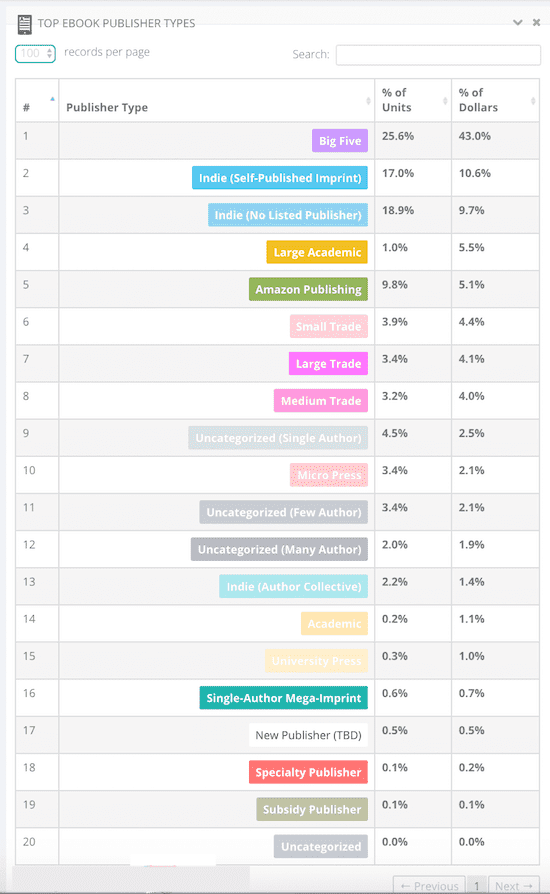


Combined Indie author ebook sales of imprint, not listed and collective amount to over 37% of the market. A full 12% higher than the Big Five publishers.

There is no doubt that readers do buy self-published titles and far more than traditionally published titles.

But do not expect to be part of this success if you think that everyone in the world is going to want to buy your book about rose care, or even romance.

You have to know your specific genre, the demographics and interests of your potential readers, and most importantly, how to get them to find your book.

You might have a fantastic book title, a brilliant professionally designed book cover and had the interior of your book formatted by a book designer.

But unless the story or subject of your book is what readers really want to read, your book can still fail.

Book buyers are fickle, so you need to give them a compelling reason to buy your book.


Learning about how people find books they want to buy



Understanding how and why people buy books is your first step towards being a successful indie publisher.

Yes, you need a great story, a brilliant book description and a killer cover design.

You need to be a little tech savvy and know how to exploit social media and attract attention via your blog with good use of SEO.

Most of all though, you need to know how to leverage categories and keywords for your books.

Getting your book into the right place for readers of your genre to find is more powerful than any other form of book marketing.


The new breed of successful Indie authors are quietly and studiously using data to help readers find their books on Amazon and other retailers. It is an electronic form of getting your book on a shelf at the front of a bookstore.

The expectation vs reality equation is now that you can only expect to gain regular book sales if you understand the reality of the necessity to use data.

Learning how to access and leverage Amazon book sales data especially is now key to succeeding in the online book market.

To use the example I mention before of the difference in the market for contemporary romance and rose care, here is some hard data.
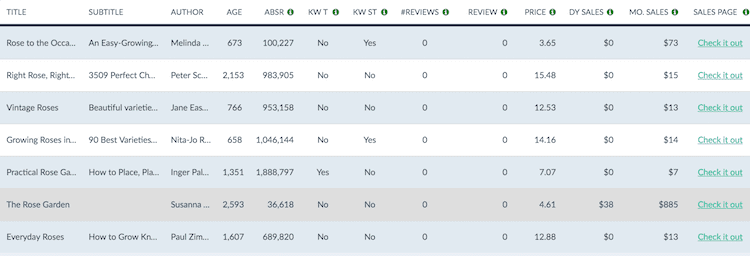

Amazon sales data for books related to rose gardening. Data source KDP Rocket

In line six, the book, The Rose Garden, is fiction, so it needs to be ignored. But you can see that the monthly sales for books related to rose care and rose gardening is very small. The best selling book is making $73.00 per month.

Now let’s looks at contemporary romance.
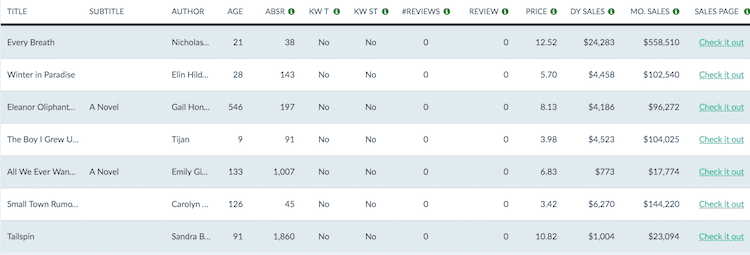

Amazon sales data for books related to contemporary romance. Data source KDP Rocket

What a difference! Yes, your eyes aren’t deceiving you. In 21 days, Every Breath has made sales of over half a million dollars.

When you can access data as I have illustrated above, you can drill down to find your niche market and find keywords and categories to make your book as competitive as possible.

This is the future of independent publishing. Using data to position your book where readers can find it, and buy it.

In SEO, there is an expression that if your page ranks on page one of Google Search, you get traffic. If it is listed on page two, it is in the cemetery.

The same applies to books on Amazon. If you book appears on the first page when a book buyer searches for a new book, you will make book sales. If it appears on page two, you won’t.


The future success stories of indie publishing

Book buyers are over discriminating between traditional published and self-published books and ebooks. They just buy books they want to read.

In the past, the best advice to new authors was to have a fantastic book cover, a great book description to hook readers and to have a book properly edited.

But today, that is now not going to be enough to succeed.


The path to success today and in the future will be to learn how to market a book to an electronic online market.

Using data research to find your market niche and to better position your title so buyers see it will be more important than your book cover and description.

That is why the Author Earnings Report I mentioned earlier stated that today’s top-selling indies are relatively new names.

They are the new authors who know the power of data, and how to use it.

Could This Be The Future Of Books?


I can't count how many times I've heard someone lament to me that they’re too busy to read a book. 

At first, I avoided these people. Who's too busy to read a book? But, the sad fact is that everyone thinks they're too busy to do most things these days. And why shouldn't they be? Our attention is constantly divvied among dozens of devices all bearing different distractions across mediums that dominate nearly all of our senses. 

The most common excuse people give me for why they haven't read a book is that they just don't have time to sit down and do one thing at a time. 

I want people to read more books, to continue to consume good stories, to let themselves get lost in someone else's imagination. 

That's why I'm intrigued about a new start-up that is trying to marry the best of books with the best of podcasts, to give readers the ability to consume stories across formats. 

Serial Box, which raised $1.65 million in funding in 2017, does exactly what its name suggests. It serializes books into episodes, bite-sized portions that are relatively easy to digest. In the past few months I've heard it called both Charles Dickens for the digital age and HBO for Books. 

The company acts as a hybrid between a production studio and a publishing house by hiring talented authors to write new fiction in addition to writing teams who can turn that books into easily consumable episodes released on a weekly basis, just like podcasts. 

A typical serial will run for about 10-16 weeks. Here's the part where it gets interesting. Consumers can listen to an episode or they can read it on an e-reader. Don't have time to sit and read a book? Listen to the next chapter/episode while driving to work or mowing the lawn. Find yourself with a spare half hour in the midst of a lazy Sunday? Why not read the next chapter in print. The two formats are aiming to be seamlessly interchangeable. This is what I find so interesting — the ability to enjoy a story in multiple formats as it suits you. 

"In the past 20 years our lives have changed as the book hasn’t changed while other entertainment forms like television and podcasting have," explains Molly Barton, Serial Box's co-founder. Barton knows books. She previously worked at Penguin Random House US as global digital director. She told me that she understands books can feel daunting to people. "The experience of reading a full-length book feels hard," Barton said. "The switching back and forth between reading and listening really appeals to people. I think people expect their content to be very mobile and very flexible." 

...So is this the future of the printed book? An evolution of the book rather than the death entirely of the printed page? Let's see if it gets more people reading before we make that call.

Read more


10 Questions to Ask Yourself if You Want to Write a Book


1. Publisher or self-publish: The publishing world has changed dramatically in recent years and the Internet has made self-publishing considerably easier. If you self-publish you have full control of your book, but also bear all costs. A publisher is harder to secure and will have control over some decisions, but also absorbs many costs (e.g., printing, distribution, cover art) and also gains access to critical distribution channels, including identifying outlets to review your book.

2. Agent or no agent: With an agent you give a portion of your royalties to them. Literary agents work on a commission basis and are incented to find you the best deal so that their payout increases when you sell books. Though you give up some of your royalties, an agent is often your best chance to get your book proposal reviewed by a major publishing house.

3. Publicist or no publicist: Publicists bring access that is hard for many people to get on their own. They identify media outlets such as television shows, newspapers, and podcasts to bring valuable exposure to you and your book. The best publicists can cost tens of thousands of dollars and you will have to consider if their services are worth it to you.

4. What is the book's "hook": Every book needs a quick and compelling hook that captures attention. This is always needed to draw in potential readers/buyers, but also literary agents, publishers, and publicists if you go that route.

5. Who is the target audience: Don't try to pretend your book is for everyone - all books have a more targeted market. If you decide to use a publisher they will want to know exactly whom you are targeting and how big the audience is. They will also want to know how your book is different from similar books that have been written and if it has relevance to sell outside your home country. The target audience will also help you decide who to ask to "blurb" or endorse your book.

6. Write or ghost write: You would be surprised how many books are written by someone other than the stated author. Ghost writers are sought after and can make anyone come across as a gifted writer. Authors may not have time to write a book or find that a professional writer is better able to capture the voice they want to convey.   

7. What is my platform: This one must be alive well before you publish your book. You must consider the best way to bring visibility to your book and contemplate platform options such as your standing as a well-known expert, your social media presence, professional speeches, access to different constituencies, etc.

8. What are my goals: Consider the reason you are writing a book to help hone your focus, especially because the outcomes are not always connected. You might want to make a lot of money but not care about getting great reviews. You way just want to build your brand by getting your name out there. You may want to achieve critical acclaim for your book even if it doesn't make a lot of money (think Indie films). Not everyone can be a NYT best selling author, but you can be pleased with the outcome if you know your goals in advance.

9. What format will the book be: You have many options. It can be hard cover, paperback, eBook, audio, small, large, etc. If you self-publish consider the costs of developing multiple formats, particularly hard cover and paperback.

10. How much time will you commit: The reality is that a book once published is there forever. In addition to the time it takes to write (or work with a ghost writer) you will also need to spend time promoting the book. You must consider you ability and willingness to travel, speak, go to book signings, and otherwise invest your time to market and sell your book.

No series of decisions is right for everyone and you must consider your particular situation and goals. One last tip: don't get too fixated on the title of your book - it often changes as the writing process progresses, especially when you have a publisher and and editor.


Read more


Why Do You Have to Market Your Book? 10 Ways to Focus Your Marketing


Your book is about to be published or already published, and now it's time to talk about the simple facts of marketing. The American marketplace, nearly 300 million strong, is the most lucrative market for books in the world -- and the gateway to the global marketplace. Amazon now has websites in United Kingdom, Spain, France, Germany, Italy, Australia, Japan, Canada, Mexico, and Brazil -- and is adding more each year. Your book's reach can truly be global -- if your book is visible.

One book in a million launches to instant sales while the author does absolutely nothing. It's the most common pathetic fallacy to think you'll succeed without PR or that the media will cover your book with little effort on your part.

The other 999,999 books require the marketing (promotional) efforts to become visible to the American and global marketplace. And marketing is an ongoing thing that never stops.

To begin with, you need to know this formula by heart:

MARKETING has no direct relationship with sales.

But GOOD MARKETING produces VISIBILITY.

Without VISIBILITY there can be no sales.

Consider BMW, Veuve Clicquot, Victoria's Secret, and many other brands that are embedded in the American consciousness. They well know that spending millions of dollars a year in the big slick magazines with sexy ads has NO direct relationship with sales. But they do it because it keeps their brands in the forefront of the browsers' awareness.

They don't dare NOT spend the money. For one thing, they know if they don't spend it, someone else will be spending it and that someone else may take their place in the buyers' awareness.

The same is true of the massively crowded world of books.

So one way or the other, you must MARKET YOUR BOOK as fervently as -- maybe even more fervently than -- you wrote it. Devote a minimum amount of time EACH DAY because time upon time produces results.

What are some of the best ways to market your book? From years of trials and errors, both my own and those of my clients and published authors, here's what I suggest:

1. Come up with a marketing plan that fits your time and budget constraints; revise it as you continue forward and as opportunities arise.

2. Put time into it, and as much money as you can spare. Nothing happens unless you invest your time and/or your money (and don't forget: money buys time).

3. Get help. If you don't have the time or desire to do it yourself, use our help to make your book visible.

4. Forget about all marketing except the internet. By 2012, 274 million (78.6% of the population) people were using the internet in North America alone; 2.95 billion are online worldwide! Why spend your money on television, or print ads, or even radio (though the last is still a good idea) when you can be in direct touch with this humongous market from your keyboard?

5. Focus your book by offering it exclusive on amazon.com--which has over 100 million subscribers. Get that "Author Central" page up as soon as your book is launched. Amazon is the 500-lb guerrilla -- so set the other monkeys aside until you've sold 100 million books.

6. Build a Facebook page instead of a blog. With 1.3 Billion users globally, where can you find a better marketplace? Maybe you'll consider that limiting when your book has sold a billion copies. Then you can think about expanding beyond Facebook. Meanwhile here's the biggest market imaginable -- nearly 200 million in North America -- right at your fingertips.

7. Focus on getting book reviews on your sell-page. First aim for 30, then 100, then 300. Magic happens when the amazon computer's algorithm starts paying attention to your book, and more and more reviews inevitably make that happen.

8. end out a press release about your book through a service that reaches internet reviewers. You will surely receive requests for review copies -- and at least half of those will end up as reviews on the internet.

9. Social networking is where it's all happening today: Facebook, twitter, Pinterest, Linked-In, YouTube, and Tumblr. Set up accounts and send out postings regularly until you grow your following, capturing their emails so you can keep in touch with them.

10. Experiment as much as you have time and funds for, but double down on anything that's working for you.

Don't be overwhelmed by the marketing process. Take control of it by limiting it to a specific time allotment each day, say 60 minutes. You'll be amazed at the results sixty minutes a day, day in and day out, will produce. Good luck -- and enjoy the excitement of this new frontier for writers, where you can reach out directly to your readers and prospective readers.

10 Questions to Ask Yourself if You Want to Write a Book


1. Publisher or self-publish: The publishing world has changed dramatically in recent years and the Internet has made self-publishing considerably easier. If you self-publish you have full control of your book, but also bear all costs. A publisher is harder to secure and will have control over some decisions, but also absorbs many costs (e.g., printing, distribution, cover art) and also gains access to critical distribution channels, including identifying outlets to review your book.

2. Agent or no agent: With an agent you give a portion of your royalties to them. Literary agents work on a commission basis and are incented to find you the best deal so that their payout increases when you sell books. Though you give up some of your royalties, an agent is often your best chance to get your book proposal reviewed by a major publishing house.

3. Publicist or no publicist: Publicists bring access that is hard for many people to get on their own. They identify media outlets such as television shows, newspapers, and podcasts to bring valuable exposure to you and your book. The best publicists can cost tens of thousands of dollars and you will have to consider if their services are worth it to you.

4. What is the book's "hook": Every book needs a quick and compelling hook that captures attention. This is always needed to draw in potential readers/buyers, but also literary agents, publishers, and publicists if you go that route.

5. Who is the target audience: Don't try to pretend your book is for everyone - all books have a more targeted market. If you decide to use a publisher they will want to know exactly whom you are targeting and how big the audience is. They will also want to know how your book is different from similar books that have been written and if it has relevance to sell outside your home country. The target audience will also help you decide who to ask to "blurb" or endorse your book.

6. Write or ghost write: You would be surprised how many books are written by someone other than the stated author. Ghost writers are sought after and can make anyone come across as a gifted writer. Authors may not have time to write a book or find that a professional writer is better able to capture the voice they want to convey.   

7. What is my platform: This one must be alive well before you publish your book. You must consider the best way to bring visibility to your book and contemplate platform options such as your standing as a well-known expert, your social media presence, professional speeches, access to different constituencies, etc.

8. What are my goals: Consider the reason you are writing a book to help hone your focus, especially because the outcomes are not always connected. You might want to make a lot of money but not care about getting great reviews. You way just want to build your brand by getting your name out there. You may want to achieve critical acclaim for your book even if it doesn't make a lot of money (think Indie films). Not everyone can be a NYT best selling author, but you can be pleased with the outcome if you know your goals in advance.

9. What format will the book be: You have many options. It can be hard cover, paperback, eBook, audio, small, large, etc. If you self-publish consider the costs of developing multiple formats, particularly hard cover and paperback.

10. How much time will you commit: The reality is that a book once published is there forever. In addition to the time it takes to write (or work with a ghost writer) you will also need to spend time promoting the book. You must consider you ability and willingness to travel, speak, go to book signings, and otherwise invest your time to market and sell your book.

No series of decisions is right for everyone and you must consider your particular situation and goals. One last tip: don't get too fixated on the title of your book - it often changes as the writing process progresses, especially when you have a publisher and and editor.


Read more


Book News: Apple Enters A New Round In E-Book Price-Fixing Fight


In its attempt to obtain a foothold in a market long dominated by Amazon, Apple ran afoul of antitrust law.

Apple is sliding back under the judicial microscope Monday in a legal challenge that could bear big implications for the e-book market. The 2nd U.S. Circuit Court of Appeals is slated to hear the company's appeal of a verdict that found it guilty of violating antitrust law.

Last year, a federal judge ruled that Apple had knowingly facilitated a price-fixing conspiracy with the five major publishing companies: Hachette, HarperCollins, Macmillan, Penguin and Simon & Schuster. In a bid to pressure Amazon — then and now a goliath of the e-book market — Apple and these publishers had agreed to set the price of e-books higher than Amazon's preferred price. The judge denounced these agreements as collusion, rendering her verdict in no uncertain terms.

 "The evidence is overwhelming that Apple knew of the unlawful aims of the conspiracy," U.S. District Judge Denise Cote wrote in her opinion. To believe Apple's case, she continued, "a fact-finder would be confronted with the herculean task of explaining away reams of documents and blinking at the obvious."

While the publishers settled their side of the case early on, Apple has vowed repeatedly to keep fighting. The latest round is expected to help clarify the legal line drawn between friendly business agreements and outright collusion.

As Philip Elmer-DeWitt notes in Fortune:

    "When the Department of Justice charged Apple with conspiring to fix the price of e-books, the case was widely seen in both Silicon Valley and New York publishing circles as an error of enforcement.

    "Why was Apple, a giant in its own right but a new entrant in the e-book market, being prosecuted and not that other giant, Amazon? ...

    "But when District Judge Denise Cote sided with the DOJ and ruled that Apple had violated the Sherman Antitrust Act, what had been a question of enforcement became a question of law."

Although Monday's hearing is expected to last about an hour, a ruling won't be rendered for several months more. And Elmer-De Witt says a verdict against Apple could very well mean this case is headed to the Supreme Court.

Read more


Romancing the ebook: A conversation with Book Riot’s Jessica Tripler by Len Edgerly


J Tripler

It turns out some of the first and most fervent adopters of ebooks still read more digital books than any anyone else.

Those readers are fans of the romance genre, and in this week’s Kindle Chronicles interview I gained new appreciation and respect for romance by talking with Jessica Tripler, who covers romance novels and other topics as a Book Riot contributor.

Tripler reads four to six romances a month, along with two or three novels in other genres. Married and the mother of two boys, she is a professor of philosophy at a university in Maine, as well as a clinical ethicist.

Romance is a $1 billion industry that accounts for more than 262 million titles sold each year in the U.S., Tripler told me. She described the genre as domestic novels that can be “very insightful when it comes to human psychology, in particular the psychology of desire, of love, of human relationships, of ethics.”
“I would stand romance writing against any other genres,” Tripler said. “Like other genres, you can have a terrific example of the genre and a terrible one. That goes for literary fiction—some literary fiction is just a real failure.”
What you won’t find in romance novels, according to a definition Tripler shared from Romance Writers of America, are pessimistic and emotionally unsatisfying endings. In a romance, you will root for the hero and heroine (or hero and hero, or heroine and heroine), whose love relationship will be central to the plot, which ends on an optimistic and emotionally satisfying note, she said.

Eighty-nine percent of all romance sales are digital, Data Guy of AuthorEarnings reported at the Romance Writers of America annual meeting last month. Tripler on August 11 wrote a BookRiot post suggesting the reasons for that dominance of the genre by e-books.

Among the factors she listed, the desire for privacy is important for some romance readers, Tripler wrote, but in the podcast interview she said that is not a big concern for seasoned romance fans.

“Maybe for the person that picks up one romance a year in an airport,” she suggested, “but most people who read it regularly don’t really care who sees them reading it.”

That’s not to say that privacy concerns don’t ever lead to a preference for digital reading, Tripler said, especially for edgy, more erotic romances which can be inappropriate for children or invite unwanted attention in public.
Other factors in the lives of busy, multi-tasking women, Tripler said, are price, portability, convenience, and the ability to hold so many books on an e-reader at once.

“One piece that gets under-emphasized in these discussions,” she added, “is that women who adopted digital reading early on were tech savvy. They were online. They were participating in discussion groups and felt very comfortable with that technology. And they had money.”

“Romance readers do quite well in terms of income and education, and they often tend to be partnered up, which usually helps with income,” Tripler said, “so they had the tech savvy and the money to go ahead and buy the Kindle or at least know how to get digital books onto their laptop.”

Of the 75 million Americans who read at least one romance novel a year, 16 percent or 12 million are men, Tripler said. As preparation for the interview, I asked her to recommend a romance novel that I might enjoy reading.
On her suggestion, my wife and I listened to the Audible version of Julie James’s Practice Makes Perfect, a hilarious and tightly plotted legal romance set at a big firm in Chicago. We both loved it.

Other contemporary romance writers that Tripler recommended are Nora Roberts, Courtney Milan, Molly O’Keefe, Beverly Jenkins, and Farrah Rochon.
As a philosopher and clinical ethicist, Tripler reads romances from a particular point of view.

“Looking at it from my professional background,” she told me, “there are always interesting questions about what is the good life, how do I move forward in an ethical way, what do we owe to each other, what does it mean to be vulnerable, dependence and independence—these are all ethical questions that have been interesting to me in my work, and they play out in very interesting ways in the genre.”

I like to think I went into this interview with an open mind regarding books of all genres, but I’m here to say that Jessica Tripler significantly expanded my understanding of why so many millions of readers, men and women, love a good romance—especially on an e-book.

Read more at Teleread


Marketing Ideas That Can Help Authors Increase Sales: Prepare Your Book Marketing Assets

Write a killer elevator pitch. Write a concise, snappy elevator pitch that shows what the book is about, what kind of world readers will be immersed in, why readers should care, and what accolades the book and author have received. A strong elevator pitch will make your book more enticing to readers deciding whether or not to purchase.

Poll your audience to test marketing copy. Use polling software like PickFu to test variations of description or marketing copy and see which variation your audience likes better. Always test and optimize to discover what copy will resonate best with readers.

 A/B test marketing copy. Unlike polling, A/B tests give you quantitative data (i.e., the number of clicks). Use your email service provider to run A/B test emails and see which copy has the highest click-through rate, or use ad platforms like Facebook to A/B test your copy.

Get blurbs from reputable authors in your genre. Blurbs can effectively catch readers’ attention, especially if they’re familiar with the quoting author or publication, and can help entice them to make that final purchasing decision. Our tests showed that book descriptions including blurbs got an average of 22.6% higher click-through rates than those without blurbs.

Create images for teasers and quotes. You can easily turn your quotes into vibrant images using free apps like Canva. Publish these teasers to your website and social media accounts in the weeks and months prior to a book’s release.

Read more at BookBub