Read Proglogue ofRea Santa Muerte, Book One of The Daniela Story by Lucina Stone FREE November 20 to November 24!
Prologue
Spring 2008
EMMA DELGADO WAS PACKING HER suitcase. It was her final night in her childhood home before moving from Mexico to the United States. Mother was not pleased with her recent choices or future plans, but they had come to an agreement. Emma would be released from her arranged marriage if she consummated with the man her mother had chosen. Why Mother would insist on Emma having sex with the guy was beyond her understanding. Perhaps her mother thought she was confused, and the one night would change her mind. Mother had been conjuring up strange requests since birth. Emma did her best to appease her, but there was no way she was getting out unscathed.
Emma no longer cared. She would get it over with and leave. It would be like ripping off a bandage or some other cliché—the sooner it was over, the better.
Emma had come out to her mother and refused the marriage last year. She was in love with Monica, her girlfriend since freshman year at Drew University. They wanted to get married, and there was nothing Mother could do about it.
The meaningless sex would allow Emma the freedom she always longed for, without her mother’s guilt hanging heavily in the shadows. Mother had promised this would be the last thing she ever asked of her.
It’s tradition. Your duty. What will your aunts think? This is part of our culture.
The statements rotated repeatedly on the conveyer belt of her mind. Maybe the distance—a whole different country—would free Emma, and help her move on from all these “traditions.”
Emma packed the last of her belongings—Tibetan prayer beads and the amethyst necklace Mother had given her for protection. She took a long look at her room and closed the door behind her. She could hear her family outside in the large garden; they were whispering, and Emma could feel their anticipation.
This time of year, Merida was full of flowers. Lilies and gardenia and plumeria trees were in full bloom. The rainy season had ended and the air smelled sweet with the prospect of a new life within her grasp. Emma tried to focus on that as she walked outside to join the clan and meet the mystery man she had heard about since she was eight years old. Her thoughts were on Monica—who could never find out what Emma had to do to earn her freedom. Monica would never understand. Emma had given up on explaining her family dynamics and beliefs by sophomore year.
The garden was Emma’s favorite place. Her family grew a variety of lush plants that created a sense of harmony and connection with nature. It was her retreat. Emma could hear the bees busy pollinating all the blossoms in a sort of organized frenzy. Usually the beauty of the garden made it difficult for her eyes to decide what to savor first, but now all she saw was him. Emma’s mother greeted her and walked her over to the man, who was with three of Emma’s aunts. He was tall and attractive, with all the grace and charm of a movie star. He smiled softly at Emma. If Emma had been attracted to men, he would have been it. She felt her cheeks flush when he looked at her. His eyes were amber and warm. To make this task easier, Aunt Lola handed her a glass of Xtabentun, a Mayan love potion. Emma declined it. She wouldn’t need it.
“What time is your flight?” he asked. The tone of his voice was smooth and soothing, like honey on a spoon dipped in hot tea.
He smelled delectable, triggering a flood of pheromones as he moved closer. His voice made Emma weak at the knees. She cleared her throat. “Uh, it’s at 7:00 a.m. tomorrow.” Emma looked down at her hands. She felt her stomach flutter.
“Good. That gives us just enough time.” He arched his eyebrow and stared at her. He extended his hand, and she readily took it. He escorted her to the casita. The small house was set up for their privacy. Emma’s family took the hint and left them alone, retreating eagerly to the big house to chat privately and imagine their own version of what was to come.
Emma could hear her heart pound in her ears as he closed the door behind them. She had never been with a man before; never had the desire to. But something about this man provoked all manner of lust. Emma felt deeply ashamed to be unfaithful to her girlfriend. Before she met him, it was just an act to get through. It was her duty. It was to cleanse her future of familial guilt. But now, with the way he was staring at her….
Obligations are not supposed to be fun. At least, Emma had thought that was the rule up to this point.
* * *
EMMA SAT IN ROW 37, seat F, in the 747, grateful no one was next to her. Every few minutes, she had to shift in her seat. Her body was sore; everything hurt. She didn’t know whether to laugh or scream. Her world was upside down; she had spent the entire night making love to a man she would never see again.
Now, she had to face Monica. Emma decided she needed to tell her.
“Damn it, Mother!” she hissed to herself. This was exactly what her mother wanted.
Story Merchant Books E-Book Deal: Ken's Book Recommendation!
#FREE November 28 through Decemer 2!
Fossil River by Jock Miller
~ Kirkus Review
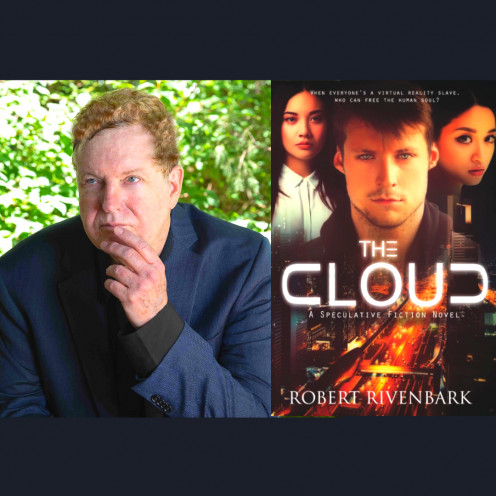
The Cloud: Interview With Author Robert Rivenbark
1. When did you realize you wanted to be a writer?
I made this startling discovery in the sixth grade, when my homeroom and English teacher, Mrs. Lee, a recent graduate of Agnes Scott College, had me elected Program Chairman in our class elections. This was at Sagamore Hills Grammar School in DeKalb County, in the Atlanta metro area. The school practiced an experimental program that allowed teachers to try special activities with gifted students; and Mrs. Lee saw that I was a natural writer. As a result, I became the class playwright and wrote, cast, and directed a couple of plays—bad knockoffs of science fiction and horror novels and movies I loved. I also read my horror short stories aloud to the class. Mrs. Lee (I never knew her first name) changed my life. I’ve been searching for her for decades, and hope that my recent success as a novelist will help me find and thank her.
2. What is your latest book? Please tell us something about it.
I’ve recently published The Cloud, a speculative fiction novel set in a future society where 24/7 neural surveillance and virtual reality addiction are mandated by a corrupt ruling corporate regime, The Cloud, headquartered in Hong Kong. In this future world, China and North America are a single empire fighting endless wars against the Caliphate. The male protagonist is a VR programmer named Blaise Pascal VII. He has a horrendous past as a lieutenant in the Cloud army who committed atrocities while fighting against the Caliphate in Nigeria. Blaise tries to escape his guilt and PTSD by using his brilliance as a VR programmer to create award-winning VR series that attract the attention of his psychopathic boss, Minsheng. Minsheng offers Blaise a big promotion and eternal life in exchange for Blaise coding a new VR series that will drive the Slag underclass—considered expendable—to commit mass suicide. Blaise finds himself caught in a romantic triangle with Mitsuko, Minsheng’s cunning and seductive daughter, and Kristina, a psychic hacker who recruits Blaise in a conspiracy to bring down The Cloud with a computer worm Blaise has the security clearance to upload. Blaise’s struggle between his hunger for eternal life and his moral horror at participating in mass murder are the novel’s central dramatic thrust.
3. How long does it take for you to write a book?
I spent 4 ½ years writing and editing The Cloud, because I was working full-time as an advertising copywriter for several Fortune 500 companies. I had the good fortune to work with Elizabeth Lyon, one of America’s greatest book editors, on the novel’s first draft. Then, after The Cloud won First Place in the Science Fiction category in the 27th Annual San Antonio Writers Guild Writing Contest in 2019, Hollywood literary manager/producer Ken Atchity signed me to an exclusive contract for representation. Under Ken’s guidance and feedback from his script doctors and fellow film and TV producer colleagues, I slogged through seven thoroughgoing rewrites of The Cloud over the next three years. It was published in August 2022.
4. What do you think makes a good story?
As my literary manager Ken Atchity told me early on in our working relationship, what captivates readers in all literary genres is, first of all, great characters. The most dazzling plot imaginable will fall flat on its face without compelling, fully rounded, identifiable, and sympathetic characters. Second, the story must have the highest stakes conceivable. The characters must be thrust into circumstances that threaten their survival again and again, so that readers are on the edge of their seats page after page, chapter after chapter, in suspense about whether the protagonists can beat such incredible odds—right through to the end. Third, a good story should teach readers something about life that they can put to use in their own struggle to survive. Good stories are the only human activity that can occupy a person’s mind for hours on end. That’s because stories are how we make sense of life and search for ways to win at it.
5. What inspires you to keep writing?
I’d sooner stop breathing than stop writing. Writing is in my blood. I’ve always had a vivid imagination and dream life, and excessive energy and passion. When I was a boy, I used to play Beethoven’s Fifth Symphony of my parents’ stereo and spin around like a dervish until I went into ecstasy. Beethoven’s music is what it feels like to be in my head. If I weren’t a writer, I’d be a composer. And if I couldn’t write, I’d probably go crazy. At the moment, what’s keeping me writing is the fact that The Cloud is in development as a TV series, and I’ve written the pilot script. And at the urging of my literary manager and book editor, I’ve outlined two sequels to The Cloud, which will make it a trilogy—or at the very least, a sequel of 600 to 800 pages. In the 40-page outline I recently finished, I’ve blown out the original concept for The Cloud and figured out—through painstaking effort, a lot of false starts and mistakes, and collaboration with my book editor and literary manager—how to turn my initial concept into an epic.
6. What would you say is your most interesting writer’s quirk?
My most interesting writer’s quirk is that I can’t stop editing; I revise everything compulsively, hundreds of times, and I’m never satisfied with the results. I acquired this quirk when I worked as a journalist and had to write 16-18 articles a week for a daily newspaper, a monthly business journal, and a university alumni magazine. The quirk deepened later, after I got into advertising, and had to work under enormous pressure to meet short deadlines and revise the ads, websites, and commercial scripts I wrote many, many times. That taught me never to get married to the way I expressed anything. There’s always a better way to say something.
7. Have you ever experienced writer’s block? If yes, how do you overcome it?
I’ve never had writer’s block because I’ve always worked as a professional writer in one capacity or another—as a journalist, advertising copywriter, screenwriter, blogger, and novelist.
8. Do you have any suggestions to help new writers become better at what they do?
New writers carry the heavy burden of creating the stories and myths that speak to their age. To become a master of what you are born to do—and writing is a calling, like the priesthood— you must first read incessantly, compulsively, and broadly; not just literature but also history, philosophy, theology, journalism, and current events; and you must watch lots of movies and TV series in all genres. Second, you must write incessantly, obsessively, hopelessly, and let yourself screw up and make false starts. Third, you must discover a writing genre that most closely fits your sensibility, personality, and interests, and read the masters in that genre. Fourth, read every book you can get your hands on about how to become an effective storyteller. There are hundreds if not thousands of books on the subject. Read reviews of them and buy the ones that make sense to you. One of my favorites is A Writer’s Time by Ken Atchity. Finally, write what you’re passionate about. I disagree with Hemingway that you should write about what you know. What you know may be tedious and uninteresting. Write instead about what sets you on fire with passion, even if you know little about it. Joseph Conrad wrote a stunning novel about 19th century South America, a continent he had never visited. It’s called Nostromo. I recommend it.
9. Does your family support your writing? If so, how do they support your books?
I’m the only artist/intellectual in my immediate family; my biological relations don’t really understand what it means to be an artist, and they’re not inclined to support me emotionally or financially—except for my mom, who loaned me money during the Great Recession of 2007-2015, when I was struggling to survive in Southern California, working hit or miss as an advertising copywriter and failed screenwriter. Aside from that, my wife, who has an artistic temperament, has always been emotionally supportive. She’s the one who convinced me to write in the science fiction/speculative fiction literary genre.
10. What is the most difficult part of your writing process?
I have the most difficulty at the beginning of a project. It’s extremely hard to crystallize an idea into a story. Every story originates as a tsunami of emotions, thoughts, half-baked ideas, and obsessions based on traumatic experiences and/or something I’ve read or seen on TV or in a film. The only way I can plow through that mess is to write as full-fledged, detailed outline. Then the project starts to make sense.
11. How do you develop your plot and characters?
The story originates in a feeling, an emotion, a dream, or a half-baked idea—like a musical theme that begins as a spray of notes. Gradually, as I outline the idea, the plot distills itself into clearly identifiable characters. The characters may begin as actual people I’ve known or composites of several people I’ve known; but as I write, the characters develop a life of their own and take control of the narrative, so that I’m following them as opposed to directing their actions.
12. Which of your characters can you relate with and why?
I relate with all my characters on some level—even the “villain” is a human being and commands my respect in some measure. Because the fact is, we’re all struggling to do the best we can to survive on a hostile planet; so even the “bad guys” deserve a little sympathy.
13. How did you come up with the title for your book?
The Cloud was the natural title for my novel, since it’s speculative, futuristic fiction. Our present age is largely the age of the Internet, which is linked through high-performance, satellite-linked computer servers collectively called the cloud. It just made sense to call the malevolent empire I invented The Cloud, since that empire dedicates itself to clouding over anything spiritual and free in humanity, with the intent of turning humanity into a race of mind slaves.
14. What inspired the idea for your book?
The Cloud came from three sources: 1) My 8 ½ years living in Los Angeles, which changed my life and introduced me, through my advertising clients, to the intricacies of global computer networks and biotechnology breakthroughs. Los Angeles also introduced me to Asian culture, which had a profound impact on my worldview. 2) My failed relationship with a beautiful Asian lady, an electric violinist and operatic vocalist whom I met in Los Angeles. I split her up into the female protagonist and the femme fatale in my novel; it was very healing. 3) My three years working for a Fortune 500 commercial real estate company in Atlanta. There I learned about how companies like the one I worked for are building cities of the future in 75 countries—but cities that will be for the top 10% only. My rage against that spurred me to write about a potential future I hope we can avoid.
15. How would you describe your book’s ideal reader?
My ideal reader is anyone, male or female (of mature age), race, nationality, or creed who is fascinated by our rapidly transforming world and concerned about what the future might look like—particularly in the face of global warming, the coming of AI and virtual reality technology, and the recrudescence of authoritarian political movements.
Listen! Jock Miller's Fossil River Sample Chapter
Library Life...
A Potter's Tale by Dave Davis... murder, betrayal and a collapsing universe. Oh, and a little romance!
The Conversation: Hollywood’s mega-monsters head back east
Jurassic World: Fallen Kingdom, Hollywood’s most recent creature feature, has taken more than US $900m at the global box office in just a few weeks. August sees The Meg unleashed – based on Steve Alten’s novel, it’s a big-budget mega-Jaws featuring Jason Statham battling a 75ft megalodon. And from Pacific Rim (2013) to Godzilla (2014) and Rampage (2018), these monster blockbusters can tell us a story about how Hollywood sits in global cinema, especially its power relationships with Asia.
It is widely believed that the giant monster movie is an import from Japan – often referred to by its Japanese name, kaiju eiga (literally, strange beast films). In 1954, Gojira (Godzilla in English), in which a huge mutant dinosaur, awoken by nuclear tests, devastates Tokyo, set the template for films that manifest the devastating effects of humanity’s destructive excesses in the form of giant city-smashing monsters.This sci-fi sub-genre emerged from processes of cultural exchange, which helps us to see how one culture borrows or recycles material from another. Gojira borrowed aspects from two key American films: King Kong (1933) and The Beast from 20,000 Fathoms (1953), both released in Japan not long before Gojira’s conception. Gojira’s name is a combination of the transliteration of gorilla, and the Japanese word for whale, kujira. The producer’s working title was even The Giant Monster from 20,000 Leagues under the Sea.
Cultural exchanges have continued for a long time in this genre. American companies worked with Japanese studios to produce new versions of Godzilla and other kaiju movies. Collaboration with Japanese producers helped guarantee a steady supply of content for exploitation cinemas, drive-ins and later television, including Frankenstein Conquers the World (1965), King Kong Escapes (1967) and Yog: Monster from Space (1970).
Kaiju eiga were also produced across Asia, including Hong Kong, and South Korea. The most notorious example is North Korea’s Pulgasari (1985), produced by Kim Jong-il and directed by Shin Sang-ok, once South Korea’s most successful film producer, who was kidnapped by the regime and forced to improve their cinema.
Hollywood’s recycling habit
In Hollywood, global tropes are adopted and reworked – and their nostalgic (sometimes fetishised) referencing is rife at the moment. Pacific Rim called its monsters kaiju in homage to the genre’s Japanese roots – and its sequel’s climactic showdown occurs in Tokyo. Steven Spielberg’s Ready Player One (2018) depicts a future dystopia where the populace has retreated into a pop culture saturated VR game. When one of its protagonists fights the evil corporate executive trying to take over the game, they take the forms, respectively, of anime robot Gundam and 1970s Godzilla enemy, MechaGodzilla, both icons of Japanese popular culture.
Rampage is an adaptation of a 1980s video game in which giant monsters smash up cities. The largely plotless game spawned a film that critiques the dangers of genetic experimentation. Godzilla (2014) and Kong: Skull Island (2017) initiated a Marvel-style shared MonsterVerse. Godzilla: King of the Monsters was teased in the end credits of Kong, and the two kaiju will face off in 2019.
Eastern appeal
The Jurassic World films challenge similar cultural and political ideas. As cinema becomes more transnational, cultural exchange and a changing global marketplace challenge our understanding of traditional power relationships. Hence, there is a different reason why we should consider Jurassic World a kaiju movie: the ownership of its producers.
If you’ve been watching the World Cup, you’ll have seen hoardings advertising the Chinese company Dalian Wanda, one of China’s biggest conglomerates, who operate the world’s largest cinema holdings. In 2016, it paid US$3.5 billion for Legendary Entertainment, the production company behind the Jurassic World, Pacific Rim and Godzilla series.
An earlier deal with state-run China Film Group had granted Legendary Entertainment unparalleled access to the Chinese market through co-production deals. The Meg is also a Chinese co-production.
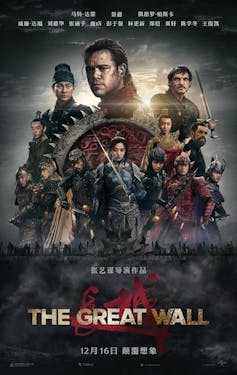
Localised strategies have also appealed to Chinese audiences. Chinese star Jing Tian has appeared in several Legendary monster films – as a military leader in kaiju martial arts spectacular The Great Wall (2016), a biologist in Kong: Skull Island and a famous scientist in Pacific Rim: Uprising. Star casting has long been one of the key techniques used by Hollywood to appeal to local markets. Locations are also important – the action in The Meg has been relocated from Maui in the novel, to China. Its cast also includes Li Bingbing, a Chinese star who also appeared in the most recent Transformers movie.
Legendary’s films demonstrate the mixture of local and global features at work. Legendary East and China Film Group
Several monster movies have recently grossed more in China than
domestically in the US. Pacific Rim: Uprising grossed almost twice as much, and Rampage over 50% more. By contrast, Star Wars films make negligible impact at the Chinese box office – clearly monster content is more appealing to Chinese audiences.This cycle of giant monster movies is currently the most prominent example of Hollywood’s globalised business. Its embrace of international material, familiar recycling and relationships with Asia are most strongly evidenced in these films. That’s not to say that all of this is new or one-way traffic: Legendary’s success with Godzilla inspired Toho studios to develop not one but two new series with the beloved national icon.
Read more