The Daily Routines of Famous Creative People
The daily life of great authors, artists and philosophers has long been the subject of fascination among those who look upon their work in awe. After all, life can often feel like, to quote Elbert Hubbard, “one damned thing after another” -- a constant muddle of obligations and responsibilities interspersed with moments of fleeting pleasure, wrapped in gnawing low-level existential panic. (Or, at least, it does to me.) Yet some people manage to transcend this perpetual barrage of office meetings, commuter traffic and the unholy allure of reality TV to create brilliant work. It’s easy to think that the key to their success is how they structure their day.
Mason Currey’s blog-turned-book Daily Rituals describes the workaday life of great minds from W.H. Auden to Immanuel Kant, from Flannery O’Connor to Franz Kafka. The one thing that Currey’s project underlines is that there is no magic bullet. The daily routines are as varied as the people who follow them– though long walks, a ridiculously early wake up time and a stiff drink are common to many.
Read more
A Write Time Reviewed by The Screenwriting Struggle
REVIEW: WRITE TIME: GUIDE TO THE CREATIVE PROCESS BY KENNETH ATCHITY
I’ve reviewed many books about the writing process, from the broad and overarching to the highly specialized, focused on a singular step of the journey. I’ve read the greats’ musings on everything from formulating the idea, to plotting it out, to emphasizing the emotional element, to remedies for writer’s block. Each is great in its own right, but what if I want a mentor to really make it personal, get in my head, delve into the intricacies of my own unique process, troubleshoot my pet neuroses that seem to chronically hold me back from reaching what I know to be my true potential, and clue me in on how to harness and optimize the writer’s most precious resource; time. Simple request, right? Simple for Kenneth Atchity, author of Write Time: Guide to the Creative Process, from Vision through Revision – and Beyond.
This book reads like a writer’s counseling session (the constructive kind), in every sense of that term; from cold hard business prudence strategies to processing deep-seated self-defeating thoughts. It grabs you from the Author’s Note which, as with any great forward or introduction, does more than just preview what’s to come. Dr. Atchity‘s credibility is firmly established here. He lets us know that 1) he feels our pain, and understands what we’re going through as creative souls who want to be professional artists, and 2) he’s been around the block enough times to know how to get us to where we want to be.
Once we get rolling, Atchity dispenses with the BS right out of the gate and lets us know that, while writing might be based on intuition and creative passions, it’s a craft and a discipline that must be honed through a rigorous and deliberate regimen. But here’s the good news – he’s going to take you by the hand and lead you through the process of establishing a productive and rewarding routine, and he’s going to leverage your own psychology to do it, turning your debilitating issues and hangups to your advantage. The book takes a deep dive into the human mind, points out how its natural workings must be considered, accommodated, and manipulated to develop habits and tricks to make your mental apparatus work for you instead of against you in achieving your creative goals, and some of his strategies will really surprise you!
Atchity provides an intriguing illustration of the interplay between parts of the brain that activates the motive power of creation. Just as conflict is the foundation of story, so it’s also the spark that sets your creative will into motion – this is the conflict between your rational faculties (which he nicknames the Continent of Reason) and your free-wheeling intuition (dubbed the Islands of Consciousness). The original quirky ideas of the islands are translated into the comprehensible and relatable language of the Continent through the intermediary function he calls the Managing Editor. Getting a grasp on these dynamics allows us to work toward striking a balance between “tricking” our brains into action and riding the wave of their natural functioning to channel our mental energy into our writing. Sound intriguing? That’s just the beginning!
As the title indicates, Write Time charts a detailed path to writing success, leaving no stone unturned, from initial dream all the way to polished product. It’s a comprehensive guide to the creative, technical, business, and personal aspects of the craft. Sound too rigid and formulaic for your taste? What if I told you it entails A LOT of variation at the numerous stages, and more than a few mandated vacations? The aim isn’t that you match a prescribed workflow to the letter. It’s to show you a proven real-world model and leave you to dovetail what’s useful with your own strengths, fill in any gaps in your process, make adjustments, and replace what’s not working for you. This section is all about establishing a writing agenda that your mind is geared to stick to and thrive on, and how to not become a statistic who perpetually and eternally has a “work in progress.”
Of course, one of the main threads of the book is the teaching of time management. It’ll show that you don’t really lack the time to achieve your writing goals. The time is there, you’re just not coordinating your cognitive resources in such a way to generate the necessary output within that time. Maintaining a reasonable perspective on the work/ time relationship is paramount. There are methods of mindset, planning, strategy, prioritizing, and step-by-step exercises to optimize your available chunks of time (even if you have to steal them). This chapter alone is worth the price of the book.
From there the writing process begins, and we’re off to the races. Here’s what’s in store as you make your way through Write Time:
- Approaching drafting and revision
- Style – how it comes about, and its rightful place in the writer’s hierarchy of values (pretty low, but valuable)
- A sample step by step process of creating a nonfiction book, explaining the reasons for the order, actions, and method at each waypoint; with an accompanying comparison to fiction writing
- The most important elements of fiction, and how to pack your story with maximum drama by tapping into your intuition to find its natural shape and structure (which has nothing to do with chronology)
- What your main priority should be to succeed in writing (Hint: It’s not using big words and feeling clever)
- A lengthy chapter on getting your book published. Don’t make the mistake of dismissing and skipping this one as irrelevant to the plight of a screenwriter. There’s a wealth of information here about…
- Dealing with gatekeepers with respect and professionalism (in person and through correspondence such as query letters and emails)
- Legal forms and contracts for deal-making
- Handling rejection, and the higher pressure situation of handling acceptance
- Seeking representation, consulting attorneys
- Customizing your workspace.
- The importance of understanding mythology for shaping and clarifying your story, with a striking illustration of how a film can go astray due to the inconsistent retelling of a myth.
- Methods and tricks for getting in touch with your subconscious through dreamwork and other avenues, along with some brilliant case studies of psychological techniques employed by writers having story problems, that’ll leave you inspired and cracking up.
- Overcoming psychological traumas of the past by channeling them into our writing and bridging the gap between conscious and unconscious.
- Some nice practical nitty-gritty stuff on screenwriting – character development, structure, twists, layers of effective storytelling; all through the prism of the key questions on the minds of the producers/ executives evaluating and vetting your work for production and/ or broadcast.
- The card system revisited, with workflow tips distinguishing the processes of novels vs. screenplays.
- Insights about revising (keep a particular eye out for the “conflict or cut” rule), and how many revisions are enough.
- The crucial golden Hollywood skill of pitching and how it must not be overlooked in one’s pursuit of a screenwriting career, with a really fun illustration of the pitch-to-production process (it involves a relay race).
- A baker’s dozen of straightforward rules for breaking into Hollywood; covering the personal, psychological, mindset, business, and more.
- A critical therapeutic chapter on Recapturing Creativity – what to do when your motivation to create (inevitably) wanes. A veritable troubleshooting manual for the writer’s perspective. Something to be revisited any time you feel you’ve lost your way.
- He closes with an amazing collection of his favorite quotes from great figures to leave the reader feeling inspired, encouraged, and motivated to carry on with the struggle.
Overall, Write Time amounts to a rather economical mentoring session with a writing sage who’s been there, done that, and wants us to get there too. It’s a premium blend of tough love, advice, encouragement, clarification, and delusion-busting. It approaches the needs of the writer from every angle and gives us what we’re yearning for, whatever that may be. For the writer at any stage of the game looking for guidance, this one is not to be missed.
Congratulations to Story Merchant Books Winning Authors!
THE 2021 INDEPENDENT PRESS AWARDS
LOS ANGELES, CA—Story Merchant is proud to
announce the 2021 Independent Press Awards acknowledges nine of our authors,
both those represented by Story Merchant or published through our imprint, Story Merchant
Books.
Congratulations to the following Story Merchant authors for these awards:
444 Days: Memoirs of a Hostage Wife by
Marge German; Winner in the MEMOIR category
The Bronx Stagger by Daniel P. Moskowitz; Winner in the CROSS-GENRE category
***
The Danger Game by Ian Bull; Distinguished Favorite in the ACTION/ADVENTURE category
The Gift from Fortuny by Terry Stanfill; Distinguished Favorite in the WOMEN’S FICTION category
Grizzly Justice by April Christofferson Distinguished Favorite in the WESTERN FICTION category
Inside the Lie by
Gary Wenkle Smith; Distinguished Favorite in the CRIME FICTION category
Irrational Fears
by Lee Lindauer; Distinguished Favorite in the THRILLER category
Japanese In-Law: Words and Phrases for Day-to-Day Living by Kenneth Atchity and Keisaku Mitsumatsu; Distinguished Favorite in the REFERENCE category
A Potter's Tale by Dave Davis; Distinguished Favorite in the SCIENCE FICTION category
The INDEPENDENT PRESS AWARD recognizes over 200 Book Award Winners and Distinguished Favorites in its annual book competition. The competition is judged by experts from different aspects of the book industry, including publishers, writers, editors, book cover designers and professional copywriters. Selected award winners and distinguished favorites are based on overall excellence.
In 2021, the INDEPENDENT PRESS AWARD had entries worldwide. Participating authors and publishers reside in countries such as Australia, Canada, India, Ireland, Japan, Singapore, Switzerland, United Kingdom, and others. In addition, books submitted included writers located in U.S. cities such as Atlanta to Santa Fe; Chicago to New York; from Boise to Honolulu, and others.
"We congratulate this year's
2021 winners and distinguished favorites in the annual INDEPENDENT PRESS
AWARD. The quality and quantity of
excellent independently published books hit a record. Independents recognized are thriving around
the globe. We are so proud to announce
these key titles representing global independent publishing." said awards
sponsor Gabrielle Olczak.
2021 WINNERS:
https://www.independentpressaward.com/2021winners
2021 DISTINGUISHED FAVORITES:
https://www.independentpressaward.com/2021distinguishedfavorites
Story Merchant – representing stories to
traditional publishing as well as to Film and TV in Hollywood
Story Merchant Books – Direct-publishing new voices
George Orwell On Writing.
It is now (1949) sixteen years since my first book was published, and about twenty-one years since I started publishing articles in the magazines. Throughout that time there has literally been not one day in which I did not feel that I was idling, that I was behind with the current job, and that my total output was miserably small. Even at the periods when I was working ten hours a day on a book, or turning out four or five articles a week, I have never been able to get away from this neurotic feeling that I was wasting time. I can never get any sense of achievement out of the work that is actually in progress, because it always goes slower than I intend, and in any case I feel that a book or even an article does not exist until it is finished. But as soon as a book is finished, I begin, actually from the next day, worrying because the next one is not begun.
~ George Orwell
Getting Your Story Straight: 3 Act Structure
Writing Advice from Haruki Murakami
Write to find out.
I myself, as I’m writing, don’t know who did it. The readers and I are on the same ground. When I start to write a story, I don’t know the conclusion at all and I don’t know what’s going to happen next. If there is a murder case as the first thing, I don’t know who the killer is. I write the book because I would like to find out. If I know who the killer is, there’s no purpose to writing the story.
Writing Advice from Haruki Murakami
Share your dreams.
Dreaming is the day job of novelists, but sharing our dreams is a still more important task for us. We cannot be novelists without this sense of sharing something.
Writing Advice from Haruki Murakami
Focus on one thing at a time.
If I’m asked what the next most important quality is for a novelist [after talent], that’s easy too: focus—the ability to concentrate all your limited talents on whatever’s critical at the moment. Without that you can’t accomplish anything of value, while, if you can focus effectively, you’ll be able to compensate for an erratic talent or even a shortage of it. . . Even a novelist who has a lot of talent and a mind full of great new ideas probably can’t write a thing if, for instance, he’s suffering a lot of pain from a cavity.
WRITING ADVICE FROM HARUKI MURAKAMI
Read.
I think the first task for the aspiring novelist is to read tons of novels. Sorry to start with such a commonplace observation, but no training is more crucial. To write a novel, you must first understand at a physical level how one is put together.
WHAT’S NEEDED IS MAGIC: WRITING ADVICE FROM HARUKI MURAKAMI
Read.
I think the first task for the aspiring novelist is to read tons of novels. Sorry to start with such a commonplace observation, but no training is more crucial. To write a novel, you must first understand at a physical level how one is put together . . . It is especially important to plow through as many novels as you can while you are still young. Everything you can get your hands on—great novels, not-so-great novels, crappy novels, it doesn’t matter (at all!) as long as you keep reading. Absorb as many stories as you physically can. Introduce yourself to lots of great writing. To lots of mediocre writing too. This is your most important task.
–from Murakami’s 2015 essay “So What Shall I Write About?,” tr. Ted Goossen
Take the old words and make them new again.
One of my all-time favorite jazz pianists is Thelonious Monk. Once, when someone asked him how he managed to get a certain special sound out of the piano, Monk pointed to the keyboard and said: “It can’t be any new note. When you look at the keyboard, all the notes are there already. But if you mean a note enough, it will sound different. You got to pick the notes you really mean!”
I often recall these words when I am writing, and I think to myself, “It’s true. There aren’t any new words. Our job is to give new meanings and special overtones to absolutely ordinary words.” I find the thought reassuring. It means that vast, unknown stretches still lie before us, fertile territories just waiting for us to cultivate them.
–from Murakami’s 2007 essay “Jazz Messenger“
Explain yourself clearly.
[When I write,] I get some images and I connect one piece to another. That’s the story line. Then I explain the story line to the reader. You should be very kind when you explain something. If you think, It’s okay; I know that, it’s a very arrogant thing. Easy words and good metaphors; good allegory. So that’s what I do. I explain very carefully and clearly.
–in a 2004 interview with John Wray for The Paris Review/em>
Share your dreams.
Dreaming is the day job of novelists, but sharing our dreams is a still more important task for us. We cannot be novelists without this sense of sharing something.
–from Murakami’s 2011 acceptance speech for the Catalunya International Prize
Write to find out.
I myself, as I’m writing, don’t know who did it. The readers and I are on the same ground. When I start to write a story, I don’t know the conclusion at all and I don’t know what’s going to happen next. If there is a murder case as the first thing, I don’t know who the killer is. I write the book because I would like to find out. If I know who the killer is, there’s no purpose to writing the story.
–in a 2004 interview with John Wray for The Paris Review/em>
Hoard stuff to put in your novel.
Remember that scene in Steven Spielberg’s film E.T. where E.T. assembles a transmitting device from the junk he pulls out of his garage? There’s an umbrella, a floor lamp, pots and pans, a record player─it’s been a long time since I saw the movie, so I can’t recall everything, but he manages to throw all those household items together in such a way that the contraption works well enough to communicate with his home planet thousands of light years away. I got a big kick out of that scene when I saw it in a movie theater, but it strikes me now that putting together a good novel is much the same thing. The key component is not the quality of the materials─what’s needed is magic. If that magic is present, the most basic daily matters and the plainest language can be turned into a device of surprising sophistication.
First and foremost, though, is what’s packed away in your garage. Magic can’t work if your garage is empty. You’ve got to stash away a lot of junk to use if and when E.T. comes calling!
–from Murakami’s 2015 essay “So What Shall I Write About?,” tr. Ted Goossen
Repetition helps.
When I’m in writing mode for a novel, I get up at four a.m. and work for five to six hours. In the afternoon, I run for ten kilometers or swim for fifteen hundred meters (or do both), then I read a bit and listen to some music. I go to bed at nine p.m. I keep to this routine every day without variation. The repetition itself becomes the important thing; it’s a form of mesmerism. I mesmerize myself to reach a deeper state of mind. But to hold to such repetition for so long—six months to a year—requires a good amount of mental and physical strength. In that sense, writing a long novel is like survival training. Physical strength is as necessary as artistic sensitivity.
–in a 2004 interview with John Wray for The Paris Review/em>
Focus on one thing at a time.
If I’m asked what the next most important quality is for a novelist [after talent], that’s easy too: focus—the ability to concentrate all your limited talents on whatever’s critical at the moment. Without that you can’t accomplish anything of value, while, if you can focus effectively, you’ll be able to compensate for an erratic talent or even a shortage of it. . . Even a novelist who has a lot of talent and a mind full of great new ideas probably can’t write a thing if, for instance, he’s suffering a lot of pain from a cavity.
–from What I Talk About When I Talk About Running
Although I compose essays as well as works of fiction, unless circumstances dictate otherwise, I avoid working on anything else when I am writing a novel . . . Of course, there is no rule that says that the same material can’t be used in an essay and a story, but I have found that doubling up like that somehow weakens my fiction.
–from Murakami’s 2015 essay “So What Shall I Write About?,” tr. Ted Goossen
Cultivate endurance.
After focus, the next most important thing for a novelist is, hands down, endurance. If you concentrate on writing three or four hours a day and feel tired after a week of this, you’re not going to be able to write a long work. What’s needed for a writer of fiction—at least one who hopes to write a novel—is the energy to focus every day for half a year, or a year, or two years. You can compare it to breathing.
–from What I Talk About When I Talk About Running
Experiment with language
It is the inherent right of all writers to experiment with the possibilities of language in every way they can imagine—without that adventurous spirit, nothing new can ever be born.
–from “The Birth of My Kitchen Table Fiction,” tr. Ted Goossen, 2015
Have confidence.
The most important thing is confidence. You have to believe you have the ability to tell the story, to strike the vein of water, to make the pieces of the puzzle fit together. Without that confidence, you can’t go anywhere. It’s like boxing. Once you climb into the ring, you can’t back out. You have to fight until the match is over.
–from a 1992 lecture at Berkeley, as transcribed in Haruki Murakami and the Music of Words, Jay Rubin
Write on the side of the egg.
[This] is something that I always keep in mind while I am writing fiction. I have never gone so far as to write it on a piece of paper and paste it to the wall: Rather, it is carved into the wall of my mind, and it goes something like this:
“Between a high, solid wall and an egg that breaks against it, I will always stand on the side of the egg.”
Yes, no matter how right the wall may be and how wrong the egg, I will stand with the egg. Someone else will have to decide what is right and what is wrong; perhaps time or history will decide. If there were a novelist who, for whatever reason, wrote works standing with the wall, of what value would such works be?
–from Murakami’s 2009 Jerusalem Prize acceptance speech
Observe your world.
Reflect on what you see. Remember, though, that to reflect is not to rush to determine the rights and wrongs or merits and demerits of what and whom you are observing. Try to consciously refrain from value judgments—don’t rush to conclusions. What’s important is not arriving at clear conclusions but retaining the specifics of a certain situation . . . I strive to retain as complete an image as possible of the scene I have observed, the person I have met, the experience I have undergone, regarding it as a singular “sample,” a kind of test case as it were. I can go back and look at it again later, when my feelings have settled down and there is less urgency, this time inspecting it from a variety of angles. Finally, if and when it seems called for, I can draw my own conclusions.
–from Murakami’s 2015 essay “So What Shall I Write About?,” tr. Ted Goossen
Try not to hurt anyone.
I keep in mind to “not have the pen get too mighty” when I write. I choose my words so the least amount of people get hurt, but that’s also hard to achieve. No matter what is written, there is a chance of someone getting hurt or offending someone. Keeping all that in mind, I try as much as I can to write something that will not hurt anyone. This is a moral every writer should follow.
–from Murakami’s 2015 advice column
Take your readers on a journey.
As I wrote A Wild Sheep Chase, I came to feel strongly that a story, a monogatari, is not something you create. It is something that you pull out of yourself. The story is already there, inside you. You can’t make it, you can only bring it out. This is true for me, at least: it is the story’s spontaneity. For me, a story is a vehicle that takes the reader somewhere. Whatever information you may try to convey, whatever you may try to open the reader’s emotions to, the first thing you have to do is get that reader into the vehicle. And the vehicle–the story–the monogatari–must have the power to make people believe. These above all are the conditions that a story must fulfill.
–from a 1992 lecture at Berkeley, as transcribed in Haruki Murakami and the Music of Words, Jay Rubin
Write to shed light on human beings.
I have only one reason to write novels, and that is to bring the dignity of the individual soul to the surface and shine a light upon it. The purpose of a story is to sound an alarm, to keep a light trained on The System in order to prevent it from tangling our souls in its web and demeaning them. I fully believe it is the novelist’s job to keep trying to clarify the uniqueness of each individual soul by writing stories—stories of life and death, stories of love, stories that make people cry and quake with fear and shake with laughter. This is why we go on, day after day, concocting fictions with utter seriousness.
–from Murakami’s 2009 Jerusalem Prize acceptance speech
No matter what, it all has to start with talent. . .
In every interview I’m asked what’s the most important quality a novelist has to have. It’s pretty obvious: talent. No matter how much enthusiasm and effort you put into writing, if you totally lack literary talent you can forget about being a novelist. This is more of a prerequisite than a necessary quality. If you don’t have any fuel, even the best car won’t run.
–from What I Talk About When I Talk About Running
Writing is similar to trying to seduce a woman. A lot has to do with practice, but mostly it’s innate. Anyway, good luck.
–from Murakami’s 2015 advice column
. . . unless you work really hard!
Writers who are blessed with inborn talent can write easily, no matter what they do—or don’t do. Like water from a natural spring, the sentences just well up, and with little or no effort these writers can complete a work. Unfortunately, I don’t fall into that category. I have to pound away at a rock with a chisel and dig out a deep hole before I can locate the source of my creativity. Every time I begin a new novel, I have to dredge out another hole. But, as I’ve sustained this kind of life over many years, I’ve become quite efficient, both technically and physically, at opening those holes in the rock and locating new water veins. As soon as I notice one source drying up, I move on to another. If people who rely on a natural spring of talent suddenly find they’ve exhausted their source, they’re in trouble.
In other words, let’s face it: life is basically unfair. But, even in a situation that’s unfair, I think it’s possible to seek out a kind of fairness.
–from Murakami’s 2008 essay “The Running Novelist,” tr. Philip Gabriel
Compiled by By Emily Temple
for Literary Hub
Self-Publishing: Expectations vs Reality For New Authors
Self-publishing is a great opportunity – if you have a head for business
Are you dreaming of becoming the next bestselling author?
For anyone who writes, it is natural to want your hard work to reap the rewards you believe it deserves.
Self-publishing today gives all authors the chance to publish for (almost) free and to have a book on sale on Amazon and many other online book retailers.
If you use Amazon’s publishing service, Kindle Direct Publishing (KDP), you can publish an ebook, and it will be on sale in around 24 hours.
For a paperback version of a book using print on demand, it takes only a few days.
In the days before self-publishing, the publishing process for a traditional publisher very often took a year or more. It has not changed a great deal for large publishers today.
It is a long road to take to get a book published the traditional way. You need first to find a literary agent to represent you, which is no easy task.
Then if you are lucky enough to find one, it can take months for your agent to secure a publishing contract for you. If you are one of the fortunate authors who manage to get this far, it is then a wait of another year before your book is released.
After that, you cross your fingers and hope your book sells well. Otherwise, the chances of another contract are slim.
However, if you self-publish, you skip all the waiting and jump immediately to crossing your fingers.
So much has changed, but the publishing industry stays the same. It is about hoping that readers will buy your book.
The expectations of publishing a book

I started publishing in 2005 with Createspace. The following four years were marvellous for me for with my print books selling well enough to get a nice check every month.
Then came the ebook.
When I self-published my first ebook in 2011, there were fewer than 800,000 Kindle ebooks on Amazon. Fast forward to today, and it is over 7 million.
Did you know that a new Kindle ebook is now published on average every 3 minutes?
You do not need to be a statistician to calculate that while the number of ebook titles has risen dramatically, the number of book buyers has not increased proportionally.
In simple terms, for a digital book, it is a highly competitive market.
On top of that, Kindle Unlimited has turned all the publishing rules on its head. No longer do you sell a book. You sell page reads. For authors and publishing companies alike, it is a considerable challenge.
Many new authors leap into publishing an ebook on Amazon with the expectation that because their book is for sale, it will sell.
Nothing could be further from the truth. The hard facts are that very few titles sell well, and most struggle to sell more than a handful of copies per year. Mostly to friends and family.
The biggest problem is that many newly published authors do zero market research before a book launch.
If you want to sell anything, you have to know what your market is and how you are going to attract people to buy your product.
Smart indie authors know this and have a clear idea of their genre and what market potential there is for their writing.
For example, there is a massive market for contemporary romance, but only a tiny market for gardening or rose care books. However, a small market segment is less competitive.
Balancing competitivity and volume is how you understand your potential market share. Do you want a tiny proportion of the highly competitive romance market, or to dominate the less competitive rose care genre?
For new independent authors, do not let your expectation cloud the reality. Selling books in today’s market is very hard unless you are an expert in book marketing and know who your potential book buyers are and how you can connect with them.
Putting your book up for sale is one thing. Selling a lot of copies is another reality altogether.
The realities of making it with self-published books

The first reality is to understand that vanity presses will never help you succeed.
I hear from so many authors who had wild dreams, were told mistruths and paid an awful lot of money to publish their book. And all for nothing.
Vanity publishing is definitely not self-publishing. Paying a vanity publishing company to sell books to you is not a recipe for success. Do not fall for the trap.
You can only succeed if you can sell books to readers. And you can.
Here is a short extract from the 2018 Author Earnings Report.
“Despite the prevalent indie doom-and-gloom rumours, today’s top sellers are handily making as much or more than the top-selling indies from prior years were.
But here’s the kicker. A lot of today’s top-selling indies are relatively new names. We didn’t recognize a lot of them. And a lot of yesteryear’s pioneering indie superstars no longer even make the Top 50.”
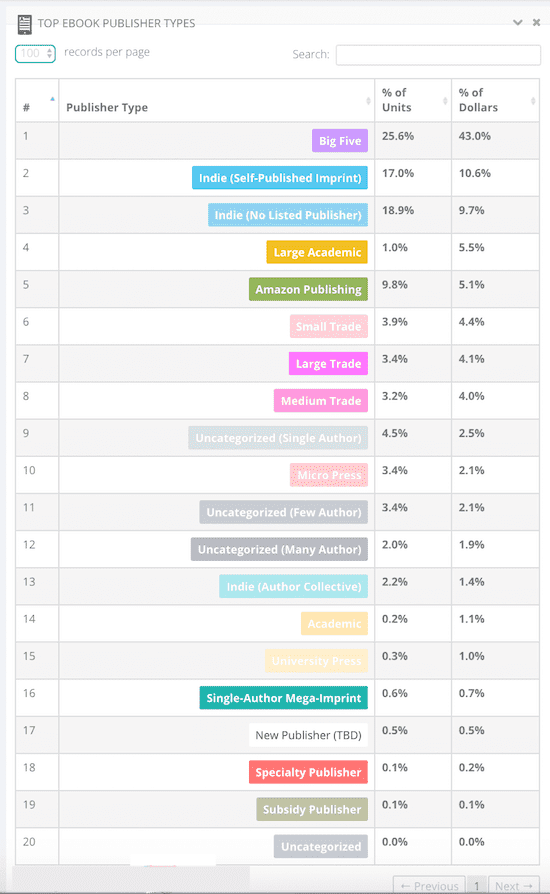
A look at ebook sales for 2017 tells an optimistic story for indie-publishing authors.

Combined Indie author ebook sales of imprint, not listed and collective amount to over 37% of the market. A full 12% higher than the Big Five publishers.
There is no doubt that readers do buy self-published titles and far more than traditionally published titles.
But do not expect to be part of this success if you think that everyone in the world is going to want to buy your book about rose care, or even romance.
You have to know your specific genre, the demographics and interests of your potential readers, and most importantly, how to get them to find your book.
You might have a fantastic book title, a brilliant professionally designed book cover and had the interior of your book formatted by a book designer.
But unless the story or subject of your book is what readers really want to read, your book can still fail.
Book buyers are fickle, so you need to give them a compelling reason to buy your book.
Learning about how people find books they want to buy

Understanding how and why people buy books is your first step towards being a successful indie publisher.
Yes, you need a great story, a brilliant book description and a killer cover design.
You need to be a little tech savvy and know how to exploit social media and attract attention via your blog with good use of SEO.
Most of all though, you need to know how to leverage categories and keywords for your books.
Getting your book into the right place for readers of your genre to find is more powerful than any other form of book marketing.
The new breed of successful Indie authors are quietly and studiously using data to help readers find their books on Amazon and other retailers. It is an electronic form of getting your book on a shelf at the front of a bookstore.
The expectation vs reality equation is now that you can only expect to gain regular book sales if you understand the reality of the necessity to use data.
Learning how to access and leverage Amazon book sales data especially is now key to succeeding in the online book market.
To use the example I mention before of the difference in the market for contemporary romance and rose care, here is some hard data.

Amazon sales data for books related to rose gardening. Data source KDP Rocket
In line six, the book, The Rose Garden, is fiction, so it needs to be ignored. But you can see that the monthly sales for books related to rose care and rose gardening is very small. The best selling book is making $73.00 per month.
Now let’s looks at contemporary romance.

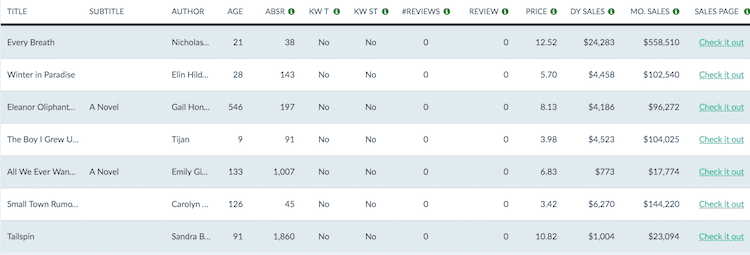
Amazon sales data for books related to contemporary romance. Data source KDP Rocket
What a difference! Yes, your eyes aren’t deceiving you. In 21 days, Every Breath has made sales of over half a million dollars.
When you can access data as I have illustrated above, you can drill down to find your niche market and find keywords and categories to make your book as competitive as possible.
This is the future of independent publishing. Using data to position your book where readers can find it, and buy it.
In SEO, there is an expression that if your page ranks on page one of Google Search, you get traffic. If it is listed on page two, it is in the cemetery.
The same applies to books on Amazon. If you book appears on the first page when a book buyer searches for a new book, you will make book sales. If it appears on page two, you won’t.
The future success stories of indie publishing
Book buyers are over discriminating between traditional published and self-published books and ebooks. They just buy books they want to read.
In the past, the best advice to new authors was to have a fantastic book cover, a great book description to hook readers and to have a book properly edited.
But today, that is now not going to be enough to succeed.
The path to success today and in the future will be to learn how to market a book to an electronic online market.
Using data research to find your market niche and to better position your title so buyers see it will be more important than your book cover and description.
That is why the Author Earnings Report I mentioned earlier stated that today’s top-selling indies are relatively new names.
They are the new authors who know the power of data, and how to use it.
“How Long Did It Take to Write the World’s Most Popular Books?”
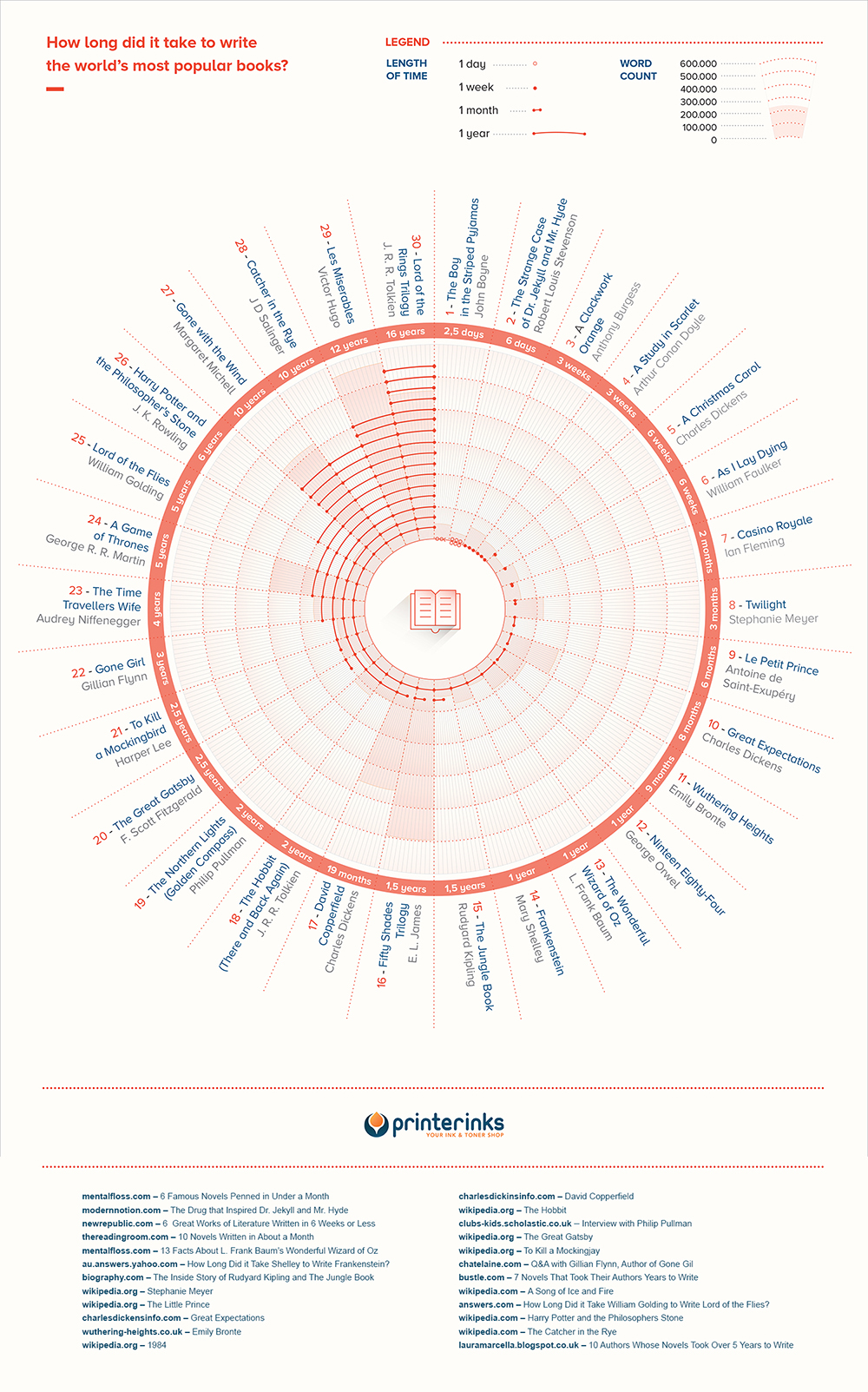
As well as knowing simply how long these novels took to write, it is interesting to note the books word-count in comparison. At over 58,000 words in length, ‘The Strange Case of Dr. Jekyll and Mr. Hyde’ was written in only 6 days, meaning Robert Louis Stevenson wrote a remarkable average of 4482 words per day to finish his story within this time. Impressive when compared with JD Salinger’s average for ‘The Catcher in the Rye’ at a mere 20 words per day over 10 years.
Have a look at these timespans in the infographic below, and then try to reconcile your own personal inspiration-to-productivity ratio.

Read more
The Personal History Behind One Hundred Years of Solitude
![]() |
Gabriel García Márquez working on “One Hundred Years of Solitude,” 1965 Photograph by Guillermo Angulo / Harry Ransom Center
|
This post is in partnership with the Harry Ransom Center at The University of Texas at Austin. A version of the article below was originally published on the Ransom Center’s Cultural Compass blog.
“The problem is mine,” Gabriel García Márquez confessed to a friend in a letter in July 1966, “that after so many years of working like an animal, I feel overwhelmed with fatigue, without clear perspectives, except in the only terrain that I like and does not feed me: the novel.” He also told his friend that he had just finished writing One Hundred Years of Solitude (Cien años de soledad). But he had serious doubts about whether the novel was good at all. For the past four months he had been under the impression that the novel “embarked me in an adventure that could be either fortunate or catastrophic.”
In this “very long and very complex” novel, as he described it to Editorial Sudamericana’s acquisitions editor, García Márquez wanted to fictionalize the atmosphere of his childhood when he lived with his maternal grandparents in Aracataca, a town located in Colombia’s Caribbean region. He stayed in his grandparents’ house until the age of 8. Soon after, the memory of the house, the family, and Aracataca not only started to haunt him but also proved crucial to his successful literary career, because the reminiscences of his childhood became the seed of One Hundred Years of Solitude and some of his early fictional works, which centered around the Buendía family and the town of Macondo.
Related
2017 MTV Movie And TV Awards - Press Room
Books
Belle of the Book Club Emma Watson Is Back to Her Novel-Hiding Ways With The Handmaid's Tale
Before he took on literature, the young García Márquez had two passions: drawing and music. Although he did not pursue drawing professionally, he was known for doodling long-stemmed flowers when dedicating his books to close friends, such as the flower that appears on the first page of a photocopied typescript of One Hundred Years of Solitude that he gave to his friend Álvaro Cepeda Samudio.
His other passion, music, permanently accompanied him. Photos of his office in Mexico City show that over the years music (first, in the form of vinyl records and cassettes, and later as CDs) occupied as much space on the shelves as his literature books. Listening to music, in fact, was as important a part of his creative process as reading was.
In March 1966, his beloved vallenatos — a popular folk music of Colombia — welcomed him to Aracataca. That month he paused the writing of One Hundred of Years of Solitude and flew from Mexico to Colombia to present Tiempo de morir at the Cartagena Film Festival. Mexican filmmaker Arturo Ripstein directed the movie and García Márquez wrote the script. After Cartagena, he traveled to Aracataca with his friend Cepeda Samudio in order to revisit the locations of his fictional Macondo, including his grandparents’ house. To García Márquez’s delight, his visit coincided with the town’s first festival of vallenato. An energized García Márquez resumed work on the novel upon return to Mexico City.
Writing took him approximately 13 months, from July 1965 to August 1966. Little documentation survives to this day to understand how he wrote it. Allegedly, García Márquez burnt all manuscripts, notes, and diagrams after receiving the first copy of the book from Sudamericana. He only saved the last version of the novel’s typescript, now kept at the Ransom Center. This typescript contains over 200 handwritten corrections, which reveal surprising textual variants with the final text of the novel published by Sudamericana. Some variants of special interest can be found on pages 46, 149, and 282.
Upon its publication on May 30, 1967, the novel achieved rapid success in Spanish-speaking countries. Yet neither the author nor the publisher expected it to succeed the way it did. At that time, they hoped One Hundred Years of Solitude would attain a success similar to other contemporary Latin American novels, such as Ernesto Sábato’s On Heroes and Tombs (1961), Alejo Carpentier’s Explosion in a Cathedral (1962), Carlos Fuentes’s The Death of Artemio Cruz (1962), Mario Vargas Llosa’s The Time of the Hero (1962), Julio Cortázar’s Hopscotch (1963), Juan Carlos Onetti’s Body Snatcher (1964), and José Donoso’s Hell Has No Limits (1966). To their surprise, the novel became an international bestseller.
Given the magnitude of its success, media outlets in Latin America and Spain tried to explain the literary phenomenon of One Hundred Years of Solitude, including special publications such as the issue number 9 of Coral, a journal of tourism, art, and culture published in Valparaíso, Chile. This special issue included a compilation of critical essays on the novel written by 11 critics and writers in five countries. Enthusiastic reviews and record sales in Latin America and Spain favored an avalanche of translations. Its publication in Great Britain, in particular, included the release of a large-format, illustrated brochure stating that echoes of William Faulkner, Leo Tolstoy, and Thomas Mann were present in García Márquez’s novel. The brochure also reproduced the famous 1967 Times Literary Supplement review calling One Hundred Years of Solitude a “masterpiece.” Witnessing the novel’s international success unfold was García Márquez’s wife, Mercedes Barcha, who, as he said in multiple occasions, appears in disguise in most of his books.
Partly due to the novel’s success, García Márquez was awarded the Nobel Prize in Literature in 1982. Since then, the stature of One Hundred Years of Solitude has continued to grow, and its style — popularly known as magical realism — has influenced major writers and books, from Salman Rushdie’s Midnight’s Children to Toni Morrison’s Beloved to the Harry Potter series. By now, One Hundred Years of Solitude has officially sold over 45 million copies and has been published into 44 languages, making it the second most translated literary work in Spanish after Don Quixote.
In 2007, the Royal Spanish Academy released a special edition of the novel to commemorate its fortieth anniversary. With the goal of amending the mistakes present in the original edition of 1967, the Academy asked García Márquez to re-read and edit the text for the last time, so that this edition will show the text as he originally intended it to be. According to the galleys kept at the Ransom Center, he made a total of 61 changes, most of them related to spelling errors. But he also took advantage of this final opportunity and brought to life several of the editing practices he adopted 40 years before, when revising the last version of the novel’s typescript. So in the 2007 edition he introduced some changes in the text to conform to his original intention of making the language as precise as possible; for example, he replaced “colonial organism” (p. 448) with “colonial liver” (p. 432). Other changes conform to his original idea of augmenting the geographic isolation of Macondo; for instance, he replaced “kilometers” with “leagues,” a more archaic unit of length, when referring to the distance between Macondo and the site of the signing of the Treaty of Neerlandia.
Half a century after its publication, the influence of One Hundred Years of Solitude on world literature is so deep and entrenched that, as American writer Eric Ormsby said, “‘it seems always to have existed.” Yet little could a García Márquez “overwhelmed with fatigue” in 1966 foresee that this novel would soon embark him on the most fortunate of literary adventures.
Álvaro Santana-Acuña is a Research Fellow at the Harry Ransom Center. His next book is titled Ascent to Glory: The Transformation of One Hundred Years of Solitude Into a Global Classic (forthcoming from Columbia University Press). His research on One Hundred Years of Solitude has received several awards and published in multiple media, including the American Journal of Cultural Sociology, Nexos, and Books & Ideas, and The Atlantic. He holds a PhD in Sociology from Harvard University and is an Assistant Professor at Whitman College.
Read more
Guest Post: Reading is bad for your eyes but... by Jerry Amernic
His interview the other day with The Washington Post revealed that he doesn’t know why the Civil War took place and that Andrew Jackson was “really angry” about it. This is quite a stretch when you consider that Jackson died in 1845 and the Civil War began in 1861.
One week earlier Trump was interviewed by Reuters. In that one, he wondered why the Israelis and Palestinians have been fighting all these years.
“There is no reason there’s not peace between Israel and the Palestinians – none whatsoever,” he said.
Uh-huh.
Isn’t it important for world leaders to know a thing or two about history? One would think it should be a prerequisite for office. How can a world leader make informed decisions if he or she doesn’t know anything about the past?
Welcome to the brave new world of the 21st century. It’s a world where we have more information at our fingertips than ever before and people seem to know less than ever. Why? Here are a few reasons.
1. The education system is sadly lacking (I’m being generous when I say this).
2. There is so much choice out there, in terms of what information we want and how we get it, that many take the easy route. Put another way, in the old days you went to the library, but now you go to Wikipedia.
3. Extension of point no. 2 – There is so much choice and so little time that people, by and large, no longer read anything of substance.
A 1968 film called Charly with Cliff Robertson was about a man who is intellectually slow and who undergoes a medical procedure that makes him a genius. He is asked what was raising the standard of living (this was 1968) and he said: “A TV in every room.” Then he is asked about the current state of education and he said: “A TV in every room.”
Which is kind of where we are today, only worse. For the record, here are a few items from my bookshelf that I recommend to young people and current world leaders.
• The Rise and Fall of the Third Reich by William L. Shirer
• Infidel by Ayaan Hirsi Ali
• Roots by Alex Haley
• The Source by James A. Michener (a novel)
• Three Day Road by Joseph Boyden (another novel).
It’s only a beginning. But it’s something.
Jerry Amernic is a Canadian writer of fiction and non-fiction books. He is the author of the Holocaust-related novel 'The Last Witness' and the biblical-historical thriller 'QUMRAN'
Why authors shouldn’t obsess over one-star reviews
And no one is immune. Whether you’ve got 10 best-sellers to your credit or it’s your first book, you can expect at least a single one-star review.
There are the one-star Amazon reviews that make you roll your eyes.
“If possible, I’d give this pile of garbage zero stars.”
“Not really of much use for me. Seems like just a lot of useless information to fill up a book.”
“The best part of this book is the cover photo.”
Then there are the one-star Amazon reviews that have a little more substance.
“If you know nothing at all and are not good at Googling this might be a good choice.”
“I really didn’t like this book. I don’t understand why it’s so highly rated. I found the characters to be either overly dramatic, willfully ignorant, or utterly apathetic. They were just too extreme.”
“I was expecting a great deal of sociological analysis that relate to the author’s personal experiences but instead got a 272 rambling, inconsistent, humble brag of a memoir sprinkled with a few facts and statistics for good measure.”
What’s the difference between the two?
You can’t learn anything from the bad reviews that seem nonsensical or just plain mean.
But if one-star reviewers consistently comment that they were disappointed because your book didn’t include information they expected — and each bad review refers to the same missing information — you should update the description to forewarn readers: “This book is not about ‘X.’ ” (And perhaps add that missing information to a revised edition.)
Or, if reviewers repeatedly comment that the book is poorly written, is so riddled with typos that they couldn’t finish reading it, or that the dialogue was stilted, it’s time to take note.
Sometimes the feedback is useless, sometimes it’s helpful, right? The challenge is to be objective enough to see it for what it is.
3 reasons to embrace one-star reviews
But even useless or mean-spirited one-star reviews serve a purpose. Here are three reasons to embrace the lowly one-star review:
1. Readers aren’t stupid.
When you see a one-star review that says, “I bought this as a gift but it arrived too late,” what’s your reaction?
I’m going to go out on a limb here and suggest that you probably don’t think any less of the book or its author. Perhaps you think less of the reviewer for reviewing the delivery schedule, not the book’s contents.
Readers can see past silliness as easily as authors can.
2. They make the four- and five-star reviews believable.
Be honest: When you see a book with 60 reviews and they’re all five stars, does a quiet little voice in your head say, “Really? Not even one four-star comment? Or a couple of threes?”
That’s because you’re smart enough to know that this is a subjective business. You might hate what I love, and vice versa. So it seems kind of odd when everybody agrees that it’s a great book.
A 4.6, review average, especially when there are lots of reviews, is more credible than 5.0. (Because, as noted in point 1, readers aren’t stupid.)
3. They can provide feedback that helps you improve the book or its description.
As noted already, if you get the same negative feedback from several people, pay attention. Consider taking action on it.
For example, if you’re charging $14.99 for a 90-page paperback and you’ve got a slew of one-star reviews saying the book isn’t worth $14.99, it’s time to evaluate price versus perceived value.
Look for patterns in those negative reviews to see what you can learn from them. Sometimes, it’s nothing. But sometimes it’s something — even a big something. You can use that feedback to your advantage.