"The universe is made of stories, not of atoms."
—Muriel Rukeyser
____________________________

The First Four Ed Noon Private Eye Novels Are Now Available on Amazon Kindle!

In 1953, Michael Avallone’s first book, THE TALL DOLORES was published; a fast, funny mystery adventure set in Manhattan.  In that book, we are introduced to ED NOON, private eye, a wise-cracking, movie and baseball-loving tough guy with a soft heart whose adventures often tipped towards the surreal. Between 1953 and 1990, in 36 novels, a handful of novellas and countless short stories, Ed Noon fought the good fight… usually out of a little midtown office so tiny and cramped that he called it the MOUSE AUDITORIUM.Welcome to the Official Website of Michael Avallone.  In 2012, we’ll be bringing Ed Noon, and other great characters from the Michael Avallone collection, back to the public.  Watch this space… 

In 1953, Michael Avallone’s first book, THE TALL DOLORES was published; a fast, funny mystery adventure set in Manhattan.  In that book, we are introduced to ED NOON, private eye, a wise-cracking, movie and baseball-loving tough guy with a soft heart whose adventures often tipped towards the surreal. Between 1953 and 1990, in 36 novels, a handful of novellas and countless short stories, Ed Noon fought the good fight… usually out of a little midtown office so tiny and cramped that he called it the MOUSE AUDITORIUM.

Welcome to the Official Website of Michael Avallone.  In 2012, we’ll be bringing Ed Noon, and other great characters from the Michael Avallone collection, back to the public.

http://mouseauditorium.tumblr.com

Register for My FREE Webinar, June 21, at 2:30 pm (EDT)

What makes a good author’s representative? 


Sometimes a writer signs with an agent, manager, or attorney and is so elated to have done so that it doesn’t occur to him that he’s signed with someone that will not advance his dream of publication or production. But how do you know before you sign? How do you know how to narrow the list? Based on decades in both publishing and entertainment, Dr. Atchity will share with you his observations about what makes a good author’s representative and how to identify the good ones—as well as how to avoid the ones who will waste your time.

About the Presenter

Dr. Atchity is the author of 15 books, including A Writer’s Time, Writing Treatments That Sell, and How to Publish Your Novel. He’s worked successfully in nearly every area of the publishing and entertainment business, and has spent his lifetime helping writers get started with and improve their careers. As founder and head of Atchity Entertainment International, Inc., The Writer’s Lifeline, Inc., including Atchity Productions and Story Merchant, and The Louisiana Wave Studio, LLC. he has produced nearly 30 films in the past 20 years for major studios, television broadcasters, and independent distribution. He is currently nominated for an Emmy for “The Kennedy Detail,” based on the New York Times bestselling book he developed. For nearly twenty years before, as professor of literature and teacher of creative writing at Occidental College and UCLA, he helped literally hundreds of writers find a market for their work by bringing their craft and technique to the level of their ambition and vision. During his time at Occidental, he also served as a regular reviewer for The Los Angeles Times Book Review.


Register Now


My Addiction Discusses The Messiah Matrix

Interview with Kenneth John Atchity


Interview with Kenneth John Atchity Author of Homer's Iliad: The Shield of Memory - Which was his Ph.D. Dissertation. The work was awarded Yale Graduate School's Highest Academic Honor - The Porter Prize; and was later published by Southern Illinois University Press (Edited by John Gardner).  Mentors at Yale Included Thomas Bergin, Thomas Greene, A. Bartlett Giamatti, Richard Ellinger, Eric Segal and Lowry Nelson Jr.


His Twenty Books Include:


·         Homer: Critical Essays (G.K.Hall), 

·         The Renaissance Reader (HarperCollins), 
·         The Classical Greek Reader (Harper-Oxford University Press),
·         Italian Literature: Roots & Branches (Yale University Press),
·         A Writer’s Time (W.W. Norton)

·         Seven Ways to Die (with William Diehl) (Story Merchant Books)

·         And The Classical Roman Reader (Harper-Oxford)


Kenneth represents writers of both fiction and nonfiction. He accounts for numerous bestsellers and movies both produced in television and on the big screen. In 2011 he was nominated for an Emmy Award for Producing “The Kennedy Detail.”


We are very pleased to introduce our readers to his latest addition to storytelling which is his first novel called The Messiah Matrix.


Kenneth – thank you so much for giving me this interview. From the interviews I have done so far over the past year I’m fairly positive that you must be one of the most aspiring authors I have ever done an interview on.  


Thank you, Nadine. I’m definitely aspiring!

1.    As a start I always like for authors to tell us a bit about themselves. Where did your journey start, what made you start writing?

I’m sure it was my mother egging me on from the kitchen as I sat at the table turning an essay into a short story. She came up with some preposterous plots, but I modified them and made them work. Her mantra was “go for it”!

2.    I have to ask (and I know I have asked some other authors the same thing), how do you approach your writing? A lot of writers build their story. They first develop their characters, then develop their plot and then start writing. Others just jump into it from the word go.

Every project is different, but the FIRST THING I always do is to carve out time each day to work on my current ‘creative project.’ Without time, we have nothing—and it is time that gets work done.

3.    Another question that I have asked before but would like your input on is how do you treat sequel writing? As an author (unpublished but striving) myself, I had written my 1st novel, whilst I was going / am going through the editing process I started work on its sequel.  I found that as my story progressed there was some stuff that came up that I wanted to add into the first novel which I thought would tie them together. Do you experience similar notions? If you did how do you deal with it?

I don’t have the ‘sequel problem’ you’re experiencing. I focus on the story at hand, which is challenge enough in itself. I can see how that would get complicated though, and would have to understand in more detail to comment usefully.

4.    From basic reviews I had obtained on The Messiah Matrix I concluded that the novel covers a great story that is layered with romance, believable characters, wonderful settings and an unpredictable ending. Would you mind elaborating a bit on what readers could expect?

Readers can expect to be drawn into one of the greatest mysteries of the last two thousand years—how did the story of Jesus Christ get started? What is its provable historical roots?

5.    Where can readers follow your novels and latest updates?

The Messiah Matrix has its own website, www.messiahmatrix.com. We’d love nothing more than questions from readers on the blog section of that website. For my progress in general, check out kenatchity.blogspot.com and storymerchant.com.  Messiah and Seven Ways to Die also have their own Facebook pages.

6.    The novel has reached number one on kindle. How do you feel about that? 

I was happily surprised, especially in England where it’s high on many lists and selling very well despite the fact that we haven’t begun to market it yet.


7.    Some readers claim that this novel was far better than the Da Vinci Code. This is high praise, what are your views?

Of course I knew the book would be compared to Dan Brown, whom I admire. My view is that the issues Messiah Matrix deals with are much more monumental—the very origins of Christianity—than Da Vinci, but I admire his mastery of detail, which I couldn’t hope to equal.

8.    Where did the idea come from for the writing of the Messiah Matrix?

It came from my Roman Catholic upbringing, and the doubts I began having at the age of 15 about the “facts” of the life of Jesus, and the “rules” of the Catholic Church. For example, everyone who ate meat on Fridays went to hell for all eternity if they didn’t receive confession before they died. THEN the Church changed the rules and said it’s okay to eat meat on Friday. So what happened to all those souls in hell for eating meat on Friday? The answer is that they’re still there because those were the rules when they were alive. Hmmm, I thought, what kind of God acts like that? Do these rules, in fact, have anything to do with God at all? Read the novel and find out.

9.    As a Christian, what can readers expect to discover with regards to the roots of Christianity, anti-Christian perspectives and general religious views.

The book is very respectful of Christianity, and its basic peaceful doctrines; it’s much less tolerant of organized religion, which I personally believe is one of the greatest causers of violence the world has ever known. If read properly, the book actually acclaims that Christianity was founded in a magnificent way that should make everyone even prouder to be a Christian.

     10.  You recently did an article on CNN religion’s site that read “the Jesus debate: man vs. myth. The article covers Timothy Freke’s discovery of a religious image that some would call obscene. From the description it was of a drawing from a third-century amulet depicting a naked man nailed to a cross. The name on the amulet however isn’t that of Jesus of Nazareth, instead it was a pseudonym for Osiris-Dionysus, a pagan god in ancient Mediterranean culture. How was this article received within the public? What’s your personal conclusion?

Why is a man hanging on a cross obscene if it’s Orpheus (not Osiris) and not obscene if it’s Jesus? Geez, this kind of stuff makes me nuts. The name on the amulet is actually Orpheus—Bacchus (another name of Dionysus).

1 1.  As an author, can you give struggling authors any advice on the way forward?

The way forward is persistence. Never give up. And, as the late great Ray Bradbury said, “Start writing more. It’ll get rid of all those moods you’re having!”

1 2.  Final quote/ inspiration note.

“Go for it!” and read The Messiah Matrix, and review it for amazon.

BEACH BOOK FESTIVAL NAMES “SEVEN WAYS TO DIE” FOR GRAND PRIZE


NEW YORK _ A crime thriller with a unique back story is the grand prize winner of the 2012 Beach Book Festival, which honors the summer’s hottest reads. “Seven Ways to Die” is the final book from best-selling author William Diehl, who passed away five years ago after writing 400 pages of the novel, yet leaving it still incomplete.

His wife allowed his  friend and fellow author, Kenneth Atchity, to step in and complete the work. Atchity, who has written 15 books and produced 30 films, used notes and an outline to finish the whodunit. Fans of intriguing plots and page-turning reads will not be disappointed.

The judges awarded the book top honors for its colorful characters and intriguing plot, making it a perfect beach read for the coming season. The authors will be honored at a private awards ceremony to be held June 22 at the Grolier Club in Manhattan.

Hollywood snaps up hot ebook titles


Producers mine a new source of branded material

ebooks are emerging as a sexy new source of material for Hollywood.

ebooks are emerging as a sexy new source of material for Hollywood.

With the "50 Shades of Grey" series hitting 10 million sales this week, ebooks are emerging as a sexy new source of material for Hollywood. The majors are keeping a close eye on digital bestseller lists and showing a willingness to pay traditional book-rights fees for digital titles -- provided they come with built-in brand awareness.

The hunt to option such titles is heating up after a handful of high-profile sales of ebooks, many self-published, including April's $3 million sale of "50 Shades" to Universal. Observers credit "Shades" with paving the way for subsequent sales of "Wool" and "On the Island," both of which sold for big bucks despite the fact that both went straight to Kindles and iPads without going through major publishers.

"As we've known for years and years, the studios have been much more interested in brands, whether that's a board game or video game or traditional book," said Steve Fisher, veep of APA and a literary agent who represents books-to-films deals. "The last couple of deals have really indicated a huge willingness on the part of studios and other buyers to be open to ebooks in a way they hadn't been before."

Fisher most recently repped the author of "On the Island," a romance eBook which MGM snapped up (Daily Variety, May 14). Tome by Des Moines, Iowa resident Tracey Garvis-Graves spent five weeks on the New York Times bestseller list before the Lion forked over a low- to mid-six-figure fee.

"The effect is that they're looking more closely than ever at the ebook list for the original ebook bestsellers," said Jody Hotchkiss, a literary agent with Hotchkiss and Associates.
But traditional books have a key advantage over their digital counterparts: publishers tend to get into business with known quantities, or properties vouched for by literary agents. With ebooks, it's the Wild West when it comes to identifying promising authors and material. Digital books are virtually free to publish, and there's no gatekeepers vetting their quality.
According to data from research firm Publishers Marketplace, film and TV producers bought rights to 209 books last year and 79 so far this year. Very few of those were ebooks, and nearly all sold before they were published.

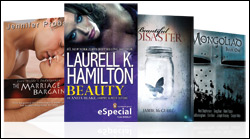
That means ebooks grab the attention of lit agents only after they start rising on the charts or generate enough word-of-mouth buzz. Currently high-charting ebooks include "Beauty" by Laurell K. Hamilton; Neal Stephenson's sword-fighting epic "Mongoliad"; romance "The Marriage Bargain" by Jennifer Probst; and "Beautiful Disaster" by Jamie McGuire -- none of which have yet been picked up. Meanwhile, E.L. James' steamy "50 Shades" continues to top the ebook chart.

The New York Times began listing bestselling ebooks in early 2011, a few months before thriller author John Locke reached 1 million in sales for his ebooks. But just like with traditional book publishing, getting discovered is a big challenge for the ebooks that aren't perched atop the bestseller list.

"The tricky thing about ebooks is that there are a lot of them out there," Fisher said, pointing out that ebooks don't get promoted the way traditional books can be. Reps often catch wind of self-published material by looking at the top-sellers lists on Amazon and iTunes.

"We follow sales by looking online, just as anybody can," said Jane Dystel, president of literary management agency Dystel & Goderich. Dystel found "On the Island" author Garvis-Graves by checking online book sales, later bringing the scribe to Fisher.

"The availability of ebooks is much greater today than it was even six months ago ... as the availability of good books increases, of course Hollywood is also going to be more interested," she said.

But because many are self-published, ebooks must also contend with the stigma that they're not the same quality as traditional novels. Most agents would rather not dig through the virtual slush pile in the hopes of finding a "50 Shades."

"I'm finding that book scouts in New York are really integral to this process even more so than they are (for) traditional books," Fisher said. "It's harder for your average ebook to separate itself from the pack, but a lot of these authors are very savvy at promoting themselves."

Case in point: Amanda Hocking, the 28-year-old self-published writer whose popular paranormal teen novels landed her a movie contract with Media Rights Capital last year. After selling more than 100,000 ebooks, Hocking landed a $2 million deal from St. Martin's Press for a four-book series, turning down a higher bid from a competitor that she felt wouldn't reach as many readers.

"Studios have signalled that they don't care whether it's an ebook or a hardbook because, ultimately, they bring the same kind of brand awareness that they so value," Fisher said.
Studios are willing to pay for that brand awareness. In a non-competitive situation, traditional book rights often fetch between $150,000 to $250,000 -- a range that now applies to popular e-fare.

While agents like Fisher may not always deal with publishers when it comes to ebooks, they rely heavily on book scouts -- filters that tend to go in and out of vogue as studios cut back budgets and depend upon junior execs to bring in material.

"In-house book scouts stopped being common when the studios determined that New York publishing was less important for movies (than) 10 to 15 years ago," Hotchkiss said.
Studios, for example, often have a book scout in-house or work with an outside company. Disney, 20th Century Fox and Sony, for example, have a scout on staff, while Warner Bros. and Universal work with outside companies on an exclusive basis.

But as hot ebooks continue to go mainstream, Hollywood will surely continue to pay attention.

"Studios and major buyers out here were taking their book scouts' calls a lot more quickly and suddenly paying attention to New York in a way that I hadn't seen in years," Fisher said of the immediate effect of the "50 Shades" sale. "I think that any qualms that buyers had about getting behind an ebook ... (are) gone."

Contact Rachel Abrams at Rachel.Abrams@variety.com

Guest Post: The Power of a Pin: Why Pinterest Is a Game Changer by Penny C. Sansevieri


About ten months ago, I listened to Gary Vaynerchuck talk about this new site called Pinterest. He was really excited about it, though at first I didn't get it. "Get on Pinterest now!" Gary encouraged. I didn't listen, thinking, "Oh, dear, not another social network!" But Pinterest has proven to be anything but another social network. First off, its growth has been extraordinary. According to several reports, including a blog post shared on Mashable, from September 2011 to December 2011, unique visitors on Pinterest increased by 429 percent. That kind of growth has never been seen in a social network and while it's still early for Pinterest, we're seeing a lot of staying power, especially with established brands like Macy's, Land's End and magazines such as Real Simple -- which got more traffic from Pinterest in October 2011 than from Facebook.

For those of you who haven't been on Pinterest, the concept is almost deceptively simple. You sign up for an account (there's a waiting period right now as Pinterest tries to manage traffic and new accounts; once you sign up it should take about a week before you can get in). The site is a collection of boards, sort of like virtual bulletin boards that you name and add to your page. You can have as many boards as you want and name them whatever you want (though make sure to read through the Pinterest terms of service so you know you're not violating any of their regulations). The boards can describe your brand, book, message, or business. We'll look at some board ideas in a minute but for now, think bulletin board.

So, that said, how can you make the most of Pinterest? Like any social network, I recommend that you poke around, follow a few people in your industry and see what they are posting about. There are a lot of creative boards and a lot of companies using Pinterest as a unique brand extension. Check out Chobani's Pinterest page; they have all sorts of boards that tie into their brand including Chobani Champions, recipes, spoons, and sans yogurt which is a board about all things non-yogurt related.

Picking your Boards

First off, it's important to come up with creative and interesting board names. Keep in mind that these board names get shared whenever someone repins you so make them catchy!
 
When you first start on Pinterest, you are a completely blank slate. It's up to you to fill your new Pinterest page with exciting boards. But where to start? Well, your business, product, message, or book will often determine the boards you put up. You should consider your audience first and what they would like to see. Here are a few ideas:
 
If you do a lot of speaking or other offline events, create a board that captures the excitement of these by posting pictures and videos. This is especially great if you have a conference or other big event you're planning. You could put the board up early with "teaser" content to encourage sign-ups, too!
 
Create a customer or reader board that has pictures and/or videos of happy customers. I often talk about capturing endorsements or reviews on video when you see someone at an event, these can be posted to this board.
 
How-to boards are great as well. You can create a board (or several) around how-to's related to your product or service.
 
Company boards are great too, you can create one that showcases your company, sharing your core values, and also highlights your team.
 
Thank you boards are great, too. Consider creating a thank you board for clients.
If you're promoting a new book, product, or campaign you can also create a board to support that. The board can have tutorials on it, or videos of the new product. It can be a combination of how-to and showcasing what you're offering.
 
Tutorials are big for our company, so we plan to offer tutorial boards to help walk our clients through how to use social media, how to continue reaping the benefits from our campaigns once they are done, etc.
 
Trends and seasonal stuff make great boards, too. So don't hesitate to create a holiday or trend board if you think your audience will be interested.
 
You can also let your customers work on a board with you. Create a user-generated content board and invite customers or readers to pin away!


Marketing Ideas

If the idea of Pinterest is still intimidating, consider the following marketing ideas for your boards:

Videos: Pinterest loves videos. What videos can you pin to a board?

Keywords are big on Pinterest, so be sure to think carefully about what you name your picture and what words you use in the description. You can even use hashtags on Pinterest and if you're trying to get the attention of another Pinner, use the @ followed by their Pin-name to tag them. You can also use a dollar sign to add a "ribbon" to your pin that will immediately show pricing. This is great if you're selling a product.
When you add your pin, don't forget to tweet it and add it to Facebook; you can do this as soon as the pin is loaded.

When you blog, be sure to add great pictures to your blog so that when you pin your blog post to your board, you can capture a great image. Images on Pinterest are obviously important!

Click the "popular" link on Pinterest to see what's hot and what's trending. You might be able to make this part of your content strategy.

Be sure to promote your Pinterest account on Facebook, Twitter, on your website, and in your email signature line, of course.

A Few Final Points

Be sure to add a catchy description to your profile and when you're setting up your Pinterest account, link it to your Facebook and Twitter accounts. This will help you gain followers, and add the icons to your profile page so you can direct people there, too.

Make sure to engage on Pinterest. Repin pins you love, comment on pins and since you can see pins on the site from folks you aren't even connected with, be sure to broaden your reach when networking. You never know where the next follower will come from.

Pinterest is a fun, if not highly addictive way, to start marketing. Still not sure what to do on Pinterest? Then get started by following others in your industry and get a sense of what they're doing. While the future of Pinterest is still uncertain, one thing we know is for sure. The site has grown at rates that no one expected and continues to do so. It's been the quickest site to monetize (to give you perspective, it took Twitter five years to monetize) and has already become a staple for many businesses.

Happy Pinning!

City Book Review Gives Story Merchant Client Dennis Palumbo's Fever Dream Four Out Five Stars!


Fever Dream


Fever Dream

By Dennis Palumbo
Poisoned Pen Press, $24.95, 350 pages
ISBN 9781455114771
Fever Dream by Dennis Palumbo is the second book to feature Daniel Rinaldi, a clinical psychologist specializing in the treatment of traumatic stress. This time he’s called into support police action to resolve a bank hostage situation. Robbers have released one woman and Rinaldi must get as much information from her as possible before SWAT goes in.

Unfortunately, time is short and, in response to shots fired inside the bank, SWAT responds. Only the bank guard survives and he’s wounded by a sniper’s bullet.
The current DA is running for governor and wants Rinaldi to stay on the case to get as much information as possible from the traumatized witness. Except nothing runs smoothly and Rinaldi becomes a target for violent attack. Now it’s a race against time to capture the robbers. Then events escalate with an attempt on the DA’s life. Rinaldi is also saddened by a suicide at the clinic where he worked as an intern. When you put these strands together, there’s a very clever set of problems to solve. Although Rinaldi’s capacity to absorb punishment is less than realistic, this is a high-adrenaline action thriller with some clever deductive reasoning to show whodunnit. Highly recommended!
Reviewed by David Marshall