"The universe is made of stories, not of atoms."
—Muriel Rukeyser
____________________________

Dana Holyfield's Cajun Sexy Cooking

Cajun Sexy Cooking


What if there was a TV show where sexy Cajun girls venture into the swamp, hunt down dinner then prepare a succulent bayou feast? 

A local author is making it happen. All based around her award winning book titled Cajun Sexy Cooking. The tasty and sexy bayou recipes are all the creation of Pearl River native Dana Holyfield. 


Guest Post: Turning Anxiety Into Creativity by Dennis Palumbo


Hollywood on the Couch

The inside scoop on Tinseltown, USA.
Using what scares you to motivate you

An old deodorant commercial on TV once proclaimed, “If you're not a little nervous, you're really not alive.”

Pretty sage advice, even though the only thing at stake was staying dry and odor-free. But there is something to be said for accepting---and learning to navigate---the minor turbulences of life. I'm talking here about common, everyday anxiety. The jitters. Butterflies.

This is particularly true for artists in Hollywood---writers, actors, directors, composers---whose very feelings are the raw materials of their craft. No matter how mundane, the small anxieties can swarm like bees, making work difficult. Those everyday distractions, like an impending visit from the in-laws, money worries, or that funny noise the Honda's been making.

Then there're the more virulent, career-specific anxieties, shared by few in other lines of work: Your theatrical agent hasn't returned your phone calls. You're three weeks past deadline with your latest screenplay draft. Your short film didn’t make the cut at the Sundance festival.

In other words, you're the stereotypical struggling Hollywood artist: bleary-eyed, sleep-deprived, staring pathetically at a blank computer screen (or the waiting edit bay, or the silent piano keys), hoping for inspiration and yearning for another cup of coffee, and maybe a nice piece of cheesecake. A dozen nagging, self-mocking thoughts echo in your head: You're untalented, a fraud. You're getting old and fat. No woman (or man) will ever want to sleep with you again. Your life is over.
Related Articles

    You Are Not Your Talent
    The Switch, Part II: Ingredients of the Hollywood Formula
    The Switch: A Despicable Hollywood Formula Threatens A Strong Romance-Comedy
    "Love and Other Drugs:" True and Mythical Paths toward Happiness
    Envy in Hollywood

Find a Therapist

Search for a mental health professional near you.
Find Local:

    Acupuncturists
    Chiropractors
    Massage Therapists
    Dentists
    and more!

These kinds of feelings are tough to deal with, to be sure, even if validated (and then gently challenged) by a supportive therapist, mate, good friend, or fellow creative type who's “been there, done that.” These deeply embedded, childhood-derived, seemingly inescapable Dark-Night-of-the-Soul feelings can, in fact, be crippling, regardless of your level of craft or years of experience.

And, as I've said countless times to the creative patients in my practice, struggling with these doubts and fears doesn't say anything about you as an artist. Other than that you are an artist.

Frankly, this difficult emotional terrain is where an artist lives much of the time---in a matrix of triumphs and defeats, optimism and despair, impassioned beliefs and crushing deflations. In the end, it's all just grist for the creative mill.

And, believe me, this is equally true for both beginning artists and accomplished, battle-hardened veterans.

But there's another kind of anxiety that emerges occasionally in a creative person’s life: the kind of gut-wrenching, dizzying upheaval from within that throws everything you think you know into doubt and that scares you to the very core. A puzzling, alarming career dive. A shattering divorce. The death of a family member. A spate of sudden, dizzying panic attacks.

Then, what balm is there to offer---or to receive---that doesn't seem trivial or woefully inadequate? Catharsis and validation, the foundation of most psychotherapeutic work, suddenly feel like mere word games. Medication, while often clinically appropriate, seems at best an armoring against something primal that's working within you.

What is an artist to do with that level of anxiety?

Use it.

Because, for an artist, when all that's left is the work, the work is all that's left.

What kind of work? Maybe numbed-out and shapeless at first; chaotic and unsatisfying. Maybe dark and ugly, or self-pitying and shameless. Maybe a blind, angry clawing at the air with inchoate feelings and inexplicable images.

The important thing to acknowledge, to accept and to make use of, is the fact of this anxiety -- its weight, its size, and its implacability at this time in your life. For whatever reason, it's there. As immoveable as a brick wall, as deep and fathomless as a sea.

And, for now, it isn't going anywhere.

So you, the artist, must ask yourself this question: Is there a character in the story I'm working on who feels such anxiety? Who feels as overwhelmed, as out of control, as terrified as I? These are the raw materials of the work. Whether writing a scene, directing a scene, acting in a scene, or composing the music for a scene, you must inhabit those aspects of the character whose narrative you’re building.

If you’re willing to do so, then plunge headlong into creating the hell out of that character, giving him or her your voice, your fears, your dreads. Create situations and scenes in which these anxieties are dramatized, exploited, “acted out.”

Create monologues, rants, vitriolic exchanges between characters, letting passions and behaviors emerge that may astound or alarm you; that stretch or distort or even demolish the narrative you've been working with. These problems can all be dealt with, deleted, perhaps even woven into the story later, in the cool light of day, when you have some kind of perspective.

Because to be truly in the eye of the emotional storm, to create from a state of anxiety, is to surrender any fantasy of perspective. In fact, in the purest sense, it's the ultimate act of creative surrender from which, out of the crucible of your deepest pain, you might discover a joyful, wonderful surprise.

Do this: put those trembling fingers on a keyboard, RIGHT NOW, and start stringing words together that reflect how you feel...without context, or narrative, or character. Just raw feeling, in as many vivid, living words as you can call forth.

Then look at what you've written. Feel whatever it is you're feeling. And hit that keyboard some more. Soon, I believe, you'll have a sense of the logjam cracking. You'll feel the urgency of creative expression, the palpable release of banked anxiety. Without judging what comes, without needing it to be anything, I think you'll find yourself creating something---even if that's just defined, for the moment, as putting words down on a page.

Does the idea of this exercise itself make you anxious? Doesn't surprise me. We're all pretty scared of creating, or making art, out of the very emotional space we'd most like to avoid or deny. It's human nature.

Besides, as famed psychiatrist Rollo May reminded us, real creativity is not possible without anxiety. In many ways, it’s the price of admission to the artist’s life.

Which means, for those artists who have the courage to embrace their own fears, to co-exist with potentially crippling anxiety and create anyway, the rewards can be significant. Consider artists as diverse as Woody Allen and Alfred Hitchcock, Stephen King and James L. Brooks, Anne Rice and Phillip Roth, Richard Pryor and Diane Arbus. They use who they are---all of who they are---as the wellspring of their creativity. Just as it is for yours.

Moreover, when all that’s left is the work…the work is all that’s left.

So trust it. Trust yourself. Like it or not, you’re all you have.

And the good news is, that’s enough.

Nadine Maritz of My Addiction Interviews Ken About The Story Merchant

Interview - Kenneth Atchity the American Story Merchant


Kenneth Atchity is an American producer and Author who has worked as a literary manager, editor, speaker, writing coach, brand consultant and professor of comparative literature. He’s been called the story merchant.


He is the captain of ships such as www.storymerchant.com ; Atchity Entertainment International, inc (www.aeionline.com ); The Writers Lifeline, Inc (www.thewriterslifeline.com ) and The Louisiana Wave Studio which together produce films and develop books for publication,  screenplays, and films for television and cinema--and consult with writers about their career strategies and tactics.

In this interview we are aiming to discover more about Kenneth himself and the world he lives in. As per the first interview http://ow.ly/dx211 which was based on the launching of the Messiah Matrix – we are enormously grateful for Kenneth to stand off his time for a written interview.


Kenneth, your entertainment career started in 1967 and is still flourishing can you tell our readers a bit more about your journey?

My journey has been a rollicking literary adventure, from my days as a professor at Occidental College and the University of Bologna, Italy, to the decision I made to leave the academic world and enter the commercial world of storytelling. There’s literally never been a dull moment—and the one thread that weaves through it all is my passion for stories of all kinds. I’ve been a first-hand witness to the world’s hunger for stories, and privileged to be able to bring them to their audiences.

You are known for producing filmography such as  “The Lost Valentine,” “Life or Something Like It,” “14 Days with Alzheimers,” “Hysteria,” “The Expatriate,” and “The Kennedy Detail,” which is but a few. What do you feel has been your best work in the filmography range?

Much as I love the movies I’ve been lucky enough to work on, I feel my best work is yet to come.


You founded Story Merchant for strategic coaching in writers in 2010. What inspired the idea behind these two new divisions?

I founded Story Merchant because the world of publishing and entertainment has changed so much in the last few years I found I was unable to spend time with individual writers in a way that made business sense—and Story Merchant allows me to do that through its (1) coaching services; (b) its publishing arm, Story Merchant Books; and its marketing arm, Story Merchant Book Marketing. We began (c), with my partner a former head of Fox Family Films, because the number one challenge of any author publishing a new book is how to make it VISIBLE in a world where thousands of books are published every single week. VISIBILITY is the published writer’s biggest challenge, so SMBM is focused on making writers visible.

Your academic career started in 1970 up to 1986 where you received the Faculty Achievement Award and the Distinguished Instructor at UCLA Writers program. How did you accomplish such awards within the same year?

You don’t really achieve awards—you just do your thing, and they either come or not. For people who love what they do, it’s not the awards that motivate it’s the privilege of getting to do what you love on a daily basis. It’s nice to be recognized, but an authorpreneur needs to be self-motivated because there’s a long wait between moments of recognition.


Your work has appeared in numerous journals and newspapers such as the American Quarterly, Classical Philology, Comparative Literature Studies, Contemporary Literature Criticism etc – how does it feel to be seen as such a popular and sought after writer?


It feels great to do the work of writing—the research, the composition, the revision. The more you publish the more you will publish. And it’s very satisfying to look back down a long road and see that many of my dreams—and those of my clients and partners--reached fruition.

You have written books such as : How to Publish Your Novel (SquareOne) (2005); How to Quit Your Day Job and Live Out Your Dreams (Skyhorse) (2012), plus Writing Treatments That Sell: How to Create and Market Your Story Ideas to the Motion Picture and TV Industry (Owl Books, 2003) and Write Time (2012, available through amazon.com).

How has exposure been on these books?
It grows over the years. It’s nice to know that several of the books have been through several editions and continue to resonate with writers year after year. It’s an extension of my years in the classroom to reach out and help people accelerate their progress along the success curve.           

Have readers ever given you input on how it    has assisted them with their career requirements and goals?

I couldn’t have written any of these books without constant input from students and clients along the way. It’s their experiences, in failure and success, that I describe in these books.

Your companies - Atchity Entertainment International, Story Merchant, and The Writer's Lifeline have been responsible for launching numerous books and films. I mean the list of stuff you have done is never ending, where to from here?

If I’m lucky enough to continue, I will continue pushing forward the projects I’m involved with—both my own personal projects like my first novel The Messiah Matrix which we talked about here earlier, and the many projects of my clients—wonderful books, screenplays, and stories that are just waiting their turn to see the light of day. And my honor and responsibility is to move them toward the light!

Have you ever thought about stretching your skills into countries that are not as skilled as America?

I did experiment a few years ago with reaching out to Brazil, at the request of a consultant from that country. I wish there were a way to do that at least in other English-speaking countries around the world because the world I work in, publishing and producing, is increasingly global so the principles I propound are universal.

In 1990 you founded the editorial and consulting company The Writer’s Lifeline, Inc. I am told that this company has been responsible for over a dozen best sellers. Can you tell our readers a bit more about what the company consists of? 


The Writers Lifeline, consisting of select editors I’ve chosen over the years to work with clients, is all about bringing “a writer’s skill and craft to the level of their vision and ambition.” On one hand, we ghost-write stories and information that the author needs put into the world; but on the other, our primary mission, is we make books and scripts ready for publication and production by giving them the conceptual, structural, style, and copy editing they need to stand out as professionally worthy of commercial acceptance.

You also do a lot of television, radio, web and television interviews and classes on contemporary literature, creativity, dreams, myth, writing, producing, publishing, time-management, business expansion, brand launching, and various other academic and entertainment-publishing subjects.


Where do you see yourself going with all of this within the future?

I am consolidating more and more of this into Story Merchant Book Marketing so that I can buy the time to help writers more. Writers need to remember the simple arithmetic, money buys time (that’s what the saying “Time is money” is all about). We all want unlimited freedom to create, so that means we need to achieve unlimited financial reward for the fruits of our creation. Anything I can do to concentrate and streamline my time helps me get more stories into the world.

In 2011 you were nominated for the Emmy for Outstanding Achievement in the Field of Documentary Programs on The Kennedy Detail – this was shown on Discovery Channel last year. And now you’ve turned the same book into a feature film, currently being written by director Stephen Gyllenhaal that will be released in 2013..


What do you expect to see from viewers on this release?

I know we will see respect for the amazing men who served President Kennedy even at the moment of this death—and had to endure the pain of it, and then go on with their work of attempting to protect the next president, and to move the country forward despite tragedy. I’ve seen that respect pouring out throughout the book tour for The Kennedy Detail and in the television audience’s reaction to the documentary—so I know the feature audience will express it as well.

How did it feel to be nominated for such an award?

It felt surreal to be in the room with the icons of television news and get to meet some of them at the pre- and after-party. There’s something so ‘arbitrary’ about awards and nominations—as I said earlier, you just do your work and focus on it, and sometimes it’s recognized. The recognition is time-consuming—I could be at my phone working on future deals. But it’s good to pause for them, take a breath, and put it all in perspective. There are SO MANY wonderful people working in publishing, television, and film that just being in the same room with them makes you realize that dreaming is the foundation for the reality we all live in. I got to be in the room with fellow dreamers. That’s like dying and going to heaven!

South Africa seems to be a country that holds a lot of promise in many things. Filmography and publishing are but some of its lesser opportunities.

How do you perceive these two factors to grow in the future?

As the world continues to shrink thanks to the technologies and the internet, film and publishing will grow in all parts of the world. I’ve been offered to amazing South African projects in the last two months, and there are many out there being dreamed at this very moment—persistence will turn them into realities.


For someone like me – Hollywood and big novel publishing brands seems to be something that is not easy to come by. It’s as if success is mostly concluded through the people you know and the money you could spend. Have you ever thought about branching out internationally? 


I’ve become all too aware of my limitations—primarily the limitation of the hours in the day. The only way I could conceive of branching out further is with the help of energetic partners who can build the infrastructure. Otherwise I’m happy with my present base, though I have clients in South Africa, Hong Kong, Germany, Belgium, France, England, Australia, Canada—and probably a few others I’ve forgotten at the moment.


If someone wanted to submit a manuscript or screenplay for your recommendation – what steps do they need to follow?

The best way to get my attention these days is to submit it to the ‘project launch analysis’ on www.thewriterslifeline.com
That way your project gets read, analysed, and reported back to me—for me to take a look at if it’s ready to move forward. If it’s not ready, you’ll be told why and we can help you do something about it.

What genres do you follow?
We have worked in every imaginable genre. I just love GOOD STORIES of all kinds.


Which age groups are you limited to?

­We aren’t limited to any age groups. We’ve found ways to work with them all.


Where can people follow your work and access your sites for possible submissions and enquiries?

My personal blog is a nexus that changes daily but gives you access to all the websites: its http://www.kenatchityblog.com/


 What do you prefer – reading, writing or screen?

I equally prefer reading and watching movies.

These days I find that the line between novel publishing and putting it to screen has become fairly narrow. There are very few books I have read that hasn’t made it to film or possible future filming.

I’m surprised because it’s my experience that the book that makes it to film is 1 in a hundred or more. Great books are the exception, but it still can take years to get to the screen.

What is your viewpoint on such a matter?

Persist. Do it right. Learn everything you can, especially from other people’s experience.


What are your views when it comes to online kindle reading and actual printed novels – do you feel that the market will always remain for physical publishing?

I’m sure it will remain for another 50 years, though I’m not sure it’ll be that long. When Gutenberg invented the printing press I’m sure folks still said, “I prefer my scroll.” But 50 years later I doubt that anyone was still making scrolls, and few still reading from them.

Final words for striving authors and producers around the world.

If you have a dream, you have a responsibility to yourself and to us to make it come true. That’s the most important thing in your life. Don’t let anything stand in its way. And let me know if we can help you get there!


Kenneth – thanks so much for granting me this interview.

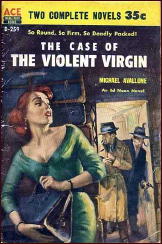
Story Merchant Client Michael Avallone's The Case of the Violent Virgin Available on Amazon Kindle!


purchase on Amazon.com

Check out this Vintage Review From 1001 Midnights ...


MIKE AVALLONEMICHAEL AVALLONE – The Case of the Violent Virgin. Bound back-to-back with The Case of the Bouncing Betty. Ace Double Ace D-259, paperback originals, 1957.
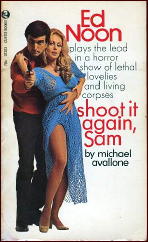
Michael Avallone,  who has dubbed himself “The Fastest Typewriter in the East” and “King of the Paperbacks,” has published more than 200 novels over the past four decades, some thirty of which feature private eye Ed Noon.

 On the one hand, Noon is your standard hard-boiled, wisecracking snoop with a taste for copious bloodletting and a Spillane-type hatred of Communists, dissidents, counterculture types, pacifists, militant blacks, militant women, and anyone or anything else of a liberal or civilized cant.
   On the other hand, he is a distinctly if eccentrically drawn character whose passions include baseball, old movies, and dumb jokes, and who gets himself mixed up with some of the most improbable individuals ever committed to paper.

MIKE AVALLONE The gold-toothed, beret-wearing villain in The Case of the Violent Virgin, for instance-a guy named Dean, who, like Ed Noon, is on the trail of a six-foot marble statue called the Violent Virgin, “The Number One Nude,” not to mention one of the world’s most precious stones, the “Blue Green.”
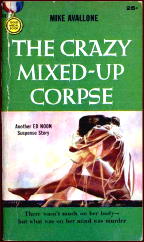
Dean is a very well-spoken fellow; at one point in the narrative, he says to Noon, “Your precipitous exodus from serene sanctuary propels me toward Brobdingnagian measures. Spider and I mourn for your misdemeanors but your palpitating perignations [sic] induce no termination of our grief.”
Spider, who is Dean’s accomplice in crime, is not nearly so well spoken; he says things like “Okay, Dad. Make the parley with them. But fast. This choo-choo could get too hot for us.”

The “choo-choo” he is referring to is the Mainliner, which travels from New York’s Grand Central Station to Chicago. Noon is on it because he has been hired to bodyguard a woman named Opal Trace (who doesn’t speak her words, she “carols” and “musicales” them).

And what a train ride it is, chockablock full of a mixed-up mish-mash of double-dealing, multiple murder, vicious dogs, shootouts, a bomb explosion, and, to cap things off, a rousing derailment. None of it makes much sense — but then, one doesn’t read Avallone looking for sense.

MIKE AVALLONE What one does read Avallone for, primarily, is his lurid, bizarre, and often hilarious prose style. Noonisms — as his better similes, metaphors, and descriptive passages have come to be called — abound in The Case of the Violent Virgin; there are more to the chapter, in fact, than in just about any other Ed Noon adventure.

A sample: “Her hips were beautifully arched and her breasts were like proud flags waving triumphantly. She carried them high and mighty.” And: “I flung a quick glance through the soot-stained windows. A mountain range and a dark night sky peppered with salty-looking stars winked at me.”

Similar “palpitating perignations” can be found in such other Avallone spectaculars as The Tall Dolores (1953); The Voodoo Murders (1957); The Crazy Mixed-Up Corpse (1957); Meanwhile Back at the Morgue (1960), in which you will find the immortal line “The next day dawned bright and clear on my empty stomach”; and Shoot It Again, Sam! (1972).
         ———


 Posted by Steve under 1001 Midnights , Reviews

Reprinted with permission from 1001 Midnights, edited by Bill Pronzini & Marcia Muller and published by The Battered Silicon Dispatch Box, 2007.   Copyright © 1986, 2007 by the Pronzini-Muller Family Trust.

The Cast and Crew of ‘Writers


Greg Kinnear, Nat Wolff, director Josh Boone and producer Judy Cairo stopped by our THR lounge to discuss their new drama. The script follows these multi-general lines, the high school element, the college element and all of them just resonated with me in a way that felt very truthful and I had never gotten to play an author before. Novelist.. I liked the sound of that” added Greg. 


Video by: R. Laski, P. Teyssier-Verger, J. Laski, C. Smith, J. Kooistra, C. Austin, O. Pratten, S. Wilson, G. Kilday, M. Lizaso, N. Ali

Story Merchant Client Royce Buckingham's Review of Demonkeeper Picked by Seattle PI

Book Review: Demonkeeper by Royce Buckingham

Nathaniel Grimlock is a demon keeper, taken in as a young boy to become an apprentice to master Demon Keeper Dhaliwahl. Now Dhaliwahl is gone, and Nat has been left behind to look after a household of demons and to keep the demon world in order. The only problem is that Nat's only non-demon companion is a sheep dog called Bel, and Nat has to admit that he is lonely. What could possibly be the harm in meeting other young people his age, in perhaps getting a girlfriend?

What could be the harm, indeed? In Royce Buckingham's Demonkeeper, demons are all around us. They are the manifestations of chaos in our universe and can range from the playful and mischievous to the outright malevolent. When Nat ventures out and meets junior librarian's assistant Sandy, he also catches the attention of two neighbourhood boys who break into the house and release The Beast, one of the nastiest demons of all. Can Nat restore order and keep the girl, and most importantly, can he do it before the Thin Man catches up with him?

Demonkeeper is a short novel aimed at children aged 10 and up. It is laugh-out-loud funny in places, and my favourite part of the book was when Nat accidentally microwaved one of his demon minions (it exploded but don't worry, the demon survived).

Nat is a fabulous character with a dry wit and self-deprecating sense of humour. Most of all, he is a strong character with an enormous responsibility on his shoulders who grows from reluctant and clumsy to heroic and competent. I liked the idea of his three demon minions as well as the Thin Man's minions.

Most of all, Demonkeeper is a cautionary tale and I really enjoyed The Beast's raison d'etre and the notion of lost children and the adults they become.

Demonkeeper is the perfect book for reluctant readers and should appeal to both boys and girls. It is fun, exciting and original and I am pleased to see that it is the first in a trilogy.

I give Demonkeeper four out of five stars and will certainly continue to read this trilogy.


Purchase Royce Buckingham's Demonkeeper at Amazon.com.
View the original article on blogcritics.org


Fran Lewis Reviews Story Merchant Client Larry D. Thompson's Dead Peasants

Look for Larry on Fran Lewis' Book Discussion on BlogTalk radio October 18th


Click to order


... Dead Peasants is a legal/ murder thriller that will keep you on edge from start to finish until you come to the surprise and shocking conclusion. Once again Larry D. Thompson has penned a five star novel that far surpasses other legal/mystery thrillers. Jack Bryant is a solid character who with the help of our esteemed author will enlighten readers as to why you need to be careful when working for any company: Dead Peasant Polices: You don’t want one taken out on your life!


Mrs. Kennedy and Me Featured in Santa Barbara News-Press

Bodyguard for Mrs. Kennedy - "Mrs. Kennedy and Me"  Tells about his work protecting the first lady. 
 
Click Below to View Full Article.