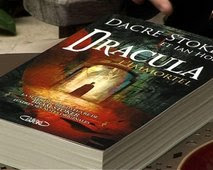
Dacre Stoker, der Nachfahre des Dracula-Autors Bram Stoker, holt den Ober-Vampir zurück. Im FR-Interview spricht er über den Hype und die Auferstehung des "wahren Draculas".
Mr. Stoker, Sie sind der Urgroßneffe von Bram Stoker, dem "Dracula"-Autor. Mussten Sie sich aufgrund dieser Verwandtschaft in der Schule oft Witze anhören?
Oh, ja. Vor allem an Halloween hieß es immer: "Huhu, wer traut sich in das Haus der Stokers?" Aber alle kannten Dracula nur aus Filmen. Keiner hatte das Buch von Bram Stoker gelesen. Ich habe es selbst erst im College gelesen für eine Arbeit über seine Motive, den Roman zu schreiben. Click Here to read more ...
Monday, 19 October 2009 "When people think of Dracula they think of handsome Bela Lugosi," said Holt, a gothic type wearing a T-shirt featuring the 1920s Hungarian actor heart-throb who starred in the first Broadway play based on Stoker's book, as well as the subsequent 1931 movie.
"Dracula was nothing like that. He was old and hunched over, had hair on his palms, and bad breath," Holt told AFP in an interview.
"He was out of the grave, he smelt like death," added Stoker. "We're going back to the original characters."
It was Holt -- whose passion for the theme stems from Francis Ford Coppola's 1992 "Dracula" movie -- who initially came up with the idea of a sequel to the Irish writer's 19th century work.
In search of data, he stalked descendants of the historical Transylvanian-born Vlad III Dracula of Wallachia, better known as "Vlad The Impaler", toured Europe on the vampire's tracks, met with scholars, and joined the Transylvanian Society of Dracula.
In 2003, he said, he came up with the idea of getting backing for a sequel novel from the Stoker family, who had lost the copyright early in the 20th century.
And Dacre, one of a score of close family scattered across Britain, Ireland, Canada and the United States, signed on. "He had Bram's genes and the name," said Holt.
From then on, the two worked together, studying notes left for the original work by Bram Stoker, writing the plot and building characters.
"We go back to the original but we don't leave it at that," Stoker said.
The sequel is set in 1912, 25 years after the finale of the first epistolary novel, as a series of chilling murders in London and Paris triggers a vampire hunt across Europe and unleashes terror of "the prince of darkness."
After careful analysis of 19th century notes left by Stoker, a theatre director who minutely researched background for the original novel, the two revived one of the old characters and added in a few, including a Scotland Yard detective and a lesbian vampire countess.
More significantly perhaps, Dacre Stoker also opted to throw his ancestor into the novel.
Why create a Bram Stoker character? "He was misunderstood, mysterious, no one knows why he wrote Dracula," the great-grandnewphew said. "He died without knowing the success of his iconic character. His life was a struggle."
Talks are under way to produce a movie version of the book, though the authors refused to say who with.
But if they have their say then Johnny Depp could play Dracula and Catherine Zeta-Jones star as the blood-sucking lesbian countess.
"When people think of Dracula they think of handsome Bela Lugosi," said Holt, a gothic type wearing a T-shirt featuring the 1920s Hungarian actor heart-throb who starred in the first Broadway play based on Stoker's book, as well as the subsequent 1931 movie.
"Dracula was nothing like that. He was old and hunched over, had hair on his palms, and bad breath," Holt told AFP in an interview.
"He was out of the grave, he smelt like death," added Stoker. "We're going back to the original characters."
It was Holt -- whose passion for the theme stems from Francis Ford Coppola's 1992 "Dracula" movie -- who initially came up with the idea of a sequel to the Irish writer's 19th century work.
In search of data, he stalked descendants of the historical Transylvanian-born Vlad III Dracula of Wallachia, better known as "Vlad The Impaler", toured Europe on the vampire's tracks, met with scholars, and joined the Transylvanian Society of Dracula.
In 2003, he said, he came up with the idea of getting backing for a sequel novel from the Stoker family, who had lost the copyright early in the 20th century.
And Dacre, one of a score of close family scattered across Britain, Ireland, Canada and the United States, signed on. "He had Bram's genes and the name," said Holt.
From then on, the two worked together, studying notes left for the original work by Bram Stoker, writing the plot and building characters.
"We go back to the original but we don't leave it at that," Stoker said.
The sequel is set in 1912, 25 years after the finale of the first epistolary novel, as a series of chilling murders in London and Paris triggers a vampire hunt across Europe and unleashes terror of "the prince of darkness."
After careful analysis of 19th century notes left by Stoker, a theatre director who minutely researched background for the original novel, the two revived one of the old characters and added in a few, including a Scotland Yard detective and a lesbian vampire countess.
More significantly perhaps, Dacre Stoker also opted to throw his ancestor into the novel.
Why create a Bram Stoker character? "He was misunderstood, mysterious, no one knows why he wrote Dracula," the great-grandnewphew said. "He died without knowing the success of his iconic character. His life was a struggle."
Talks are under way to produce a movie version of the book, though the authors refused to say who with.
But if they have their say then Johnny Depp could play Dracula and Catherine Zeta-Jones star as the blood-sucking lesbian countess. Visit the Dracula the Un-Dead website.
Bram Stoker's own blood runs through the veins of a sequel to his 1897 novel "Dracula," which goes on worldwide release this month, in a work penned by his great-grandnephew who is hoping to revive the original vampire myth.
Copyright 2009 Reed Business Information, US, a division of Reed Elsevier Inc.
All Rights Reserved
Library Journal Reviews
September 1, 2009
Dracula the Un-Dead
BYLINE: Patricia Altner
SECTION: REVIEWS; Fiction; Pg. 109
LENGTH: 223 words
Stoker, Dacre & Ian Holt. Dracula the Un-Dead. Dutton. Oct. 2009. c.416p. ISBN 978-0-525-95129-2 . $26.95. F
This sequel to Bram Stroker's Dracula (1897) takes place in 1912, 25 years after the events of the first novel. The survivors of the encounter with Dracula are still haunted by the horror. Mina and Jonathan Harker's marriage is strained. Their adult son Quincy knows nothing of Dracula, and his parents hope-in vain, as it turns out-to keep him ignorant of past events. Jack Seward barely sustains his sanity with heroin. Arthur Holmwood hides in his manor, while an aged Dr. Van Helsing impatiently awaits the vampire's return. A demonic force begins insinuating itself into their lives. Death stalks them and those close to them. Meanwhile, Bram Stoker remains a bitter author who has had little success with his fictional version of Dracula. How he knew anything about the events of years ago is one of many mysteries explored here. VERDICT The authors (Stoker is a descendant of Bram, and Holt is a noted Dracula historian) skillfully explore the nature of evil while weaving together several complex plotlines throughout this mesmerizing story. Readers who enjoy dark fantasy with fast-paced action will plow through this book, not wanting to stop. [See Prepub Alert, LJ 6/1/09.]-Patricia Altner, BiblioInfo.com, Columbia, MD
Dracula: The Un-Dead Dacre Stoker and Ian Holt Dutton,Oct 2009, $26.95 ISBN 9780525951292
Twenty-five years has passed since the horrific events of 1897 ended with Dracula turning into dust; none involved have moved on as each remains haunted by the encounter with the Count. Mina and Jonathon married, but neither obtained closure when the vampire was killed; stressed and estrnaged, they conceal from their son Quincey what happened. Seward survives with heroin while Holmwood became a hermit. Their mentor Van Helsing obsessively lives for the return of Dracula as the vampire’s death was his life’s goal so he has nothing else. Scotland Yard believes Van Helsing was involved in the unsolved Ripper murders.
In 1912, Stoker is frustrated as he struggles to convert his horror thriller Dracula to the London stage. However, although the author knows the full truth, he and the others except perhaps the ever vigilant Van Helsing are unprepared for a gruesome serial killer horrifying London. Scotland yard once again believes a fanatic Van Helsing is deeply connected to the killings, but too old to perform them. Those involved with what happened back then find themsleves and their loved ones under siege as if Van Helsing’s belief the Count will return from the dust has occurred. The survivors of the previous encounter regroup to battle evil again although they are unsure who stalks them.
This is a super vampire thriller that brings forward the stars of Dracula into the Edwardian Era with a where are they now tale. The clever story line is fast-paced while introducing the audience to the survivors of the previous horrific encounter to include Bram Stoker. Dacre Stoker and Ian Holt explore the essence of evil and good through a cast of humans who have used psychological defense mechanisms to barely survive and a vampire who may or may not be Dracula, but has the same attitude re the food chain as well as a thirst for the blood of vengeance. Filled with terrific twists fans of Dracula and those who appreciate a strong historical urban fantasy will relish the THE UN-DEAD.
Stoker, Dacre & Ian HoltDRACULA: The Un-DeadBram’s great-grandnephew teams up with Dracula buff Holt to reclaim vampire lit from the unholy, unlettered legions churning out today’s fang-and-cloak stuff.This big, blood-filled kitchen sink of a debut boasts a vast cast of characters: Bram Stoker himself, as well as his nefarious Count, Jack the Ripper, Jonathan Harker, Dr. Van Helsing, Oscar Wilde, “blood Countess” Elizabeth Bathory, a mysterious Eastern European actor and a whole bunch of extremely hot (but also extremely cold, being dead and all) vampire chicks of uncertain gender preference. Bathory is definitely the heavy of the story, and it seems she’s spoiling to outdo the number of grisly murders she is said to have committed in life, aided by a coterie of spidery bloodsucking assistants. As befits a multigenerational saga that springs from a book that had few survivors, some familiar characters are on the other side of the live/dead line, and some—well, some are indeed in the undead camp. There’s lots of good old-fashioned polymorphously perverse degenerate romping (“Every orifice in her body became his plaything”). Stoker and Holt are careful not to go too far afield from the conventions of the original; Van Helsing, for instance, comes armed with “crosses, wafers, holy water, a wooden stake, a Bowie knife, and a crossbow armed and ready to fire,” rather than some postmodern substitute for all that good wood and metal. Yet this competently (but no more than competently) written sequel—endorsed by the Stoker family, the publisher assures—has plenty of contemporary twists, including a weird Darth Vaderish turn at the end that some Bram-faithful readers may find magnificently silly.Flies and spiders, master! Big, messy, lots of fun—and not Stephenie Meyer.
“Unclean, unclean!” Mina Harker screams, gathering her bloodied nightgown around her. In Chapter 21 of Bram Stoker’s “Dracula,” Mina’s friend John Seward, a psychiatrist in Purfleet, near London, tells how he and a colleague, warned that Mina might be in danger, broke into her bedroom one night and found her kneeling on the edge of her bed. Bending over her was a tall figure, dressed in black. “His right hand gripped her by the back of the neck, forcing her face down on his bosom. Her white nightdress was smeared with blood, and a thin stream trickled down the man’s bare breast which was shown by his torn-open dress. The attitude of the two had a terrible resemblance to a child forcing a kitten’s nose into a saucer of milk to compel it to drink.” Mina’s husband, Jonathan, hypnotized by the intruder, lay on the bed, unconscious, a few inches from the scene of his wife’s violation.
Later, between sobs, Mina Mina relates what happened. She was in bed with Jonathan when a strange mist crept into the room. Soon, it congealed into the figure of a man—Count Dracula. “With a mocking smile, he placed one hand upon my shoulder and, holding me tight, bared my throat with the other, saying as he did so: ‘First, a little refreshment to reward my exertions . . .’ And oh, my God, my God, pity me! He placed his reeking lips upon my throat!” The Count took a long drink. Then he drew back, and spoke sweet words to Mina. “Flesh of my flesh,” he called her, “my bountiful wine-press.” But now he wanted something else. He wanted her in his power from then on. A person who has had his—or, more often, her—blood repeatedly sucked by a vampire turns into a vampire, too, but the conversion can be accomplished more quickly if the victim also sucks the vampire’s blood. And so, Mina says, “he pulled open his shirt, and with his long sharp nails opened a vein in his breast. When the blood began to spurt out, he . . . seized my neck and pressed my mouth to the wound, so that I must either suffocate or swallow some of the—Oh, my God!” The unspeakable happened—she sucked his blood, at his breast—at which point her friends stormed into the room. Dracula vanished, and, Seward relates, Mina uttered “a scream so wild, so ear-piercing, so despairing . . . that it will ring in my ears to my dying day.”
That scene, and Stoker’s whole novel, is still ringing in our ears. Stoker did not invent vampires. If we define them, broadly, as the undead—spirits who rise, embodied, from their graves to torment the living—they have been part of human imagining since ancient times. Eventually, vampire superstition became concentrated in Eastern Europe. (It survives there today. In 2007, a Serbian named Miroslav Milosevic—no relation—drove a stake into the grave of Slobodan Milosevic.) It was presumably in Eastern Europe that people worked out what became the standard methods for eliminating a vampire: you drive a wooden stake through his heart, or cut off his head, or burn him—or, to be on the safe side, all three. In the late seventeenth and early eighteenth centuries, there were outbreaks of vampire hysteria in Western Europe; numerous stakings were reported in Germany. By 1734, the word “vampire” had entered the English language.In those days, vampires were grotesque creatures. Often, they were pictured as bloated and purple-faced (from drinking blood); they had long talons and smelled terrible—a description probably based on the appearance of corpses whose tombs had been opened by worried villagers. These early undead did not necessarily draw blood. Often, they just did regular mischief—stole firewood, scared horses. (Sometimes, they helped with the housework.) Their origins, too, were often quaint. Matthew Beresford, in his recent book “From Demons to Dracula: The Creation of the Modern Vampire Myth” (University of Chicago; $24.95), records a Serbian Gypsy belief that pumpkins, if kept for more than ten days, may cross over: “The gathered pumpkins stir all by themselves and make a sound like ‘brrl, brrl, brrl!’ and begin to shake themselves.” Then they become vampires. This was not yet the suave, opera-cloaked fellow of our modern mythology. That figure emerged in the early nineteenth century, a child of the Romantic movement.
A new Dracula novel, co-authored by the fragrantly named Dacre Stoker (a great-grandnephew of Bram), will be published in October by Dutton. The movie rights have already been sold.
Taiwan rights to Dacre Stoker & Ian Holt’s Dracula: The Un-Dead, sequel to Dracula authorized by the Bram Stoker family to As If Publishing by Baror International for Atchity Entertainment International. kja@aeionline.com