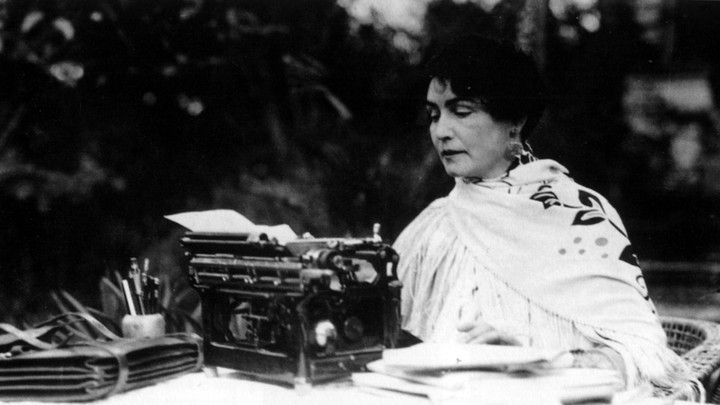
Female writers, directors, and producers were pioneers of the silent-film era—but were pushed out of the industry as its influence grew.
Lois Weber, a prolific screenwriter and director, was the first woman to establish her own film studio.HULTON ARCHIVE / GETTY
Given the dearth of women among this year’s Oscar nominees for writing and directing, not to mention behind the camera in Hollywood at all, you may be surprised to learn that before 1925, during the silent film era, women wrote the outlines for roughly half of all films. In fact, a great many women were behind the camera in those days—producing and directing films, and running studios. Women also pioneered much of the film technology that still exists today—only to be pushed out of the burgeoning industry once its influence and moneymaking potential had become more widely recognized. When the writer and satirist Dorothy Parker and her writer husband, Alan Campbell, moved to Hollywood and signed contracts with Paramount, she was paid four times as much as he was. Frances Marion, who would go on to become the founding vice president of the Screen Writers Guild, was the country’s highest-paid screenwriter in the 1920s and ’30s; more than 100 of her scripts were made into films, and in 1930, she became the first woman to win an Oscar for writing. Lois Weber, a prolific screenwriter and director, in 1917 became the first woman to establish and run her own film studio. The year before, her wage as a director was the highest in Hollywood. Read more
At this year’s Sundance Film Festival, the annual event broke some of its own barriers, doling out each of its four directing awards to female filmmakers. For the first time in the festival’s 34-year history, directing prizes went only to women, spanning all four major categories — narrative and documentary, U.S. and world cinema: Sara Colangelo (“The Kindergarten Teacher”), Alexandria Bombach (“On Her Shoulders”), Sandi Tan (“Shirkers”), and Isold Uggadottir (“And Breathe Normally”). The festival’s juries also awarded Desiree Akhavan’s “The Miseducation of Cameron Post” the Grand Jury Prize, the festival’s highest honor; Sundance’s sole dedicated screenplay honor, the Waldo Salt Screenwriting Award, went to Christina Choe for “Nancy.”
In short, it was a big festival for women. But what does winning an award at Sundance actually mean for female filmmakers? How does it impact future projects? Does it guarantee further success in the industry? None of those questions have an easy answer.
The festival only started giving out dedicated directing awards in 1998 – before that, any prize that singled out a filmmaker fell under the banner of “special jury prize” – and even then, they were simply divided up into “dramatic” and “documentary” sections, with no differentiation between the world cinema and U.S. slates. Ten years later, the festival began giving out four directing prizes total, one for each competition section.
Prior to 2018, the best showing for women directors was way back in 2008, when they won three of the four prizes. While the U.S. dramatic directing award went to Lance Hammer for “Ballast,” Anna Melikyan and Nino Kirtadze dominated the world cinema front, and documentarian Nanette Burstein won for her U.S. documentary “American Teen.”
Mostly, though, directing prizes for female filmmakers have been limited to about one a year, with a slight uptick taking hold in 2012, when the prizes began to be more evenly split along gender lines. There were some lean years, though, including 2001, 2005, and 2006, when no women won a directing award.
Debra Granik on the set of "Leave No Trace"
In 2010, Debra Granik won both the Grand Jury Prize and the Waldo Salt for her lauded “Winter’s Bone,” even though the dramatic directing award ultimately went to Eric Mendelsohn for “3 Backyards.” Similarly, in 2016, female filmmakers picked up three of the four Grand Jury Prizes, though none of them earned a directing prize to match. Talk about mixed signals.
The female filmmakers who have been honored by Sundance’s jury run the gamut from household names like Ava DuVernay and Jill Soloway to anomalies like Barbara Sonneborn and Tinatin Gurchiani, who have yet to follow up their wins with new projects. There’s no guarantee that winning a Sundance award will catapult a career to new heights, and even for the most recognizable of filmmakers, it wasn’t their Sundance wins that pushed them over the top.
DuVernay and Soloway won directing awards in the U.S. dramatic section in 2012 and 2013, respectively. Both have gone on to huge successes: DuVernay is the first woman of color to direct a $100M+ live-action film, while Soloway’s beloved Amazon series “Transparent” has earned them two Emmys so far. However, it wasn’t their Sundance wins that immediately catapulted them into such huge projects.
DuVernay first made “Selma” before getting the chance to make “A Wrinkle in Time,” while Soloway has said that “Transparent” was partially spawned by audience backlash to “Afternoon Delight.” They didn’t benefit from what Akhavan herself has termed the “Colin Trevorrow moment,” i.e. being a white male director who gets a huge opportunity after screening a well-regarded film at the festival. (While Trevorrow’s Sundance breakout, “Safety Not Guaranteed,” did win a Sundance award, it was for screenwriting and went only to writer Derek Connolly; Trevorrow was later hired to direct “Jurassic World.”)
Another big name that scored her first batch of good buzz at Sundance? Catherine Hardwicke, who won the dramatic directing award for her debut “thirteen” in 2003. Even with that accolade under her belt, Hardwicke didn’t get her first arguably big film until “Twilight,” five years later (she directed a pair of other films before her YA vampire offering, but both had budgets under $30 million).
Karyn Kusama similarly won a directing award for her own debut, “Girlfight,” in 2000, though she didn’t direct another film for five years. Like DuVernay, her career is on a major upswing, but it wasn’t a result of some immediate response to her Sundance win. The same goes for Debra Granik, who won a directing award for her first film, “Down to the Bone,” at Sundance in 2004 and didn’t make another film for six years. That feature, “Winter’s Bone,” served as Jennifer Lawrence’s big breakout and earned a pair of nods for Granik. She returned to the festival this year with her latest, “Leave No Trace.”
Other Sundance winners have struggled to translate their very important wins into new work. The first winner of the documentary directing award, Julia Loktev, eventually turned to narrative films, but has only made two since her “Moment of Impact” won in 1998. Still other winners have yet to make another film, including 1999 doc winner Barbara Sonnenborn, 2013 doc winner Tinatin Gurchiani, and 2017 doc winner Pascale Lamche. And there’s also “Beach Rats” director Eliza Hittman, who won just last year and continues to top lists of female filmmakers to watch, but has not yet locked down an official next project. When she won her prize at Sundance, she said in her acceptance speech: “There is nothing more taboo in this country than a woman with ambition. Hollywood, I’m coming for you.”
It’s in the documentary section that many filmmakers have been able to move beyond their big Sundance wins. Heavy hitters like Lauren Greenfield (who just returned to the festival with her “Generation Wealth”) and Kim Longinotto (the 2015 winner for “Dreamcatcher”) are not only still working, but didn’t necessarily require the attention of the festival to break out. Longinotto, in fact, had made nearly 20 films before Sundance gave her an award.
Rebecca Cammisa – who co-directed the doc winner “Sister Helen” alongside Rob Fruchtman – has worked steadily since her 2002 win, including offerings in both film and television. Similarly, “American Teen” filmmaker Nanette Burstein continues to create in both film and television, narrative and documentary. Andrea Nix, who won for her 2007 doc “War Dance,” is still working in documentary realm. Nino Kirtadze has made three additional documentaries after her 2008 win for “Durakovo: Village of Fools.”
In 2009, both the U.S. and world cinema documentary awards went to women, and “Afghan Star” director Havana Marking has since made two films. Natalia Almada made one more documentary and moved to narrative filmmaking with “8” and “Everything Else.”
There are recent signs of life for narrative directors, too. “52 Tuesdays” director Sophie Hyde is prepping her first narrative after her 2014 win, a big screen take on Emma Jane Unsworth’s novel “Animals.” Another winner in 2014, “20,000 Days on Earth” co-director Sophie Hyde recently moved into narrative television with “Neil Gaiman’s Likely Stories.” Alanté Kavaïté, who wrote and directed 2015 winner “The Summer of Sangaile,” recently wrote the twisty sci-fi noir “Evolution.”
For now, however, there is much work to be done. Sundance may have lauded some of our finest filmmakers – gender notwithstanding – but even walking away from the country’s most important film festival with a shiny award doesn’t guarantee a huge career boost, greater name recognition, or even the ammo for the next project. For so many female filmmakers, that’s a story they already know.
Cady McClain has spent the past year traveling the globe, speaking to female directors of film and television and documenting their stories for her serialized documentary, Seeing is Believing: Women Direct. Interviewees include Sarah Gavron, Lee Grant, Meera Menon, Betty Thomas and other accomplished and award-winning directors, as well as the next generation of women filmmakers who are just out of filmschool and finding their career paths. Not yet ready for release, Seeing is Believing: Women Direct is intended to elucidate the skills and tools needed to succeed as a woman in the directing field, and features women mentoring women by sharing their experiences via filmed interviews. Here, McClain writes about her own filmmaking process, why she’s making this documentary series and what she’s learning from doing so. Read on…
Cady McClain on Making Seeing is Believing: Women Direct, Her Own and Other Women’s Visions, Gender Diversity in Film, and Sharing Skills:
“Today I was watching clips from an interview I did with the filmmaker Nicole Conn and I found myself smiling. One of the great pleasures of this documentary has been getting to know women like Nicole—women who are smart, talented and beautifully unique. Nicole is not categorized as a “mainstream” filmmaker yet, but she is an important one, and in a way she personifies why I am making this documentary series and what I value—she is true to herself. She is true to her vision. She loves old black and white movies, believes in romance, and is a gay woman. Her calling and talent is filmmaking, so she has made three seminal films about passionate relationships between lovers that happen to be female.
“Somehow her films, as wildly successful as they are (and they are WILDLY successful) are still not considered mainstream. So I have to ask myself, what is mainstream? What is it about one narrative (a narrative that is not inclusive of the reality of a very large percentage of the world’s population) that continues to have a hold over what we as a society deem “normal”?
“(Without finger pointing or getting political, I think it is fair to say that it is a mode of storytelling that is on the verge of becoming irrelevant.)
“Why should lesbian cinema be marginalized? Or faith-based films, Black or Latin cinema, Asian cinema, Indian cinema or women’s cinema for that matter? What IS normal in a world full of variation? Why must we categorize everything? How can we even use the expression “mainstream” when the Internet exposes us all to the cultures of the world?
“The process of making this series has exposed me to more kinds of storytelling and people than I thought possible. It has been so fulfilling to watch the art films of German filmmaker Diana Cignoni; the transgender series, HerStory, directed by Sydney Freeland; and the powerful short film And Nothing Happened by Naima Ramos-Chapman that explores the surreal after-life of a rape survivor. I think I’ve become a better person by watching Meera Menon’s first film, Farah Goes Bang, and the films of Lizzie Borden—Working Girls and the incredible Born in Flames. And the documentaries exploring American Indian life by Anne Makepeace are nothing short of breathtaking. These women are visionaries.
I’ve learned that categorizing films into “women’s stories” is actually a neat and tidy way to shame women. I also learned that being a visionary means holding your ground—not letting the words of others push you away from what you “see” in your mind as worthy.
I made this series because I want to give women and girls HOPE, ENCOURAGEMENT and TOOLS. Something they can watch quietly in the middle of the night to hear other women talk about how they work without being judged, talked down to, or lectured at. I want all women who desire to tell a story to feel heard and seen, validated and understood.
In Seeing is Believing: Women Direct, audiences will hear from women who are on the front lines of the field—from major award winners and those in the vanguard of television and feature films, to graduated students and frustrated auteurs. Considering all aspects of the directing experience for women, we will learn how they drive through obstacles creative, cultural and professional. The film is also intended to serve as “peer to peer mentorship” for anyone (of any gender) looking for guidance and real world experience as they pursue their dreams of becoming a visual storyteller. — Cady McClain