"The universe is made of stories, not of atoms."
—Muriel Rukeyser
____________________________
Showing posts with label ebooks. Show all posts

Survey: Most people prefer reading paper books over digital books on tablets, phones


LONDON — Digital books on tablets, smartphones, and devices like Amazon’s Kindle are certainly convenient, but according to a new survey most people still prefer a good old fashioned paper book. There’s just something satisfying about turning the page and holding a physical book in one’s hands, as over two-thirds of adults say they always opt for a real book over digital reading.

Put together by Oxfam, researcher polled 2,000 respondents in the United Kingdom regarding their thoughts on paper books versus digital books. Close to half (46%) enjoy physically turning pages and 42 percent prefer the feel of a physical book in their hands. One in four say they love the smell of paper books. Meanwhile, another 32 percent feel like they become much more immersed in the story while reading a paper book and 16 percent go for traditional books because they remind them of libraries.

The look and feel of books is still special

Interestingly, over a third of respondents (35%) enjoy buying paper books because that allows them to proudly display them on their bookshelf as a background during Zoom meetings.

All in all, only 16 percent of adults prefer digital books and a meager eight percent who favor audio books. On average, the survey finds most adults own 49 books and read for three hours per week. 


"People prefer to read physical books because they offer something more tangible and grounded. There’s something that can feel more “permanent” about real books over digital formats,” says Dr. Elena Touroni, a consultant psychologist and co-founder of The Chelsea Psychology Clinic, in a statement. “Reading offers us a form of escapism. It provides us with a break from our everyday lives, and often also, an opportunity to learn something new and expand our minds.”

What’s old is new again

Over half the poll (58%) read to relax, while 46 percent usually read as a break from the real world. More than three in 10 like to read as a means of learning something new and 39 percent read to feel happier. Close to half (45%) have been reading more ever since COVID lockdowns began. Moving past the pandemic, 84 percent plan to take a few books with them on vacation this year.

Three-quarters say they’re considering donating books they’ve finished and 72 percent usually buy used books themselves. Moreover, this research suggests that books are the top item most adults are willing to buy used. Seventy-one percent say they buy used books because it is cheaper and 52 percent do it because it is better for the environment.

Nearly one in five (18%) just like the smell of used books, while another 18 percent like the texture of a second-hand book. Fifteen percent of respondents just love the idea that they might find a note or letter written inside a used book. Nearly one in two people (45%) like to ponder where their old books have been before landing in their hands. Generally speaking, 49 percent of adults often buy second-hand items, with goods such as books, clothes, CDs, DVDs, and cars topping the list. Six in 10 adults believe buying used items is just as good as buying new.

The survey was conducted by OnePoll.

Self-Publishing: Expectations vs Reality For New Authors


Self-publishing is a great opportunity – if you have a head for business

Are you dreaming of becoming the next bestselling author?

For anyone who writes, it is natural to want your hard work to reap the rewards you believe it deserves.

Self-publishing today gives all authors the chance to publish for (almost) free and to have a book on sale on Amazon and many other online book retailers.

If you use Amazon’s publishing service, Kindle Direct Publishing (KDP), you can publish an ebook, and it will be on sale in around 24 hours.


For a paperback version of a book using print on demand, it takes only a few days.

In the days before self-publishing, the publishing process for a traditional publisher very often took a year or more. It has not changed a great deal for large publishers today.

It is a long road to take to get a book published the traditional way. You need first to find a literary agent to represent you, which is no easy task.

Then if you are lucky enough to find one, it can take months for your agent to secure a publishing contract for you. If you are one of the fortunate authors who manage to get this far, it is then a wait of another year before your book is released.

After that, you cross your fingers and hope your book sells well. Otherwise, the chances of another contract are slim.

However, if you self-publish, you skip all the waiting and jump immediately to crossing your fingers.

So much has changed, but the publishing industry stays the same. It is about hoping that readers will buy your book.


The expectations of publishing a book



I started publishing in 2005 with Createspace. The following four years were marvellous for me for with my print books selling well enough to get a nice check every month.

Then came the ebook.

When I self-published my first ebook in 2011, there were fewer than 800,000 Kindle ebooks on Amazon. Fast forward to today, and it is over 7 million.

Did you know that a new Kindle ebook is now published on average every 3 minutes?

You do not need to be a statistician to calculate that while the number of ebook titles has risen dramatically, the number of book buyers has not increased proportionally.

In simple terms, for a digital book, it is a highly competitive market.

On top of that, Kindle Unlimited has turned all the publishing rules on its head. No longer do you sell a book. You sell page reads. For authors and publishing companies alike, it is a considerable challenge.

Many new authors leap into publishing an ebook on Amazon with the expectation that because their book is for sale, it will sell.

Nothing could be further from the truth. The hard facts are that very few titles sell well, and most struggle to sell more than a handful of copies per year. Mostly to friends and family.

The biggest problem is that many newly published authors do zero market research before a book launch.

If you want to sell anything, you have to know what your market is and how you are going to attract people to buy your product.

Smart indie authors know this and have a clear idea of their genre and what market potential there is for their writing.

For example, there is a massive market for contemporary romance, but only a tiny market for gardening or rose care books. However, a small market segment is less competitive.

Balancing competitivity and volume is how you understand your potential market share. Do you want a tiny proportion of the highly competitive romance market, or to dominate the less competitive rose care genre?

For new independent authors, do not let your expectation cloud the reality. Selling books in today’s market is very hard unless you are an expert in book marketing and know who your potential book buyers are and how you can connect with them.

Putting your book up for sale is one thing. Selling a lot of copies is another reality altogether.


The realities of making it with self-published books



The first reality is to understand that vanity presses will never help you succeed.

I hear from so many authors who had wild dreams, were told mistruths and paid an awful lot of money to publish their book. And all for nothing.

Vanity publishing is definitely not self-publishing. Paying a vanity publishing company to sell books to you is not a recipe for success. Do not fall for the trap.

You can only succeed if you can sell books to readers. And you can.

Here is a short extract from the 2018 Author Earnings Report.

“Despite the prevalent indie doom-and-gloom rumours, today’s top sellers are handily making as much or more than the top-selling indies from prior years were.

But here’s the kicker. A lot of today’s top-selling indies are relatively new names. We didn’t recognize a lot of them. And a lot of yesteryear’s pioneering indie superstars no longer even make the Top 50.”

A look at ebook sales for 2017 tells an optimistic story for indie-publishing authors.
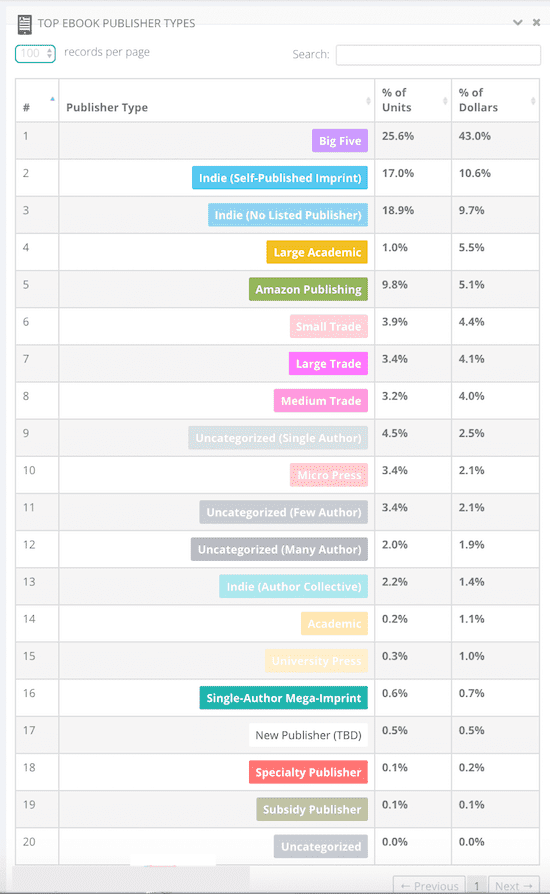


Combined Indie author ebook sales of imprint, not listed and collective amount to over 37% of the market. A full 12% higher than the Big Five publishers.

There is no doubt that readers do buy self-published titles and far more than traditionally published titles.

But do not expect to be part of this success if you think that everyone in the world is going to want to buy your book about rose care, or even romance.

You have to know your specific genre, the demographics and interests of your potential readers, and most importantly, how to get them to find your book.

You might have a fantastic book title, a brilliant professionally designed book cover and had the interior of your book formatted by a book designer.

But unless the story or subject of your book is what readers really want to read, your book can still fail.

Book buyers are fickle, so you need to give them a compelling reason to buy your book.


Learning about how people find books they want to buy



Understanding how and why people buy books is your first step towards being a successful indie publisher.

Yes, you need a great story, a brilliant book description and a killer cover design.

You need to be a little tech savvy and know how to exploit social media and attract attention via your blog with good use of SEO.

Most of all though, you need to know how to leverage categories and keywords for your books.

Getting your book into the right place for readers of your genre to find is more powerful than any other form of book marketing.


The new breed of successful Indie authors are quietly and studiously using data to help readers find their books on Amazon and other retailers. It is an electronic form of getting your book on a shelf at the front of a bookstore.

The expectation vs reality equation is now that you can only expect to gain regular book sales if you understand the reality of the necessity to use data.

Learning how to access and leverage Amazon book sales data especially is now key to succeeding in the online book market.

To use the example I mention before of the difference in the market for contemporary romance and rose care, here is some hard data.
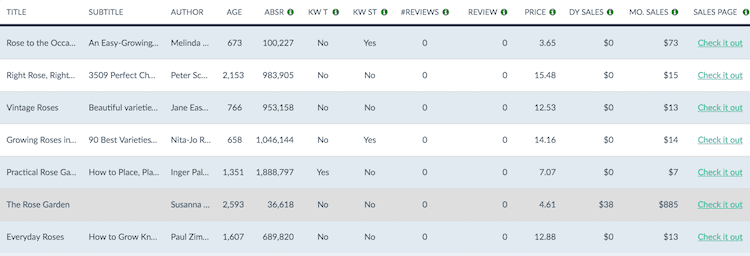

Amazon sales data for books related to rose gardening. Data source KDP Rocket

In line six, the book, The Rose Garden, is fiction, so it needs to be ignored. But you can see that the monthly sales for books related to rose care and rose gardening is very small. The best selling book is making $73.00 per month.

Now let’s looks at contemporary romance.
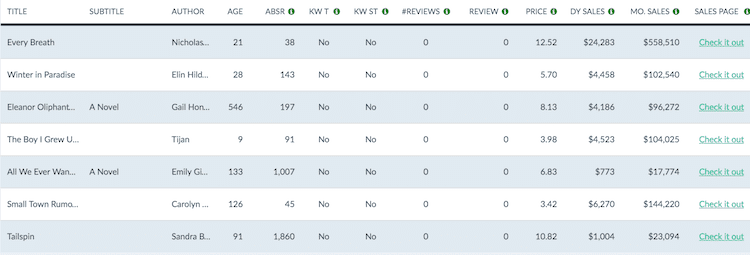

Amazon sales data for books related to contemporary romance. Data source KDP Rocket

What a difference! Yes, your eyes aren’t deceiving you. In 21 days, Every Breath has made sales of over half a million dollars.

When you can access data as I have illustrated above, you can drill down to find your niche market and find keywords and categories to make your book as competitive as possible.

This is the future of independent publishing. Using data to position your book where readers can find it, and buy it.

In SEO, there is an expression that if your page ranks on page one of Google Search, you get traffic. If it is listed on page two, it is in the cemetery.

The same applies to books on Amazon. If you book appears on the first page when a book buyer searches for a new book, you will make book sales. If it appears on page two, you won’t.


The future success stories of indie publishing

Book buyers are over discriminating between traditional published and self-published books and ebooks. They just buy books they want to read.

In the past, the best advice to new authors was to have a fantastic book cover, a great book description to hook readers and to have a book properly edited.

But today, that is now not going to be enough to succeed.


The path to success today and in the future will be to learn how to market a book to an electronic online market.

Using data research to find your market niche and to better position your title so buyers see it will be more important than your book cover and description.

That is why the Author Earnings Report I mentioned earlier stated that today’s top-selling indies are relatively new names.

They are the new authors who know the power of data, and how to use it.

The E-book as a Starting Point to Print Publishing? - article

Image result for e publishing vs. traditional images


Many authors see an e-book as a starting place for their publishing dreams. Their ultimate goal is to publish their book as a print book. This is certainly possible, as illustrated by the story of Amanda Hocking’s self-published e-books that caught fire through the following she built through her platform of networked blogs. Her efforts ultimately led to sales of over a million dollars and then to a traditional publishing contract.

Other authors have also found their way from e-book to print success. Author Victorine E. Lieske e-published and found her way onto the New York Times Best Sellers list with her suspense romances. She now offers paperback covers of her novels on her website. Yet another success story is Aaron Patterson’s. He achieved a No. 1 Amazon Kindle Best Selling Book status with his e-Book and now also sells print books. For more success e-book stories, check out Novlr , a website dedicated to reading, writing, and Internet fiction. Generally, successful e-Book authors redistribute with indie-published print books.

Heady stuff, but don’t go crazy with excitement because only relatively few authors are achieving this kind of success. Proceed with the idea that you might succeed if you work hard, your content is excellent, and you educate yourself. There are a myriad of print-on-demand publishing (POD) options available to successful e-book authors.  Be aware that print options continue to evolve. Author Solutions has partnered with several traditional publishing companies to provide a hybrid-platform for self-published authors.

Finally, no one can guarantee that your book will be a hit. All publishing is a risk. The beauty of e-publishing is you have a chance to test the waters before trying paper copies. The low production costs and the ability to test the popularity of a book in the market helps self-published authors make informed decisions. Research the success stories. If your e-books achieve significant sales, educating yourself will put you a step ahead of the competition, if you should later decide to print books.

Read more

Molly Blaisdell
by Molly Blaisdell

Book News: Apple Enters A New Round In E-Book Price-Fixing Fight


In its attempt to obtain a foothold in a market long dominated by Amazon, Apple ran afoul of antitrust law.

Apple is sliding back under the judicial microscope Monday in a legal challenge that could bear big implications for the e-book market. The 2nd U.S. Circuit Court of Appeals is slated to hear the company's appeal of a verdict that found it guilty of violating antitrust law.

Last year, a federal judge ruled that Apple had knowingly facilitated a price-fixing conspiracy with the five major publishing companies: Hachette, HarperCollins, Macmillan, Penguin and Simon & Schuster. In a bid to pressure Amazon — then and now a goliath of the e-book market — Apple and these publishers had agreed to set the price of e-books higher than Amazon's preferred price. The judge denounced these agreements as collusion, rendering her verdict in no uncertain terms.

 "The evidence is overwhelming that Apple knew of the unlawful aims of the conspiracy," U.S. District Judge Denise Cote wrote in her opinion. To believe Apple's case, she continued, "a fact-finder would be confronted with the herculean task of explaining away reams of documents and blinking at the obvious."

While the publishers settled their side of the case early on, Apple has vowed repeatedly to keep fighting. The latest round is expected to help clarify the legal line drawn between friendly business agreements and outright collusion.

As Philip Elmer-DeWitt notes in Fortune:

    "When the Department of Justice charged Apple with conspiring to fix the price of e-books, the case was widely seen in both Silicon Valley and New York publishing circles as an error of enforcement.

    "Why was Apple, a giant in its own right but a new entrant in the e-book market, being prosecuted and not that other giant, Amazon? ...

    "But when District Judge Denise Cote sided with the DOJ and ruled that Apple had violated the Sherman Antitrust Act, what had been a question of enforcement became a question of law."

Although Monday's hearing is expected to last about an hour, a ruling won't be rendered for several months more. And Elmer-De Witt says a verdict against Apple could very well mean this case is headed to the Supreme Court.

Read more


Romancing the ebook: A conversation with Book Riot’s Jessica Tripler by Len Edgerly


J Tripler

It turns out some of the first and most fervent adopters of ebooks still read more digital books than any anyone else.

Those readers are fans of the romance genre, and in this week’s Kindle Chronicles interview I gained new appreciation and respect for romance by talking with Jessica Tripler, who covers romance novels and other topics as a Book Riot contributor.

Tripler reads four to six romances a month, along with two or three novels in other genres. Married and the mother of two boys, she is a professor of philosophy at a university in Maine, as well as a clinical ethicist.

Romance is a $1 billion industry that accounts for more than 262 million titles sold each year in the U.S., Tripler told me. She described the genre as domestic novels that can be “very insightful when it comes to human psychology, in particular the psychology of desire, of love, of human relationships, of ethics.”
“I would stand romance writing against any other genres,” Tripler said. “Like other genres, you can have a terrific example of the genre and a terrible one. That goes for literary fiction—some literary fiction is just a real failure.”
What you won’t find in romance novels, according to a definition Tripler shared from Romance Writers of America, are pessimistic and emotionally unsatisfying endings. In a romance, you will root for the hero and heroine (or hero and hero, or heroine and heroine), whose love relationship will be central to the plot, which ends on an optimistic and emotionally satisfying note, she said.

Eighty-nine percent of all romance sales are digital, Data Guy of AuthorEarnings reported at the Romance Writers of America annual meeting last month. Tripler on August 11 wrote a BookRiot post suggesting the reasons for that dominance of the genre by e-books.

Among the factors she listed, the desire for privacy is important for some romance readers, Tripler wrote, but in the podcast interview she said that is not a big concern for seasoned romance fans.

“Maybe for the person that picks up one romance a year in an airport,” she suggested, “but most people who read it regularly don’t really care who sees them reading it.”

That’s not to say that privacy concerns don’t ever lead to a preference for digital reading, Tripler said, especially for edgy, more erotic romances which can be inappropriate for children or invite unwanted attention in public.
Other factors in the lives of busy, multi-tasking women, Tripler said, are price, portability, convenience, and the ability to hold so many books on an e-reader at once.

“One piece that gets under-emphasized in these discussions,” she added, “is that women who adopted digital reading early on were tech savvy. They were online. They were participating in discussion groups and felt very comfortable with that technology. And they had money.”

“Romance readers do quite well in terms of income and education, and they often tend to be partnered up, which usually helps with income,” Tripler said, “so they had the tech savvy and the money to go ahead and buy the Kindle or at least know how to get digital books onto their laptop.”

Of the 75 million Americans who read at least one romance novel a year, 16 percent or 12 million are men, Tripler said. As preparation for the interview, I asked her to recommend a romance novel that I might enjoy reading.
On her suggestion, my wife and I listened to the Audible version of Julie James’s Practice Makes Perfect, a hilarious and tightly plotted legal romance set at a big firm in Chicago. We both loved it.

Other contemporary romance writers that Tripler recommended are Nora Roberts, Courtney Milan, Molly O’Keefe, Beverly Jenkins, and Farrah Rochon.
As a philosopher and clinical ethicist, Tripler reads romances from a particular point of view.

“Looking at it from my professional background,” she told me, “there are always interesting questions about what is the good life, how do I move forward in an ethical way, what do we owe to each other, what does it mean to be vulnerable, dependence and independence—these are all ethical questions that have been interesting to me in my work, and they play out in very interesting ways in the genre.”

I like to think I went into this interview with an open mind regarding books of all genres, but I’m here to say that Jessica Tripler significantly expanded my understanding of why so many millions of readers, men and women, love a good romance—especially on an e-book.

Read more at Teleread


Story Merchant eBook Bargains for Tuesday on BooksGoSocial!


image


image

Brae MacKenzie, a successful San Francisco painter, is a woman who seems to have it all but who's felt a sense of loss and longing since childhood.

image

To what lengths would the Vatican go to suppress the secret origins of its power? "...a unique combination of carefully researched material and breathless adventure story," Book, Bones & Buffy.


HarperCollins Explores Ebook Bundling Avenues


HarperCollins and Ingram have teamed up with BookShout, a direct-to-consumer e-book platform, to set up a bundling program that lets independent bookstores offer customers physical and digital editions of a book. Eleven indie stores around the country are participating in the new program.

The program allows consumers to buy a physical copy of a book and for small fee, receive a digital edition via the BookShout platform. Founded by Jason Illian, BookShout is a direct-to-consumer e-book platform specializing in bulk e-book sales, digital book donations and e-giftcards.

Among the 11 indie bookstores participating in the program are Village Books in Bellingham, Wa., Politics and Prose in Washington D.C., Book People in Austin, Texas, and Books and Books in Miami, Fla. All the stores will feature displays highlighting the program.

When a customer buys a physical copy of one of the titles included in the bundling program, they can pay a small fee, get a BookShout code that lets them download a digital edition. Among the initial titles to be offered in the program are Richard Ford's Canada, Jess Walter's Beautiful Ruins, and Jacqueline Winspear's The Care and Management of Lies.

Chantal Restivo-Alessi, chief digital officer at HarperCollins, said all parties will be looking at data and feedback with the expectation of expanding the program in the near future. “This is a good first step in getting our bestselling content into reader's hands in a way that increases choices for them. We are happy to support our independent retail partners in putting forth a digital component to their customers.”

"It's a pleasure to craft these types of innovative services,” said John Ingram, chairman and CEO of Ingram Content Group. "We know that all of our publishing and retail partners are looking for new solutions.”

Amazon: Friendly giant or unstoppable bully?


Not since the Vietnam War, according to the New York Times, has America’s cultural machinery been so divided.

“There’s enough ruthless intrigue in this profile of the machine also known as Amazon,” writes the widely followed Twitter pundit who posts as Kontra, “to make a TV mini-series.”

Indeed, David Streitfeld’s article on the front page of the New York Times’ Sunday Business section — Feed the Beast (or Else) – is a must-read for anyone who has been following the ongoing clash between Amazon AMZN 2.63% and the lumbering giants in the first retail business Amazon entered: books.

Streitfeld’s story opens with a mystery writer who a few years ago was reduced to returning bottles and cans for grocery money and now pulls in six figures a year from pot-boilers published, promoted and awarded prizes by Thomas & Mercer, one of Amazon’s many book imprints.

Toward the end of the piece Streitfeld tells the story of Berkshire Publishing, a small academic house in Great Barrington, Mass., that is dependent on Amazon for 15% of its sales. “I offered them a 30% discount,” says Berkshire’s Karen Christensen, “and they demanded 40.”

Amazon got what it wanted, the Times reports. Then it asked for 45%.

According to Streitfeld, the very public dispute with Hachette that came to light when Amazon stopped carrying the publisher’s titles was triggered by an even more aggressive demand. “The general belief,” Streitfeld writes, “is that [Amazon] wants to increase its share of revenue on every e-book to 50% from 30%.”

Apple is currently appealing a judge’s ruling that it violated U.S. antitrust laws when it conspired with publishers to switch from a business model where Amazon set the prices of e-books to one where publishers set the prices and gave Apple a 30% cut.


Follow Philip Elmer-DeWitt on Twitter at @philiped.

Reposted from Fortune