FREE February 3 - February 7!
"This woman is clearly REALLY twisted, and frankly scares me."
Bestselling author, ADAM CROFT.
FREE February 3 - February 7!
"This woman is clearly REALLY twisted, and frankly scares me."
Bestselling author, ADAM CROFT.

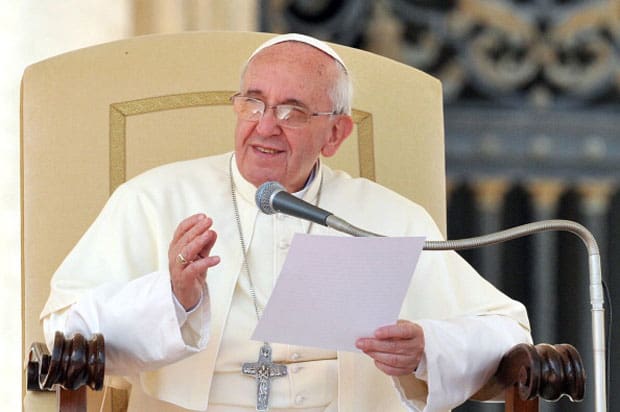
“With this writing, I wish to propose a radical shift concerning the great attention that, in the context of the formation of candidates for the priesthood, must be paid to literature.”
“Contact with different literary and grammatical styles will always allow for deepening the polyphony of Revelation without reducing or impoverishing it to one’s historical requirements or mental structures.”
“an assiduous frequentation of literature can make future priests and all pastoral agents even more sensitive to the full humanity of the Lord Jesus, in which His divinity is fully poured out, and to proclaim the Gospel.”
“In reading, we dive into the characters, the concerns, the dramas, the dangers, the fears of the people who have ultimately overcome the challenges of life.”
“Here is a definition of literature that I like very much: listening to someone’s voice. And do not forget how dangerous it is to stop listening to the voice of the other who calls out to us!”
“literature helps us to say our presence in the world, to “digest” and assimilate it, capturing what goes beyond the surface of life; it serves, therefore, to interpret life, discerning its fundamental meanings and tensions.”
“When one reads a story, thanks to the author’s vision, everyone imagines in their own way the tears of an abandoned girl, the elderly woman covering her sleeping grandson’s body, the passion of a small entrepreneur trying to move forward despite difficulties, the humiliation of one who feels criticized by everyone, the boy who dreams as the only way out of the pain of a miserable and violent life.”
“The spiritual power of literature finally recalls the primary task entrusted by God to man: the task of “naming” beings and things (cf. Gn 2:19-20). The mission of guardian of creation assigned by God to Adam passes first and foremost through the recognition of the reality and meaning of the existence of other beings. The priest is also invested with this original task of “naming,” of giving meaning, of becoming an instrument of communion between creation and the Word made flesh and of its power to illuminate every aspect of the human condition.”

Capesters: A Hero Bureau Thriller
by Peter G. Bielagus
It's 2025 and the United States Federal Government has passed The Vigilante Act, allowing private citizens to operate as for-profit crime fighters. Under the jurisdiction of the Hero Registration Bureau (HRB), Registered "Heroes" are popping up in major cities, hitting the streets, solving crimes, raiding warehouses all while grabbing the action on video. When a seven-and-a-half-foot armored Rogue begins a nationwide killing spree, disgraced NYPD detective Stan Magreen is coaxed into the case; not just because he's a good detective but because he was the first Rogie.
“Where would one go to sell a kidney?” Hightower asked.
Vlad leaned back; his expression turned sour. “People get killed wanting to know.”
Author Lee Lindauer, an engineer by trade before turning to thriller novels, uses the tools and techniques of his original vocation to develop well-researched and tightly conceived stories and complex and well-defined characters, clearly evident in his most recent work, The Sava Steps.
Throw in a generous helping of history to get the narrative going. During the Bosnian War in 1995, in a period referred to as the Srebenica Genocide, a Dutch Battalion of the United Nations Protective Force, known as Dutchbat III, was charged with providing peacekeeping operations, protecting the “safe zone” and preventing the escalation of atrocities on local villagers. It is said that the Dutch did not live up to that responsibility.
The protagonist, Melika Zbanic, 17 at the time and one of those villagers, was forced into a long journey by foot with her younger brother against their will at the hands of armed soldiers. The battalion’s Dutch captain, Pieter Van Dere, made decisions and took actions that left lifelong scars on Melika – so hideous that she vows decades later to settle all scores and seek out revenge on Van Dere, regardless of the consequences.
Fast forward to present day, where Melika, a doctor, lives in a small village. On the grounds high above her clinic, there is a structure of a once-prominent hotel whose presence now is unclear. However, as she witnesses strange comings and goings, even the apparent nighttime burial of a body, she suspects something unsavory. Yet she is singularly focused to travel wherever she may to find Van Dere and bring about her personal justice.
THE PACE IS SWIFT, WRITING CRISP
Meanwhile, an analyst for Interpol in Lyon, France, is close to cracking a case and identifying a suspect in an apparent illegal kidney trafficking operation – the savage process of grabbing donors and taking vast sums from people in need of a transplant who can’t procure the organ through traditional means.
When the analyst is murdered, enter Thorne Hightower, a former disgraced FBI agent who happens to be the brother-in-law of the victim. Van Dere, whose current cover is a position at Interpol, now appears central to the kidney trafficking scheme.
Melika and Hightower, with seemingly different motives for seeking out Van Dere, become intertwined in the chase and subject to many dangerous twists, turns and circumstances in which they find themselves along the way.
The author introduces us to an intriguing cast of supporting characters representing both good and evil. Perhaps none is more curious than Melika’s daughter Valery, for the mere reason that she is stone deaf but also a virtuoso violinist. What role might she play close to home as her mother takes off in search of Van Dere and his accomplice?
INTRICATE PLOT WITH FINE DETAIL
Like many of the relationships, with that of Melika and Hightower at the forefront, the matter of trust is a constant theme. While some wavering confidences are apparent, even the two lead characters fail to easily establish what seems like a natural bond to work together. Perhaps Melika’s history, shrouded with shady characters and betrayal, forces her to question everything and anything.
Lindauer has truly taken to his new craft of writing thrillers: “They’re an easy way to escape, and someone is always in danger — it never is the reader. I was never a voracious reader growing up, but the books I did read were packed with adventure, thrills, and mayhem, with words and characters that got your blood flowing.”
The Sava Steps will indeed get readers’ blood flowing. The author has combined an intricate plot with fine detail and much to think about. He gives us complex, flawed characters for which we feel their anguish, fear, desperation and the focus on the specific objectives at hand.
Dare we say that Lindauer has “engineered” a masterful work with all the elements you’d hope for in a thriller. The pace is swift, the writing crisp, and the overall experience one that will encourage readers of this genre to proudly add this book to their shelves.
AUTHOR
Contrary to popular belief, Lee Lindauer, author of The Sava Steps and Irrational Fears, did not obtain an MFA in Creative Writing but did earn both BS and MS degrees in Architectural and Civil Engineering, respectively. From years of designing buildings and other structures, he now engineers fast-paced plots and creates intriguing characters in authentic technical and natural settings to produce emotional rollercoaster rides for the reader. A member of the International Thriller Writers, he and his wife, Teri, divide their time between Colorado and Nevada. Visit his website at www.leelindauer.com
Jim Alkon is Editorial Director of BookTrib.com. Jim is a veteran of the business-to-business media and marketing worlds, with extensive experience in business development and content. Jim is a writer at heart – whether a book review, blog, white paper, corporate communication, marketing or sales piece, it really doesn’t matter as long as he is having fun and someone is benefitting from it.
Phil Koury was Cecil B. DeMille's "personal representative" since 1946 and stood close as DeMille made some of the most successful movies of his time.
This is a first-hand account of the ups and downs of one of our most controversial Hollywood legends. It covers his legendary qualities, exhibitionism, terrorism as a director, rampant individualism, tremendous public following, and box office success—and the scorn of the critics—and follows his career from the theatre to early "flickers" and on through the talking pictures.
It is not to be missed if you love learning about the mechanics and foibles of the film business.
1935. Roz Lhulier and his team unearth the massive tomb of Pakal, the greatest Mayan king. It’s the discovery of the century, they think. They’re wrong.
Instead, deep in the pyramid that holds the seventh-century ruler, hides a primitive Codex, a book of prophecy, predicting the collapse of the solar system. Raising the question, “Does the world end?”
Get in on the Conversation by Leaving Your Own Amazon Review Today!
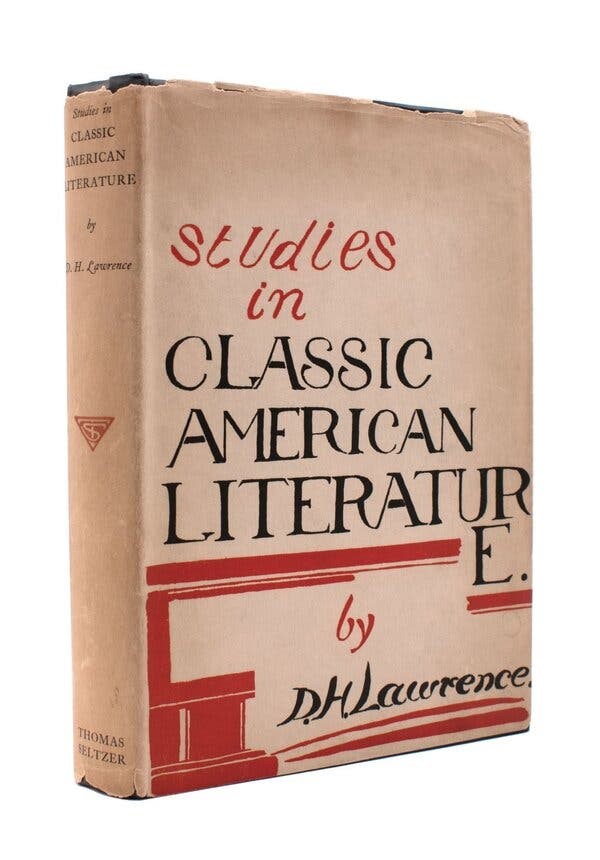
Inflamed, impertinent and deeply insightful, D.H. Lawrence’s “Studies in Classic American Literature” remains startlingly relevant 100 years after it was originally published.
![]() |
Every American is “a torn divided monster,”
D.H. Lawrence wrote, in a book that saw in the nation’s literature a key to its
soul.Credit...Fine Art Images/Heritage
Images, via Getty Images |
It has been a hundred years since D.H. Lawrence published “Studies in Classic American Literature,” and in the annals of literary criticism the book may still claim the widest discrepancy between title and content.
Not with respect to subject matter: As advertised, this compact volume consists of essays on canonical American authors of the 18th and 19th centuries — a familiar gathering of dead white men. Some (Nathaniel Hawthorne, Herman Melville, Walt Whitman) are still household names more than a century later, while others (Hector St. John de Crèvecoeur, Richard Henry Dana Jr.) have faded into relative obscurity. By the 1950s, when American literature was fully established as a respectable field of academic study, Melville’s “Moby-Dick,” Hawthorne’s “The Scarlet Letter,” Whitman’s “Leaves of Grass” and Crèvecoeur’s “Letters From an American Farmer” had become staples of the college and grad school syllabus, which is where I and many others found them in the later decades of the 20th century. Thank goodness Lawrence got there first.
This is not going to be one of those laments about how nobody reads the great old books anymore. Not many people read them when they first appeared, either. My point is that nobody ever read them like Lawrence did — as madly, as wildly or as insightfully.
That’s what I mean about the gap between the book and its title. “Studies in Classic American Literature” is as dull a phrase as any committee of professors could devise. Just try to say those five words without yawning. But look inside and you will be jolted awake.
Lawrence’s deep reading and idiosyncratic learning are abundantly evident — he tosses off snippets of French, German, Italian and Latin, sprinkling his pages with allusions to ancient poetry and modern philosophy — but his tone is the opposite of scholarly. With its one-sentence paragraphs (“Flop goes spiritual love.”), jabbing exclamations (“Freedom!”), semi-rhetorical questions (“But what of Walt Whitman?”) and heavy use of italics and all-caps, the book can read like a scroll of social-media rants. Its manner is neither respectable nor respectful. Lawrence harangues his subjects in the second person (“Nathaniel!”), and subjects them to parodic paraphrase and withering, ad hominem judgment. “I do not like him,” he says of Benjamin Franklin. Benjamin Franklin!
The irreverence is refreshing, but these studies are far from frivolous. Lawrence’s bristling, inflamed, impertinent language provides a reminder that criticism is not just the work of the brain, but of the gut and the spleen as well. The intellectual refinement of his argument — fine-grained evaluations of style and form that still startle with their incisiveness; breathtaking conceptual leaps from history to myth and back again — is unthinkable without the churn of instinct and feeling beneath it. This is the work of a writer whose fiction — including his briefly banned masterpiece “The Rainbow” and his long-suppressed “Lady Chatterley’s Lover” — makes much of the conflict between decorum and desire.
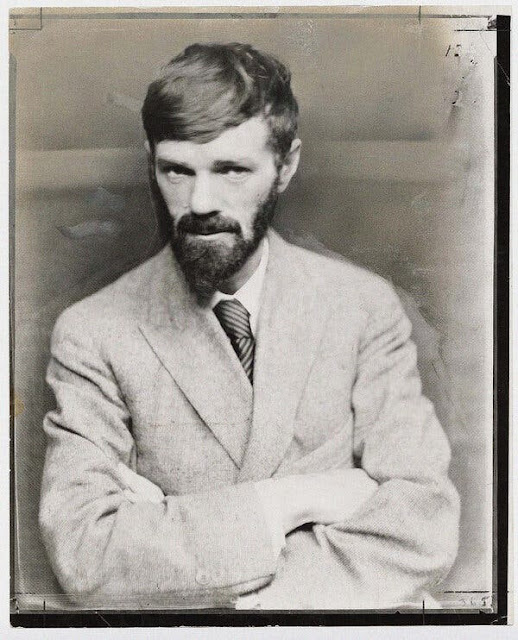
In that respect, the book is the mirror of its subject. Each of the writers under scrutiny, like the culture that spawned them, is a divided soul, pulled between contrary impulses. On one side, there is a moralizing, do-gooding, civilizing imperative, a force that Lawrence variously identifies with idealism, “saviorism” and democracy, none of which he much cares for. Franklin is one avatar of this tendency — “the pattern American, this dry, moral, utilitarian little democrat” — which explains Lawrence’s dislike:
Here am I now in tatters and scratched to ribbons, sitting in the middle of Benjamin’s America looking at the barbed wire, and the fat sheep crawling under the fence to get fat outside, and the watchdogs yelling at the gate lest by chance anyone should get out by the proper exit. Oh America! Oh Benjamin! And I utter a long loud curse against Benjamin and the American corral.
But Franklin is not the only American writer bound by the constraints of careful morality. Even the wildest of Lawrence’s specimens — the feverish Edgar Allan Poe, the restless Melville, the ecstatic Whitman — are corralled by various forms of propriety and high-minded sentiment.
The thorniest part of Lawrence’s argument — the strain in the book that feels scandalous, even dangerous, at present — is that he identifies those sentiments with what many Americans would consider the positive substance of our national identity. His hostility to the idea of democracy and the ideal of equality partly reflects a general philosophical bias. “Damn all ideas and all ideals,” he rails, seeing such abstraction as an impediment to authentic human connection: “If only people would meet in their very selves.” But this idea of authenticity is bound up with a mystical ideology of race, sex, blood and destiny that is apt to trouble 21st-century sensibilities.
Or maybe not. Like some other modernist writers — W.B. Yeats, Ezra Pound, Wyndham Lewis — Lawrence, who died in 1930, dabbled in a mode of aesthetic anti-liberalism that may be making a comeback. His critique of America, where he had traveled in the early 1920s, living for a time in Taos, N.M., was a broadside against the nation’s progressive traditions. Its writers were both his antagonists and his allies. Or rather, their expressed beliefs were anathema, while their work revealed what to him was a more congenial truth.
“The artist,” he writes in one of the most frequently quoted passages, “usually sets out — or used to — to point a moral and adorn a tale. The tale, however, points the other way, as a rule. Two blankly opposing morals, the artist’s and the tale’s. Never trust the artist. Trust the tale.”
The tale that classic American literature tells, in the aggregate, is largely one of violence, conflict and cruelty, whether it unfolds on Cooper’s frontier, in Hawthorne’s Salem, in Poe’s fantastical mansions or on Melville’s South Seas. There is a remorseless clarity to Lawrence’s perception of this bloody tapestry, summed up in his description of Cooper’s Natty Bumppo:
But you have there the myth of the essential white America. All the other stuff, the love, the democracy, the floundering into lust, is a sort of by-play. The essential American soul is hard, isolate, stoic and a killer. It has never yet melted.
This is a hard formulation to accept, but it is also not an easy one to dismiss. Much as we may wish to deny it, racial violence is a central fact of our history. And as distasteful as it may be to imagine this country defined by Cooper’s “essential American” on one hand and Franklin’s industrious, positive-thinking “pattern American” on the other, the tension between them might be more than just a literary conceit. Without it, American literature might not exist at all.
What Lawrence saw in his eccentric, passionate reading of that literature was division, polarization and contradiction. Not so much among factions, parties, regions or races — ordinary politics doesn’t really enter his field of vision — as within individual hearts and the collective soul. Every American is “a torn divided monster,” he writes at one point.
And elsewhere, a century ago that might as well have been last week: “America has never been easy, and is not easy today.”
via A.O. Scott
Critic at large for the Book Review. He joined The Times in 2000 and was a film critic until early 2023. He is also the author of “Better Living Through Criticism."More about A.O. Scott"