"The universe is made of stories, not of atoms."
—Muriel Rukeyser
____________________________
Showing posts with label Homer's Iliad:The Shield of Memory. Show all posts

Kenneth Atchity's Homer's Iliad:The Shield of Memory #FREE January 24 through January 28!

 "I know of no other book as good."--John Gardner


purchase on Amazon.com


Foreword

During the past quarter century the study of classical literature, and of Homer in particular, has gone through something like a revolution. Part of the reason for the new look at Homer was something called "the Homeric question"—really a cluster of questions, all of them more or less wrongheaded but important nonetheless: did Homer compose orally, making up his poetry on the spot, brachiating from formula to formula ("swift-footed Achilles," "Hektor of the shining helm"), or did he use writing and achieve his majestic effects by means of revision, like an ordinary mortal? Was there ever a "Homer" in fact, or were the Iliad and the Odyssey high-class folktales, shaped, expanded, modified through a long process of folk or court tradition? What makes such questions seem wrongheaded is of course the beauty and intellectual density of the poetry. The Yugoslavian oral poets whose practice set off "the Homeric question" were interesting people and occasionally achieved rather interesting effects, but even the most sympathetic critic must admit that their work is feeble, almost silly beside Homer's. Homer, we know, was free to write, instead of compose orally, if he wanted to. We have no evidence that he was, as tradition claims, blind, like his own fictitious bard Demodokos, in the Odyssey; and even if he was blind, he could easily get someone else to write his words down and read them back to him, as did John Milton. More important, common sense would argue, it was at about Homer's time that writing came back into general use. The rediscovered tool made someone like Homer practically inevitable. Before Homer, heroic lays were apparently all short, usually about the length of a book or two of the Iliad. With the ability to look back, read one's work over carefully and thoughtfully, came the ability to weave in symbols—the connected bow symbolism that runs through the Iliad, the emblems of art Professor Atchity points out, and so forth. When one works out in full detail, as Professor Atchity does here, the imagistic, dramatic, and philosophical structure of the Iliad, it becomes difficult to believe that the poem is anything but a work achieved by the process of writing and revising.

To say that a thing is difficult to believe is of course not any sort of proof. Scholars for some reason devoted to the notion that Homer composed on his feet, like a Yugoslavian bard or the traditional black American minister, point out Homer's fondness for traditional formulae (though they cannot seem to agree among themselves about which formulae are traditional), and they ask, shaking their fingers at us, "Why would Homer use formulae if he was writing with a pen and had no need for them?" That is easily answered: poets before Homer—oral poets—had used formulae; he was imitating their methods, merely for tone, or out of love and respect, much as modern ministers occasionally say, for love of their tradition, "Brothers and sisters we are gathered this day." But this too is merely a plausible answer, not a proof.

The more one works at the Homeric question the more annoying it gets, but for all that, the raising of the question has been wonderfully beneficial. Though some scholars have made the question a stumbling block, refusing to listen to even the most reasonable and obvious readings of Homer's verse on the grounds that no man composing on his feet—and certainly no tradition of oral composers—could possibly be so subtle, the best of our scholars have responded to the question by looking more closely than anyone ever did before (at least in print) at the structure and texture of Homer's poetry. Finally, of course, it makes no difference whether Homer composed on his feet or at his desk, or whether Homer was one man or twenty—though we all have our opinions and may incline to think contrary opinions rank foolishness. The only important Homer question is: How do the Iliad and the Odyssey work? How tight are the poems? how beautiful? how profound?

As if "the Homeric question" had never been raised, Professor Atchity raises these more important questions about the Iliad, then answers them. He proves what we all suspected all along, that the poem is a brilliantly organized work, philosophically profound, perhaps the noblest work of art produced in the entire tradition of Western Civilization. His method is close analysis, tracing particular images and themes throughout the poem so that the general reader, not just the Homer specialist, can return to the poem and experience it more richly. I know of no better introduction to this splendid poem. In fact, I know of no other book as good.
Kenneth Atchity is an associate professor of comparative literature at Occidental College. He has written and lectured on subjects ranging' from Homer to Wallace Stevens, wrote the libretto for a sinfonia cantata, In Praise of Love, produced at Lincoln Center in New York, has published numerous poems, a collection of essays on Spenser, a collection coedited with Giose Rimanelli, on Italian literature, and is presently editor of CQ, contemporary quarterly: poetry and art.

John Gardner
New York, 1977


Praise for Hommer's Iliad:The Shield of Memory

"Homer’s Iliad: The Shield of Memory contains many brilliant insights. The poet knows that the “world of the remembered past” and the contemporary world, though chronologically distinct and substantially different, are both comparable in their reflection of continuing human experience. The Iliad is about man in the generic sense, and Kenneth John Atchity’s profound study fully respects Homer’s fundamental human concerns." —Professor John E. Rexine, Dana Professor of the Classics, Colgate University,

"The Hellenic Chronicle Annual Christmas Edition This very beautiful book renews and enriches at one blow, everyone’s reading of the Iliad." —Anne Lebeau, Revue des Etudes Grecques

This book presents a refreshingly original interpretation of Homer's Iliad, inviting today's reader to rediscover the beauty, intelligence, and power of Western civilization’s greatest epic poem.

For too many decades, academic classicists removed Homer from the mainstream reader's grasp with their claims that poets composing in the "oral tradition" are incapable of intentional organization. Instead, Atchity believes, metaphorical organization was introduced to the literate world by these "singers of tales."

The theme of the Iliad, Dr. Atchity points out, is the relationship between order and disorder, from the personal to the cosmic levels. Homer’s poem, crafted from a memory so strong it created a culture around it, proclaims that once order has been disrupted by disorder it can be restored only through the total destruction of all disorderly elements.

To reveal the Iliad’s guiding aesthetic, Atchity examines specific images connected with artistic creativity in the Iliadic world—artifacts such as shields, spears, and scepters, that form a cohesive symbolic pattern by which the character of men and gods is related to action, and one characteristic action to all other actions in the gradually unfolding thematic tension that defines the poem’s world view. Helen’s loom and Hephaistos’ great shield of Achilles, the two central art images, reveal most clearly Homer’s concept of his own artistry and of epic art in general: its origins, process, purpose, and impact on social reality.

Much of Atchity’s interpretation of the Iliad deals with comparing the characters of Helen and Achilles, around whom center “galaxies” of characters and images that can be identified in terms of order and disorder. The historical art of Helen is contrasted with the poetic vision of the smith-god, and both with the art of Homer himself who in his unforgettable wrath-poem combines the particulars of history with universal insight into the human condition which is at once inspired and philosophical.

Atchity examines the poem’s presentation of the art of words, of the singer and of the practiced speaker, to reach a clearer understanding of the relationships of memory, cognition, and action in the epic tradition. From this comes the striking conclusion that the Iliad is a poem about human love, the announcement of Homer’s insight that it is the love between two individuals, a love over-leaping blood bonds and political bonds, that provides the basis for the achievement of the noblest humanity. the imminent fall of one doomed city, and despite the imminent death of Achilles.

Atchity’s reading of the Iliad is of inestimable value to ordinary readers--as well as students of epic poetry, heroic poetry, classical literature, Greek literature, and anthropology.

Atchity was Professor of Comparative Literature at Occidental College. He received his Ph.D. from Yale
 
John Gardner, editor of the Literary Structure series, was best known as a novelist and poet. His novels included October Light, Grendel, and The Life and Times of Chaucer.

Kathleen Vail: Reviewing Homer’s Iliad: The Shield of Memory by Dr. Ken Atchity

Homer's Iliad: The Shield of Memory, by Kenneth Atchity

Artistic Reconstruction and Original Translation From Homer's "Iliad" by Kathleen Vail


In Homer’s Iliad: The Shield of Memory, Dr. Kenneth Atchity follows Homer’s footsteps through the Iliad like a lover intent on winning his heart and mind. What’s more, Atchity invites us to a beautiful symposium, discussing his journey clearly and compellingly, enticing us with amazing glimpses into the ingenious mind and motives of Homer.

In spite of everything you may have learned about Homer’s Iliad, Dr. Ken proves that it is an epic love story. In fact, it’s such a powerful love story that it can generate immortality in the form of human memories, perpetuating human desire to imitate this epic level of love. And, if we are successful, this is the kind of love that actuates social stability and brings about peace in our lives.

“In his appreciation of the poem,” says Atchity about the Iliad, “Even the man for whom war is the reality, therefore, can find peace.” He explains, “While historical peace may be ephemeral and rare, human peace is not only possible, but also truly realized, in the poems of memory.” (1)

Especially in Homer’s Iliad–arguably the greatest poem of memory every recorded.

 Painting of "Homer Among the Greeks" by Gustav Jäger. The following image is of a mural at the Weimar Castle in Germany, which was completed in 1808 by painter, Gustav Jäger entitled, "Homer Among the Greeks" Source: Hadrian6 via 300SpartanWarriors


Let the Symposium Begin


The late poet and novelist, John Gardner, in his foreword to Homer’s Iliad: The Shield of Memory, states that he knows of no better introduction to the Iliad than this book. Gardner hails Atchity for his close analysis of specific themes and images throughout the Iliad, for proving “what we all suspected all along, that the poem is a brilliantly organized work, philosophically profound, perhaps the noblest work of art produced in the entire tradition of Western Civilization.” (2)

"Vulcan at Work on the Armour of Achilles," by William Heath Robinson, ca. 1872-1944. Source: sofi01 / Flickr (for non-commercial use only)
Vulcan at Work on the Armour of Achilles, by William Heath Robinson, ca. 1872-1944. Source: © sofi01 / Flickr (for non-commercial use only)

Peering over the shoulder of Hephaistos as he creates Achilles’ magnificent shield, we benefit from Dr. Atchity’s intimate analysis, learning the central theme of both the shield in particular and the entire Iliad in total. Plain and simple, it is the establishment of order, the rise of human appreciation which coalesces into a love of order. But this is a divinely prescribed order which will only be achieved when Achilles dons his Olympian armor and carries Hephaistos’ emblematic shield into battle.

Reclining comfortably, now, upon our symposium couches, Atchity explains that, even as we are watching over Hephaistos’ shoulder, Hephaistos is doing essentially the same thing that Homer is doing, as we are reading or listening to the Iliad:

The artist creates the world, through and to his own vision of order.
Achilles’ shield contains the whole cosmos known to Homeric man—of the inanimate stars and waters, and of all life and time and space and action. Forged into the very substance of this supreme tool of warfare is a detailed vision that transcends all momentary circumstances, all individual fates, and reveals humanity in its continuing, essential character. In the process of its making, the ideal and real become one dynamic continuum. (3)

The Shield of Achilles is a Symbol of the Entire Iliad


Encompassing, as Atchity puts it, the poem’s “mnemonic technique, purpose, and function,” the Shield of Achilles is a divine masterpiece–at once the central image and a symbol of the entire epic. As a supernatural mnemonic device, Hephaistos’ creation “remains untarnished as only a memory can be.”

Atchity has become our bard, compelling us to lean forward as he continues, “And as we maintain that breathtakingly clear vision in our memory, it directly affects how we view ourselves and our actions, instilling in our minds the very order that fashioned it.” (4)

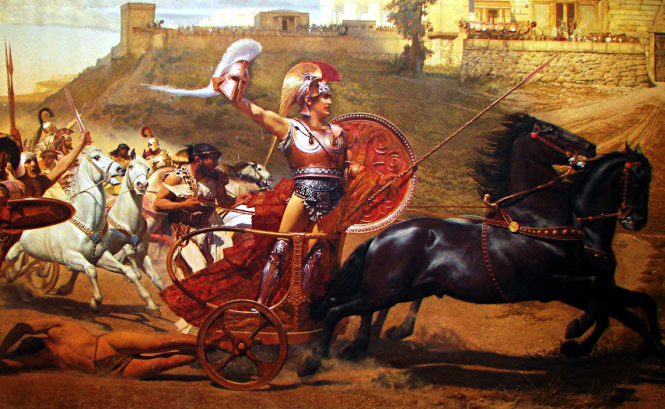
As a devoted student of Dr. Ken’s visionary perspective, I see Achilles whipping his horses and riding into the fray. I understand that when he swears to end the war single-handedly, he is swearing to protect the Achaeans who follow him and all the future generations who will follow him, as well–even mine.

The Triumph of Achilles by Franz Matsch, a fresco on the upper level of the main hall of the Achilleion at Corfu, Greece. Source: Wikimedia Commons

Just as Achilles understands and imitates the Olympian order depicted on his new shield by launching into battle selflessly, I understand Atchity means that, with growing insight via divinely inspired memory, we, too, are able to imitate Achilles. As Atchity explains, this is the goal and highest service of the poet: By perpetuating the hero’s name and deeds in the memory of generations to come, the poet’s song–the hero’s glory–will encourage the further perpetuation of Olympian order.

We see that poetry, as Homer conceives of and practices it, is the ordering agent in human affairs, a form of worship as well as a sign of man’s awareness of divine order. From a detachment that is virtually Olympian—because the Muses possess the poet with a vision of past, present, and future, and of both sides of the conflict in all their complications—Homer presents the happy results of orderly human action and the disastrous consequences of disorderly behavior.

All mortals and immortals within the Iliadic world are polarized by these cosmic opposites: order and disorder. Each character is defined in terms of his link with one or the other. The great shield is a magnificent emblem of poetic order from which ideal human society issues.(5)

You knew that, right? Oh, yes, me too. I love it!

Focusing on the Central Images Within the Iliad


Atchity’s profound philosophical understanding of Homeric society is achieved by focusing on central images within the Iliad. He sees the ideal world depicted on the divine Shield of Achilles. And he sees this ideal world functioning as a counterbalance to the social upheaval in Achilles’ real world.

Atchity attributes this social upheaval to the simultaneous decline of the “heroic” social system colliding with the rise of the “familial” social system in Ancient Greece.

The Shield of Achilles, offering a new, enlightened social system with both heroic and familial components harmonized within the social hierarchy, depicts Homer’s poetic resolution to the social upheaval occurring in the Iliadic world. By serving one another in mutual reciprocity, Homer’s vision foresees individuals perfectly balanced within the wider community.

As Atchity explains, the tension between the two social systems becomes a constructive force in the ideal world, each serving the other. This is because the emotional strength of the familial system, which binds primarily via love between individuals/families/community, is additionally strengthened by the pragmatic power of the heroic system, which binds primarily via honored oaths of loyalty to individuals/tribes/confederations. (6)

The Turbulent Relationship Between Order and Disorder


The primary theme woven into the chaotic events of the Iliad, on every level from the human to the divine, is the turbulent relationship between order and disorder. And, unfortunately for the participants, social disorder is the natural, but terrible result as social systems collide.

“Specifically,” states Atchity, “the poem is a statement of the consequences to order when disorder is inserted at any level of the hierarchical cosmos as Homer conceives of it, and the restoration of order through the obliteration of the disorderly intrusion. Order, once interrupted, can only be returned through the destruction of disorder: that is the lesson of the Iliad.” (7)

Turning his piercing gaze to the marriage bed of Hektor, upon which the close of the Trojan War pivots as Hektor’s body is gently laid to rest prior to his funeral, Atchity recognizes a particularly antithetical image. While the Shield of Achilles offers an image of the victorious ascent of order over disorder, the marriage bed of Hektor depicts the terrible price humans must pay for the destruction of disorder.

As she mourns the loss of her husband, Atchity notes that “Andromache’s lament concludes with the image of the marriage bed deprived of its natural occupant. It is in this way that Homer communicates his characteristically social perspective: that war ends, as it begins, with conjugal disorder.” (8)

Indeed, it is the “heroic” social system embodied in the character of Paris that inspires his selfish desire to seduce the wife of an Argive king until she abandons her conjugal bed in Sparta and travels with him to Troy.

Hektor Admonishes Paris Pierre Claude Francois Delorme
Hektor Admonishes Paris, by Pierre Claude Francois Delorme. Source: Wikimedia Commons

 Without pointing a poetic finger of blame at her, Homer’s passive treatment of Helen’s character nevertheless guides her to admit to Hektor her shame. Atchity interprets Helen’s role as central to the resolution of the tumultuous social transition which is occurring all around her:

Helen is human progress itself, vacillating between two orders, waiting in suspension for a continuity that will come only when their conflict has been transformed into cooperation, their antithetical potentials synthesized. The fact that Helen’s individual will is suspended but that her actions, although involuntary, have collective repercussions which are material for memory reveals Homer’s refusal to accept either norm, the heroic or the familial, as sufficient; neither, alone, provides man with a divinely-sanctioned order for social well-being, or even for social survival.

Inasmuch as he rejects both purely communal and purely personal motivations, Homer stands as a prophet of the great Athenian phenomenon which managed to gloriously combine the (“know thyself”) of Socrates with the holistic spirit of Plato’s Republic. When a balance is maintained between these two orientations, human nature achieves its fullest, most nearly divine expression. (9)

Ahhhhhh, may I die and wake up in such a great symposium in heaven!

It Is Our Memories That Make Our Heroes Immortal


In the final analysis, then, it is our love of epic stories, even (or perhaps especially) epic love stories framed with all the gory constructs of war, that fire our finest synapses, indelibly etching into our memories the finest deeds of the finest heroes.

It is our memories, in fact, that make our heroes immortal. Dr. Atchity explains that this is because memory communicates the promise of continuity on an essentially human level–remembered words can bring living order even to fatal encounters. (10)

I think that Dr. Ken has brought to light a very appealing point about the enduring love relationship between life and memory. Blessed by this very poignant relationship, “memory shields the individuals from death.” (11)
We never forget the ones we love, as long as they live on in our memories. Even within the most mundane levels of society, we may cast aside our fear of death, knowing that our loved ones will keep us alive in their memories.

How much more glorious to be the source of ageless memories of an epic victory–A magnificent hero ushering in the triumph of order over disorder?

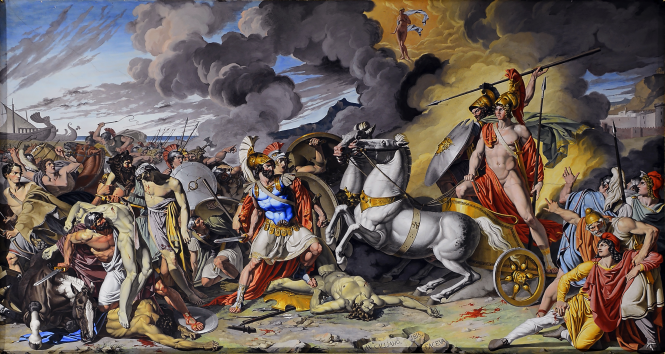
Protected by Ares, Achilles Overwhelms Hektor. By Antonio Raffaele Calliano, 1815. Source: Wikimedia Commons
Protected by Ares, Achilles Overwhelms Hektor, by Antonio Raffaele Calliano, 1815. Source: Wikimedia Commons

As Dr. Ken explains,

We understand, with the Achilles who no longer shuns death, that the shield gives him access to an immortality that is purely human: though he, like all who share human nature, can’t escape mortality in time, he will have an orderly place forever in the minds of men to come who will hear how he carried this shield into battle to restore the honor of his dear friend and of the Argive nation.” (12)

Offering love as the most powerful incentive for social stability, Homer’s Iliad ends with a glorious vision of order on the very cusp of reestablishment.

Achilles’ personal love for Patroklos becomes, at the end of the story, the pattern for the international love between him and the old king of Troy; and the epic ends, not with the death of Achilles or even of Troy or Priam, but with a ritual that promises the continuity of human order—made possible by Achilles’ loving gesture: the return of Hektor’s body. (13)

Priam Returning with the body of Hektor, by John Trumbull, ca. 1756-1843.
Priam Returning with the body of Hektor, by John Trumbull, ca. 1756-1843. Source


And there you have it. It’s all about love. If you stayed with me this far, then, without a shadow of a doubt, you will leave Dr. Atchity’s symposium understanding that Homer’s Iliad is, after all, a love story. Yes, it’s framed in all the gory constructs of war–a really epic war. I’m sure that’s what helps us to remember it so well, but now you might also remember it as a love story.
A really epic love story–from the beginning, all the way to the end.

…Heavy sigh… I love a great love story, don’t you? This book, Homer’s Iliad: The Shield of Memory by Dr. Kenneth Atchity, just keeps getting better and better, every time I read it.

Pick it up on Amazon and get the added bonus of seeing my reconstruction of the Shield of Achilles on his Kindle edition cover–A very great honor that Dr. Atchity has bestowed upon my work!


Read more


FOOTNOTES:
(1) Atchity, Kenneth. Homer’s Iliad: The Shield of Memory (Kindle Locations 1843-1846). Story Merchant. Kindle Edition.
(2) ibid, (Kindle Locations 65-68).
(3) ibid, (Kindle Locations 109-114).
(4) ibid, (Kindle Locations 117-119).
(5) ibid, (Kindle Locations 130-135).
(6) ibid, (Kindle Locations 139-145).
(7) ibid, (Kindle Locations 148-150).
(8) ibid, (Kindle Locations 2002-2005).
(9) ibid, (Kindle Locations 2041-2053).
(10) ibid, (Kindle Locations 1819-1829).
(11) ibid, (Kindle Location 1857).
(12) ibid, (Kindle Locations 109-114).
(13) ibid, (Kindle Locations 99-155).