"The universe is made of stories, not of atoms."
—Muriel Rukeyser
____________________________
Showing posts with label self care. Show all posts

FREE JULY 24 - JULY 28! Stressed in the U.S. by Dr. Meg Van Deusen


It seems like the American public is more “stressed out” than at any time in recent memory. But why? Is this seemingly sudden increase in stress due to current events in our world? Is technology to blame? Perhaps financial strain or increased pressures at work? Or is it all simply a coincidence?

Dr Meg Van Deusen has gleaned a wealth of knowledge during her twenty-seven years as a clinical psychologist. She has worked with a multitude of people from varying backgrounds. and is passionate about attachment theory, its relationship to stress, and how we can use it to feel less harried and improve our lives.⁠


Dr. Meg Van Deusen Author of Stressed in the U.S. on THE MOUTH OF MANLINESS


The Mouth Of Manliness with Nick Noise. Talking mental health, well being and everything under the sun. Expect tears and laughter as he shares real stories with real people.


Check out her book Stressed in the US: 12 Tools to

Tackle Anxiety, Loneliness, Tech-Addiction, and more

AVAILABLE on AMAZON

Ken's Weekly Book Recommendation: Stressed in the U.S. by Meg Van Deusen

Dr. Meg Van Deusen has gleaned a wealth of knowledge during her twenty-seven years as a clinical psychologist. She has worked with a multitude of people from varying backgrounds. and is passionate about attachment theory, its relationship to stress, and how we can use it to feel less harried and improve our lives.⁠


Check out her book Stressed in the US: 12 Tools to

Tackle Anxiety, Loneliness, Tech-Addiction, and more

AVAILABLE on AMAZON


HEALTH MEDIA NOW INTERVIEWS DR. MEG VAN DEUSEN-STRESSED IN THE US


Meg Van Deusen received her BA in English from Santa Clara University in 1985 and her PhD in Clinical Psychology from the California School of Professional Psychology in Los Angeles in 1992. She has worked with children, adolescents, and adults both in inpatient and outpatient settings throughout the Los Angeles and Seattle areas. Her knowledge of and passion for attachment theory, mindfulness, interpersonal neurobiology, sleep and dreams informs her belief that meaningful connection with ourselves and others helps us handle stress. In her review of the literature and interviews with researchers, everyday Americans, and clients, she has cultivated a first-hand understanding of how our current American culture is creating barriers to human attachments and, therefore, weakening our ability to handle the stressors we face today.


Check out her book Stressed in the US: 12 Tools to

Tackle Anxiety, Loneliness, Tech-Addiction, and more

AVAILABLE on AMAZON


Guest Post: Where Are We Now? by Dennis Palumbo

 Psychotherapist Dennis Palumbo gives an update on how writers are adapting after 10 months of staying safer-at-home.

By Dennis Palumbo


Here’s a question I’ve been asked recently:

“Now that we’ve lived through more of the pandemic, do you see a shift in how your therapy patients are coping?”

My answer: Yes and no.

Yes, in terms of a shift in responses among my writer patients, though it ranges all over the place. Some patients seem to have a kind of resignation to the fact that we don’t know how, or if, this lockdown will end. For these patients, this has meant a deeper hunkering down. Unhappy but resolved to hang on for the duration, they also report that since their initial stunned reaction to the pandemic has faded, they’re better able to focus on writing. It seems to help if they have contracted deals to work on projects, but even those working on specs report being more focused.

Other patients, encouraged by the news of the various vaccines, are feeling more upbeat than they have in months. There’s an end in sight, they believe, so their overall mood has lightened. Again, and more expectedly, their ability to focus on their writing has risen as well.

One important point: whether patients are accepting of an indefinite timeline for the lockdown, or else see it as ending soon, the effect on their families vary widely. Marital tensions, issues around virtual schooling for their children, and financial worries provide the context in which each individual writer has to work. And, therefore, the stresses of these various contexts are different for each household.

But what about those patients whose feelings and attitudes haven’t changed much since the lockdown began? Usually, since March, their general reaction has been anger, fear or frustration—or some combination of the above. The length of the pandemic and its restrictions hasn’t changed their reactions. Even the promise of a vaccine has done little to cause a shift in their feelings.

Why not? Remember, each of us lives in our individual subjective world, formed by a combination of our childhood experiences (which help mold our personal mythology about how life works), filtered through our firmly-held intellectual beliefs of how life works, and the personal and professional events in our adult lives. To put it bluntly, people tending toward pessimism or holding a dark view of the future see in the pandemic a confirmation of their worst fears. As one of my writer patients said when a long-fought-for project was scuttled once the pandemic hit, “See, I was waiting for the other shoe to drop... and now it has.”

If, however, a patient tends to be more optimistic (admittedly, for a therapist who treats Hollywood creative types, these kinds of patients are rare), the pandemic has been seen since it started as an opportunity to just write, unburdened by the other tedious obligations of their show business careers.

Then there’s a third category: writer patients who’ve complained in therapy over the years about never having had an extended period of time to work on their dream project—that big, special, personal script or play or novel that they just can’t get to because of their daily paying writing gigs. Yet when forced into staying home, suddenly having uncounted hours of free time, they were so psychologically impacted by the pandemic that they were unable to write. Anything.

Which brings me back to the initial question, and my somewhat meandering answer: while some patients’ attitudes—their fears and hopes and beliefs—have shifted, there are an equal number who feel the same frustrations and fears for themselves and loved ones that they’ve expressed in therapy since the pandemic began.

As in all aspects of clinical work with patients, there is no one-size-fits-all model for providing therapy. As the context of our lives changes, so do our emotional responses.

So my only advice is to try to live embedded in the moment, day by day, and resist feeding yourself catastrophic meanings about what the future holds.

Because if the year 2020 has shown us nothing else, it’s that predicting the future is a fool’s game.

For three decades, Palumbo has been a licensed psychotherapist for working writers and others in creative fields. To the therapy setting Palumbo brings his own experience as a sitcom writer, screenwriter, and, more recently, crime novelist (2018’s Head Wounds is the fifth installment in his Daniel Rinaldi series). Palumbo’s non-fiction book Writing from the Inside Out (2000) was an adaptation and expansion of his regular columns for Written By.

Connect spoke to Palumbo in May 2020 about recurring themes in his therapy practice among writers who were under extended stay-at-home orders and grappling with an entertainment industry on indefinite pause.

Building Secure Attachment with Dr. Meg Van Deusen


"When we have secure attachment we're more resilient." ~ Dr. Meg Van Deusen

Dr. Meg Van Deusen discusses the importance of building secure attachment in turbulent times, how secure attachment is a foundation for resilience, and how from mindfulness compassion and non-judgement are the basis for secure attachment on 
PTSD and Beyond Podcast with Dr. Deb Lindh.


"Secure attachment says 'everything is going to be okay' and 'we are there for ourselves no matter what',"

~ Dr. Meg Van Deusen


Dr. Van Deusen's book, Stressed in the U.S. : 12 Tools to Tackle Anxiety, Loneliness, Tech-Addiction and More, looks at how current cultural stressors have increased our stress levels, changed our stress levels, and weakened our resilience to stress. Dr. Van Deusen shares that "every minute provides an opportunity to change your life in some positive way."


Check out her book Stressed in the US: 12 Tools to

Tackle Anxiety, Loneliness, Tech-Addiction, and more

AVAILABLE on AMAZON


Dr. Meg Van Deusen Author of Stressed in the U.S. on Pen Podcast


Penpodcast.com is a place for authors to share their work and process with the world.


Check out her book Stressed in the US: 12 Tools to

Tackle Anxiety, Loneliness, Tech-Addiction, and more

AVAILABLE on AMAZON


MEG VAN DEUSEN Author of Stressed in the U.S. on on Fit for Joy

Healing the Soul - Back to Calm: Mindfulness and Simplicity

Valeria interviews Meg Van Deusen — the author of Stressed in the U.S.: 12 Tools to Tackle Anxiety, Loneliness, Tech-Addiction, and More 

AVAILABLE on AMAZON


Seventy-five percent of Americans are moderately stressed. Seventy-five percent of Americans are also lonely. More than 33 percent of us sleep less than six hours a night. In addition, 77 percent of us use social media daily and 81 percent of us own a smartphone. Why are these statistics important? Because loneliness, sleep-deprivation, social media use, tech use, and even gut-imbalance—which the Huffington Post refers to as “the modern plague”—are all causes and results of stress. Stress is the reason for at least 75 percent of today’s doctor’s visits, costing the US billions per year in employee absenteeism, accidents, and illnesses.

9/11, climate change, a historic economic crisis, numerous mass shootings, an inordinate amount of school lockdowns, a foreign attack on our election, a politically divided country, tech-induced anxiety and addiction, and information overload: since 2000, these unique-to-our-time phenomena have created a petri dish of stress in the US, causing a host of emotional and physical ailments.
Here’s the problem: while the well-researched, psychological theory on attachment tells us that secure attachments to each other and to our nation create resilience to stress, our current American culture is creating barriers, not pathways, to human trust and closeness.


Meg Van Deusen received her BA in English from Santa Clara University in 1985 and her PhD in Clinical Psychology from the California School of Professional Psychology in Los Angeles in 1992. She has worked with children, adolescents, and adults both in inpatient and outpatient settings throughout the Los Angeles and Seattle areas. Her knowledge of and passion for attachment theory, mindfulness, interpersonal neurobiology, sleep and dreams informs her belief that meaningful connection with ourselves and others helps us handle stress. In her review of the literature and interviews with researchers, everyday Americans, and clients, she has cultivated a first-hand understanding of how our current American culture is creating barriers to human attachments and, therefore, weakening our ability to handle the stressors we face today. She believes that the ancient art of mindfulness, the recent research on happiness, and the simplicity of nature can, among other things, help us build resilience and calm during a time when disconnection has us lost in a worried world.

To learn more about Meg Van Deusen and her work please visit: http://megvandeusen.com/

How to Affect Change Through Agency by Dr. Meg Van Deusen Author of Stressed in the U.S.

 How to affect change through agency

As 2020 comes to a close, some of you may find yourselves feeling weary, wary and downright impatient. You may feel weary from the months of mask-wearing, zooming, and social distancing. You may feel wary that the new administration, despite hope, will solve our 2020 problems. You may feel impatient about money, political divide and how long it will take to get vaccinated.


It’s been a long haul, my friends, and while there may be a visible light or two, we are still in the tunnel. So, what keeps us going when weariness, wariness and impatience are present? Agency. Agency is the art of picking yourself up when you feel kicked down. It is the ability to move forward when life feels like it has moved backward. It entails tuning into what’s bothering you, providing yourself with encouragement and taking action. It requires that you honor your emotions without getting stuck in them. Agency comes from a grounded, parental voice within that reminds you of your value and your ability to make a difference.

Three Steps to Recruiting Agency


1. Define a Problem You Want to Address

This step may be the easiest as our negativity bias has us more aware of what is wrong with our lives than what is right with them. Don’t make this overly complicated or get mired in the details of a situation. Simply list the things you want to make better in your life. Be careful not to dismiss any problems you think are too big or too small.

Take them seriously and take yourself seriously. For example, systemic racism may be a problem that makes you sad, a problem you wish you could impact. Instead of getting lost in the sadness, allowing yourself to feel flattened by the depth of it, put it on the list. Other possible situations that beg attention may be your financial situation, emotional distance in your romantic relationship or better physical fitness. List the problems without judgment so that, later, you can pick where to start.

2. Improve Your Self-Talk

We all talk to ourselves. Some of us are more aware of our internal dialogues than others and some of us are more critical of ourselves than others. Research has shown the way in which you talk to yourself is crucial to your well-being, including your motivation to do something about a problem. If you’ve found yourself repeatedly telling yourself things like, “You’ll never find a good-paying job,” or “You’ve done nothing with all this time alone,” you won’t feel inspired to get off the couch and make positive change in your life.

If, however, you speak to yourself with compassion and encouragement (and when I say compassion, I don’t mean condoning complacency), you will be more likely to apply for that job, study for that exam or volunteer for that organization.  Here is an example: Judy is lonely and depressed and worries about climate change. She’s unhappy with herself and the world. So, she decides to improve her relationship to herself by speaking to herself supportively. “It’s been a rough year, Judy, but you deserve better care. Let’s start by walking around the block every day to get you exercise and fresh air. You can do it, even if you feel tired.”

Another technique Judy can use to talk to herself is “self-distancing” or talking about herself.  “If Judy spends one hour a week volunteering for that tree-planting organization, she will help reduce the effects of climate change. Judy can make a difference.” Just changing how we talk to ourselves from a critical or cynical voice to a hopeful and encouraging one or from first-person language to third-person language can help us recruit agency.

3. Take Action, One Thing At A Time

In order to follow through on the behaviors that can positively impact a situation, it is vital that you learn self-discipline. Taking action works best when you are consistent. Set reminders in your phone. Time block your schedule for exercise, talking with friends, looking for a job or whatever you decided to affect.

Try not to get into a debate or discussion in your mind about whether or not it’s worth it to follow through on the action, just respond to the reminder bell or time block in a matter-of-fact manner. The phone dings to remind you to work on your resume for ten minutes, bring yourself to the task. Taking action is not about kicking yourself or threatening yourself—that creates stress in the mind and body. Instead, it is about putting an arm around yourself and guiding yourself to the task you set out to do.

When the action is repeated (for example, daily ten-minute meditations to tackle stress), it is more likely to become habit and, therefore, affect permanent change. But please don’t take on too much. One thing at a time will feel less overwhelming and more doable.

How to Affect Change Through Agency: Conclusion

I know we are all tired. We’ve had to navigate perpetually scary and painful circumstances this past year. Some of us had to find stamina when the previous three years had already been challenging. As humans, we have the capacity to be more resilient than we realize. Agency is key to developing resilience. But if you threaten yourself with pessimism and doubt your ability to make change, you’re likely to fall into complacency. Now is the time to offer yourself compassion, pick yourself up with encouragement and take action to improve your life.

References

Hanson, Rick and Hanson, Forrest. (2018). Resilient: How To Grow An Unshakable Core of Calm, Strength, and Happiness. New York: Harmony Books.

Kross, E., Bruehlman-Senecal, E., Park, J., Burson, A., Dougherty, A., Shablack, H., Bremner, R., Moser, J., & Ayduk, O. (2014). Self-talk as a regulatory mechanism: How you do it matters. Journal of Personality and Social Psychology, 106(2), 304–324.

Help, we're stressed out! Election stress and anxiety in America

 Feeling a little stressed? Anxious? So are we!

Psychologist Meg Van Deusen on understanding existential stress and anxiety and how to deal with it.

Seattle's Meg Van Deusen, PhD, is a licensed clinical psychologist, mindfulness practitioner, and the author of Stressed in the US: Twelve Tools to Tackle Anxiety, Loneliness, Tech-Addiction and More helps us deal with our feelings of stress and anxiety around the election, the pandemic ... everything!

She also fills us in on how stress is impacting different parts of the population and what role technology might play.


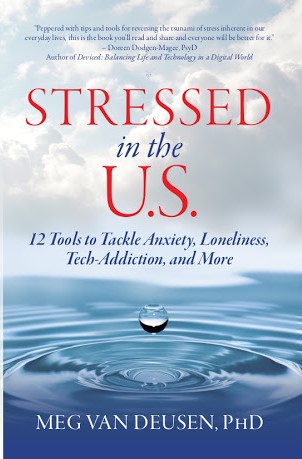
Stressed in the US Book Cover

Stressed in the US: Twelve Tools to Tackle Anxiety, Loneliness, Tech-Addiction and More

Stressed in the US addresses the relevant cultural phenomena that are contributing to stress in the US since the turn of the millennium, such as tech addiction, loneliness and anxiety. Meg Van Deusen talks about what we can do to mitigate this pervasive problem.

“In this compelling book, Meg Van Deusen delivers on her promise of sharing effective navigational tools to help us make our way safely across the troubled waters of our times.”

 Dr. Vincent Atchity, President and CEO, Mental Health Colorado

About the Book

Seventy-five percent of Americans are moderately stressed. Seventy-five percent of Americans are lonely. More than 33 percent of us sleep less than six hours a night. In addition, 77 percent of us use social media daily and 81 percent of us own a smartphone. Why are these statistics important? Because loneliness, sleep-deprivation, social media use, tech use, and even gut-imbalance—which the Huffington Post refers to as “the modern plague”—are all causes and results of stress. Stress is the reason for at least 75 percent of today’s doctor’s visits, costing the US billions per year in employee absenteeism, accidents, and illnesses. 

9/11, climate change, a historic economic crisis, numerous mass shootings, an inordinate amount of school lockdowns, a foreign attack on our election, a politically divided country, tech-induced anxiety and addiction, and information overload: since 2000, these unique-to-our-time phenomena have created a petri dish of stress in the US, causing a host of emotional and physical ailments.

Here’s the problem: while the well-researched, psychological theory on attachment tells us that secure attachments to each other and to our nation create resilience to stress, our current American culture is creating barriers, not pathways, to human trust and closeness. Stressed in the US: Twelve Tools to Tackle Anxiety, Loneliness, Tech-Addiction and More investigates current, cultural phenomena that are causing a convergence of increased stress with decreased interpersonal connection from an attachment theory perspective.

Dr. Van Deusen explains why and how our relationships are breaking down at a time when we need them the most. The good news? As a clinical psychologist, psychotherapist, and mindfulness practitioner, she offers insights and solutions to a complex, pervasive problem.

• Restorative practices protect us
• Nature calms us
• Mindfulness connects us 

curiouser & curiouser Podcast: Stressed In The U.S. With Dr. Meg Van Deusen


 Listen to the episode here!

I loved getting to speak with licensed clinical psychologist and author Dr. Meg Van Deusen for this podcast episode. I read Meg’s book — Stressed in the U.S.: Twelve Tools to Tackle Anxiety, Loneliness, Tech-Addiction and More — recently, and boy was it timely given the current state of our nation and our world! I was so glad to get to chat with Meg to dig a bit more into some of the themes of her book and share them with you here in this conversational format.  

Obviously, stress and anxiety are nothing new to our culture, but during her years treating patients Meg realized there were some themes she was seeing again and again. She wanted to dig more into those themes and issues, and the result is this book.

She gives some helpful context as to WHY we as a nation might be experiencing so many of these issues, and also shares some things we can do to reduce them in our own lives. That’s one of the most important things about the book: you’ll be left with practical tips you can incorporate right away to help you feel more grounded. She shared many of those tips during our conversation for this podcast as well, so listen up! (If you want to dig deeper into this topic after listening to this episode, be sure to grab a copy of Meg’s book as well!)

Stressed in the US Book Cover

Stressed in the US: Twelve Tools to Tackle Anxiety, Loneliness, Tech-Addiction and More

Stressed in the US addresses the relevant cultural phenomena that are contributing to stress in the US since the turn of the millennium, such as tech addiction, loneliness and anxiety. Meg Van Deusen talks about what we can do to mitigate this pervasive problem.

“In this compelling book, Meg Van Deusen delivers on her promise of sharing effective navigational tools to help us make our way safely across the troubled waters of our times.”

 Dr. Vincent Atchity, President and CEO, Mental Health Colorado

About the Book

Stressed in the US Book Cover


Seventy-five percent of Americans are moderately stressed. Seventy-five percent of Americans are lonely. More than 33 percent of us sleep less than six hours a night. In addition, 77 percent of us use social media daily and 81 percent of us own a smartphone. Why are these statistics important? Because loneliness, sleep-deprivation, social media use, tech use, and even gut-imbalance—which the Huffington Post refers to as “the modern plague”—are all causes and results of stress. Stress is the reason for at least 75 percent of today’s doctor’s visits, costing the US billions per year in employee absenteeism, accidents, and illnesses. 

9/11, climate change, a historic economic crisis, numerous mass shootings, an inordinate amount of school lockdowns, a foreign attack on our election, a politically divided country, tech-induced anxiety and addiction, and information overload: since 2000, these unique-to-our-time phenomena have created a petri dish of stress in the US, causing a host of emotional and physical ailments.

Here’s the problem: while the well-researched, psychological theory on attachment tells us that secure attachments to each other and to our nation create resilience to stress, our current American culture is creating barriers, not pathways, to human trust and closeness. Stressed in the US: Twelve Tools to Tackle Anxiety, Loneliness, Tech-Addiction and More investigates current, cultural phenomena that are causing a convergence of increased stress with decreased interpersonal connection from an attachment theory perspective.

Dr. Van Deusen explains why and how our relationships are breaking down at a time when we need them the most. The good news? As a clinical psychologist, psychotherapist, and mindfulness practitioner, she offers insights and solutions to a complex, pervasive problem.

• Restorative practices protect us
• Nature calms us
• Mindfulness connects us 

Dr. Meg Van Deusen Author of "Stressed in the U.S. on The Panic Pod


In this episode of the Panic Pod, Ella has a conversation with Dr. Meg Van Deusen, a Seattle-based psychologist and author of the new book Stressed in the U.S.: 12 Tools to Tackle Anxiety, Loneliness, Tech Addiction and More. 

Through the stress of the Coronavirus pandemic, climate crisis related events, and state of racial inequality and the presidential election in the U.S., Dr. Van Deusen provides hope using tools that have come from practical experience as a therapist. Just a few of the many tools in her book are discussed in this interview against the backdrop of our present-day stresses.


Follow Meg Van Deusen on social media or learn more about her at https://www.megvandeusen.com/


Dr. Meg Van Deusen Speaks with Jim Oliver on his Dancing with Grief Podcast


Our ability to create secure attachments to other people increases our resilience to stress, but our current American culture is creating barriers, not pathways, to human trust and closeness.

Jim Oliver sat down and had a chat with Dr. Meg Van Deusen about her insights regarding Stress in the US and how our stress levels are increasing while our interpersonal connections are decreasing.

In this insightful interview with Dr. Meg Van Deusen, we discuss topics such as:

• What is stress?
• What are different types of stress?
• What are some things that create stress?
• How does stress impact our lives?
• What can you do to cope with stress and loneliness?

In a time of great stress and disconnection in the U.S., she offers insights and solutions to help readers reconnect and live healthier lives.