"The universe is made of stories, not of atoms."
—Muriel Rukeyser
____________________________
Showing posts with label The Last Witness. Show all posts
Guest Post: Why I Wrote This Book by Jerry Amernic, Author of The Last Witness
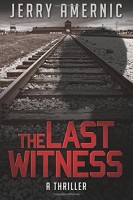
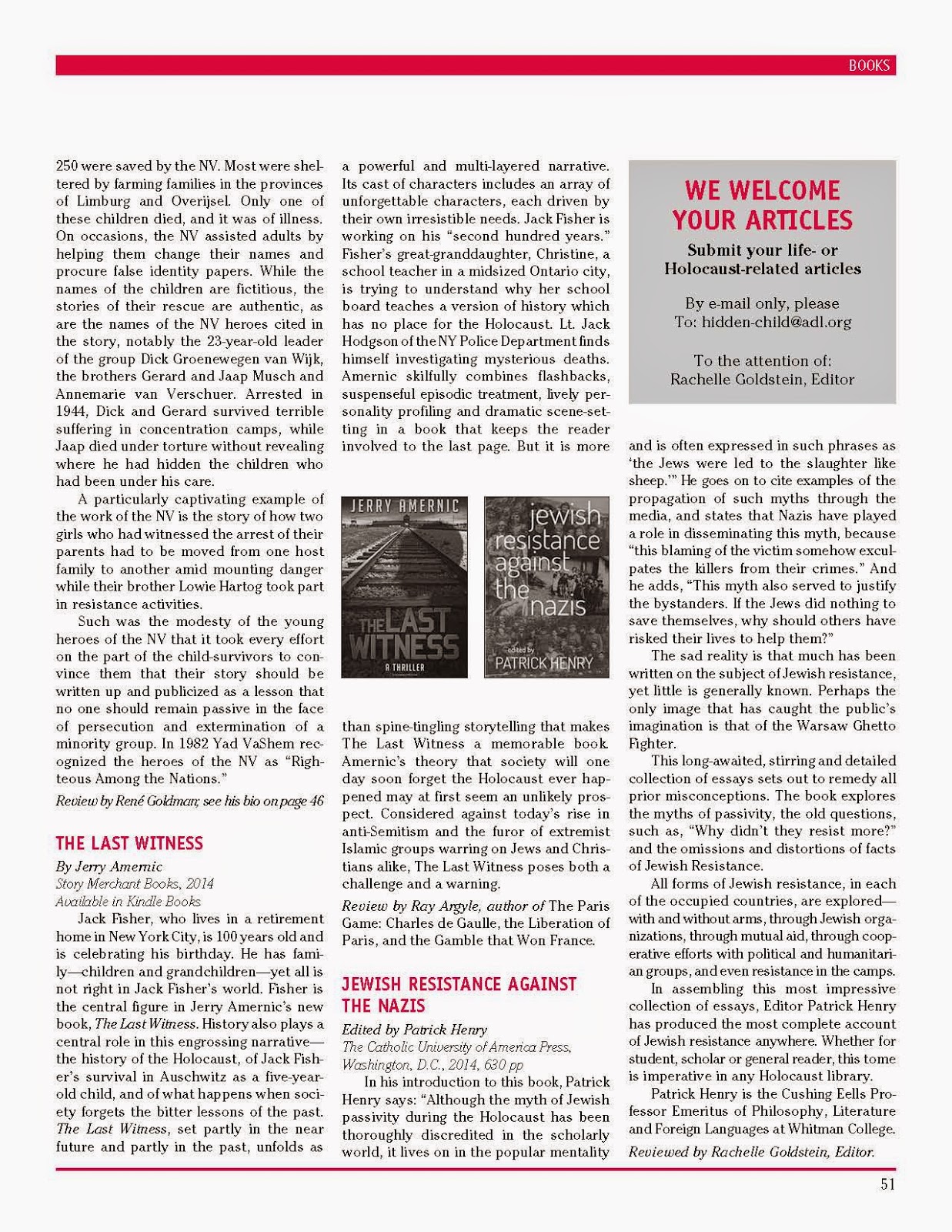
The year is 2039, and Jack Fisher is the last living survivor of the Holocaust. Set in a world that is abysmally complacent about events of the last century, Jack is a 100-year-old man whose worst memories took place before he was 5. His story hearkens back to the Jewish ghetto of his birth and to Auschwitz where, as a little boy, he had to fend for himself to survive after losing his family. Jack becomes the central figure in a missing-person investigation when his granddaughter suddenly disappears. While assisting police, he finds himself in danger and must reach into the darkest corners of his memory to come out alive.
What inspired this book?
Guest post by Jerry Amernic
The Last Witness is a novel that has been germinating in my mind for a long time. It’s about the last living survivor of the Holocaust in the year 2039, with a protagonist who is 100 years old and still in possession of his faculties. But the near-future world I devise here is abysmally ignorant and even more complacent about events of the past century. Let’s make it clear right off the bat; this is not sci-fi – not even close, I don’t write sci-fi – but rather a commentary on what is already happening in the world today, albeit in the guise of a thriller that packs a lot of history between the covers.
My central character, Jack Fisher, is a man whose worst memories took place before he was 5. After the sudden disappearance of his granddaughter, actually his great-granddaughter who is a schoolteacher, he becomes the central figure in a missing-person investigation that winds up involving two countries – the United States and Canada. A sympathetic NYPD detective takes on the case and, in the process, befriends him. While all this is going on, there is a mysterious string of murders of old people taking place around the world.
It isn’t long before Jack finds himself in danger and must reach into the darkest corners of his memory to come out alive. Indeed, some of those memories have been repressed through years, decades, of torment and suffering.
Jack’s story hearkens back to the Jewish ghetto of his birth as a hidden child, and then to the death camp at Auschwitz where he had to fend for himself after losing his family. These are all captured as flashbacks in my novel.
While there have been many books about the Holocaust, including works of fiction, I don’t believe anyone has taken a futuristic slant quite like this. But the seeds for despair about the level of knowledge out there are all around us right now.
In researching this book, I met with real-life child survivors, including some who were liberated by the Red Army in 1945; one of these survivors was as young as three and his memories are very sketchy, but the others were older at war’s end, and the things they remember are etched in stone. I had former child survivors tell me that after coming to North America they were put into classrooms and told by their teachers not to talk about their experiences. One woman who now goes into schools doing talks about the Holocaust had a particularly gut-wrenching story; she was visiting a school only to have a number of Muslim students turn their backs on her when she spoke; they had been told at home that the Holocaust never happened.
I also met with eminent British historian Sir Martin Gilbert who has written extensively about the Holocaust and who is the official biographer of Winston Churchill; one of his suggestions really piqued my imagination and found its way into my novel.
So why did I write The Last Witness? Well, I have been seized by the idea that one day in the not-too-distant future, there will be one last remaining survivor of the Holocaust. If this individual was a child survivor who had been born in 1939, in the year 2039 he would be 100 years old. And that is my Jack. What will the world be like in 2039?
Aye, there’s the rub, as the Bard would say.
Consider this. A Gallup Poll done just a few years ago found that knowledge of the Holocaust was pathetically feeble in the United States. For example, only 46 per cent of Americans polled could say how many Jews were killed, and only 44 per cent could properly identify Auschwitz, Dachau and Treblinka as Nazi death camps. It is a sad commentary when less than half of Americans can answer these questions. In another poll some 70 per cent of Americans said they knew what the Holocaust was, but the sorry flipside of that is that 30 per cent apparently had no idea.
Yet another poll, this in the United Kingdom, found that 28 per cent of people aged 18 to 29 claimed to not know if the Holocaust ever happened at all. Then there was the survey done five years ago in Israel which said that 40 per cent of Israeli Arabs do not believe the Holocaust took place.
In my own country, Canada, knowledge is also on the wane, especially in the province of Quebec. Where I live in Ontario, the school system is such that any young person can graduate from a public high school with but a single credit in history during that whole time, and it doesn’t even have to be North American or European history.
This means we have spawned an entire generation that is abysmally ignorant of history, and the future does not hold good prospects.
The McCormick Tribune Freedom Museum in Chicago was America’s first museum dedicated to the freedoms guaranteed by the First Amendment. It opened in 2006, but closed its doors only three years later and took its displays on the road. In 2008 the museum did a survey. Are you ready for this? Close your eyes. According to the study, while more than half of Americans could name at least two members of TV’s fictional cartoon family The Simpsons (22 per cent could name all five of them), only one in four Americans could identify more than one of the five freedoms guaranteed by the First Amendment.
So consider The Last Witness not so much a commentary on what the near future will look like, but a warning about profound ignorance and complacency just a quarter-century down the road. For what it’s worth, the very first person to post a review on Amazon said she read the entire book through the night, that she could feel the pain of the memories of the witness, and even cried during some parts. If there is one thing an author wants from a reader, it’s an emotional gut reaction.
Stay tuned for my next historical thriller. Qumran. That is the place in the Holy Land where the Dead Sea Scrolls were discovered back in 1947. But the discovery in this story has the potential to make that one pale by comparison.
Jerry Amernic is a Toronto author of fiction and non-fiction books. In doing his research for The Last Witness, he interviewed such people as noted Holocaust historian Sir Martin Gilbert, and met with real-life survivors who were children when they were liberated in 1945.
Reposted from Quiet Fury Books Blog
Guest Post: Op-Ed: History is not a Strong Point with the Young in America
"The Last Witness" is a book about the last Holocaust survivor. Do not take it for granted that the younger generation - those who did not get a Jewish education, that is - knows what that means.
For years I had an idea – a novel about the last living survivor of the Holocaust. The man would be 100 years old. He would have been a child survivor, so after working out the details and doing the math, I pegged his birth to the year 1939. When he is 100 years old we are in 2039, the near future, and that’s when my story in The Last Witness takes place. But there’s a hook. My character is living at a time when knowledge of the Holocaust is pretty meager, and that was the problem this publisher had; he couldn’t buy my premise that one generation from now ignorance of the Holocaust would be widespread.
The novel includes flashbacks about my survivor as a hidden child in a Jewish ghetto, and then being discovered and winding up at Auschwitz with his family. He is the only one who gets out.
Edmund Burke said those who don’t know history are doomed to repeat it, and this is what is so frightening about the current generation. Indeed, their lack of knowledge about times past is an epidemic of dire proportions.
Poll after poll has shown that young people are abysmally ignorant where history is concerned.
I have seen this first-hand. I used to teach writing and journalism to college students; there were those right out of high school and those with university degrees. One thing I learned early on was that history is not a forte with the young, and unless they had attended religious school as children, they also weren’t up to snuff on the most basic biblical analogies. It meant no jokes about living as long as Methuselah. No references to the
One student said that “thousands” of Jews had been killed in the Holocaust, and another said that while he’s heard of the Holocaust, he couldn’t explain it.
parting of the Red Sea. Nothing about David and Goliath or the Three Wise Men.
Have you ever played Trivial Pursuit with someone under 35 and asked questions in the History category? It’s incredible what they don’t know.
After getting the rejection from that publisher, I decided to produce a video. We went out to ask university students in Toronto, where I live, what they know about the Holocaust.
“When did the Holocaust take place?” I asked the first two I encountered.
The two girls stared at each other. Hmm. One of them said, “Nineteen-eighty …” but she wasn’t sure. Then her friend said it wasn’t the 1980s. They looked at each other again. “Nineteen-forty?” they said as one voice.
I asked the next pair, a young man and woman, if they have ever heard of The Final Solution. No they hadn’t. As it turned out, they weren’t up to snuff on D-Day, the Beaches of Normandy, FDR or Churchill either.
Not one student I spoke to that afternoon could tell me who Josef Mengele was. One student said that “thousands” of Jews had been killed in the Holocaust, and another said that while he’s heard of the Holocaust, he couldn’t explain it.
I don’t blame the students for knowing so little about history. When I was their age I might have been in the same boat, except history was compulsory then. But that isn’t the case today, which is why these students were scratching their heads searching for a tidbit of information about the Holocaust or Churchill.
Novelists must learn to deal with rejection. We get rejected all the time and receive replies like “This does not fit in with our current editorial needs.” But when a publisher turns down a novel because “I found that I had to suspend disbelief,” as one of them told my literary agent, that is another thing.
For years I had an idea – a novel about the last living survivor of the Holocaust. The man would be 100 years old. He would have been a child survivor, so after working out the details and doing the math, I pegged his birth to the year 1939. When he is 100 years old we are in 2039, the near future, and that’s when my story in The Last Witness takes place. But there’s a hook. My character is living at a time when knowledge of the Holocaust is pretty meager, and that was the problem this publisher had; he couldn’t buy my premise that one generation from now ignorance of the Holocaust would be widespread.
The novel includes flashbacks about my survivor as a hidden child in a Jewish ghetto, and then being discovered and winding up at Auschwitz with his family. He is the only one who gets out.
Edmund Burke said those who don’t know history are doomed to repeat it, and this is what is so frightening about the current generation. Indeed, their lack of knowledge about times past is an epidemic of dire proportions.
Poll after poll has shown that young people are abysmally ignorant where history is concerned.
I have seen this first-hand. I used to teach writing and journalism to college students; there were those right out of high school and those with university degrees. One thing I learned early on was that history is not a forte with the young, and unless they had attended religious school as children, they also weren’t up to snuff on the most basic biblical analogies. It meant no jokes about living as long as Methuselah. No references to the parting of the Red Sea. Nothing about David and Goliath or the Three Wise Men.
Have you ever played Trivial Pursuit with someone under 35 and asked questions in the History category? It’s incredible what they don’t know.
After getting the rejection from that publisher, I decided to produce a video. We went out to ask university students in Toronto, where I live, what they know about the Holocaust.
“When did the Holocaust take place?” I asked the first two I encountered.
The two girls stared at each other. Hmm. One of them said, “Nineteen-eighty …” but she wasn’t sure. Then her friend said it wasn’t the 1980s. They looked at each other again. “Nineteen-forty?” they said as one voice.
I asked the next pair, a young man and woman, if they have ever heard of The Final Solution. No they hadn’t. As it turned out, they weren’t up to snuff on D-Day, the Beaches of Normandy, FDR or Churchill either.
Not one student I spoke to that afternoon could tell me who Josef Mengele was. One student said that “thousands” of Jews had been killed in the Holocaust, and another said that while he’s heard of the Holocaust, he couldn’t explain it.
I don’t blame the students for knowing so little about history. When I was their age I might have been in the same boat, except history was compulsory then. But that isn’t the case today, which is why these students were scratching their heads searching for a tidbit of information about the Holocaust or Churchill.
The Last Witness is fiction, but a lot of research went into it. I met with former child survivors and Sir Martin Gilbert, the eminent historian and master chronicler of the Holocaust who passed away recently. Gilbert and all those former child survivors had no trouble accepting my premise that knowledge of the Holocaust is lagging and will only get worse in the future.
Should we be concerned? Yes. Today we have a rising Cold War with Russia and a cauldron in the Middle East, never mind far-right political parties getting scary levels of support in many European countries. Hate seems to be everywhere.
With all this in mind, I recently took out a book from the library – Jewish Power: Inside the American Jewish Establishment by respected journalist J. J. Goldberg. The book was a thoughtful, well-researched exploration of the history of Jews in America, the Israel lobby, and what impact Jews may have in certain areas. Goldberg, of course, is Jewish himself. But when I got home I saw, scribbled in pencil on the first blank page just inside the cover, this handwritten message:
‘We hate jews because we know that judaism is not simply another religion but the ideology of class/racial exclusivity apartheid and supremacism and they succeed in imposing their will on the rest of us. Simply put we hate jews because jews hate and control us.’
I was mortified. The message wasn’t signed – bigots are not known for their courage – and I’m sure whoever wrote it didn’t read the book. What is likely is that the person saw the title Jewish Power and thought this was about Jews taking over the world – the so-called Protocols of the Elders of Zion, a myth created in Russia in 1903 and which to this day seeps into the consciousness of those who think they have it all figured out.
After finishing the book, I returned to the library and told the librarian there was an offensive message inside. She promised to address the matter. As for the cretin who wrote it, I can only say this: one thing I know about the human condition is that the greatest crimes in history are due to ignorance. That, of course, brings up our friend Edmund Burke again. But is anyone listening?
Reposted from Israel National News
The year is 2039, and Jack Fisher is the last living survivor of the Holocaust. t in a world that is abysmally complacent about events of the last century, Jack is a 100-year-old man whose worst memories took place before he was 5. His story hearkens back to the Jewish ghetto of his birth and to Auschwitz where, as a little boy, he had to fend for himself to survive after losing his family. Jack becomes the central figure in a missing-person investigation when his granddaughter suddenly disappears. While assisting police, he finds himself in danger and must reach into the darkest corners of his memory to come out alive.
Guest Post: Perspective and balance by Jerry Amernic
The call came on a Wednesday morning. They were a group whose guest speaker had suddenly taken ill and was in the hospital, and could I come and take his place. And when might that be?
The very next day.
Well, they say it’s best to be flexible in life and so, I did it. My topic was A Crusader for Preserving History and while it was short notice – this was as short as it gets – I did manage to bring some books and give them an hour of my schtick which sort of goes like this.
First, put them at ease and offer to speak to their book clubs; this particular group had four of them! Then explain that I’m a writer who talks about heroes, history and ‘perspective.’ What does that mean?
Remember the movie ‘Back to the Future?’ It takes place in 1985 and Marty McFly returns to the 1950s where he tells the crazy scientist played by Christopher Lloyd about the future.
“Who’s the President in 1985?” Lloyd asks.
“Ronald Reagan,” McFly says.
“The actor?” replies the surprised Lloyd. “Who’s the Vice President? Jerry Lewis?”
Funny as that exchange was then, it doesn’t seem so far-fetched now. In 2018. Because it’s all about perspective. We’ve been there, we’ve seen the future and anything is possible.
That accomplished, the presentation continues with a discussion about my books – fiction and non-fiction – and the hero in each of them. And not losing sight of this thing called perspective.
Perspective means you can be a college student who just saw the film ‘Dunkirk’ and loved it, but you don’t know who Winston Churchill was.
Perspective means you can be a refugee from a war-torn country who comes to the West only to wonder what everyone is complaining about over here.
Perspective means you can be a woman who’s fed up with a lifetime of men taking advantage and so, you take part in a march and carry a sign that says ‘Men ruin everything’ and really believe it.
It’s all about perspective. But alas, each of us has different experiences and tends to reach conclusions based on what we know, what we’ve done or what we were told.
This could be why so many people hate so many other people. And yet, perspective is a two-edged sword. On one hand, it can open up the world and on the other, it can be a killer.
In a court proceeding, they start with a Statement of Facts which is a good starting point as long as we realize that an apple is an apple and a banana is a banana. However, nowadays that is fast becoming a blur with so many charlatans out there who put their own fanciful spin on history with alternative facts, fake news, what have you.
Which makes the Statement of Facts more important than ever.
Jerry Amernic is a Canadian writer of fiction and non-fiction books. He is the author of the Holocaust-related novel 'The Last Witness' and the biblical-historical thriller 'QUMRAN'

Jerry Amernic
Ph: 416-284-0838
Mobile: 416-707-8456
www.jerrythenovelist.com
The Girly Book Club Reviews Jerry Amernic's The Last Witness
4/5 *
A dystopian story. 1984 meets The Holocaust. The Last Witness, written by Jerry Amernic, has one of the most fascinating premises for a book I’ve ever come across. Two years ago Amernic asked university students what they knew about The Holocaust and WWII. Their lack of knowledge and incorrect information in their answers inspired Amernic to write this futuristic thriller.
Within the first 4 pages of this book I thought three things:
1. It’s the future
2. It’s set in NYC
3. Although I was already sucked into the plot, the characters, and the language, there was a small part of me that knew it was probably going to break my heart over and over throughout the journey.
And I was right.
Jack Fisher is the last living Holocaust survivor. It’s 2039. Jack has a great-granddaughter Christine who is an 8th-grade history teacher. Christine is fighting the school board to have The Holocaust inserted back into the curriculum. When Christine suddenly goes missing, Jack soon finds himself in danger once again. We’re left to discover that what was once science is now personal belief, and what was once history has morphed into religion.
If Orwell is your guy, and Atwood (The Handmaid’s Tale) is your lady, then this is right up your alley.
For all our sakes, I hope this remains just a great novel and not a sign of things to come
Review by Sara Kafka
Jerry Amernic's The Last Witness Makes the Cut CYGNUS BOOK AWARDS for Science Fiction 2017 – Slush Pile Survivors
The
Cygnus Book Awards recognize emerging new talent and outstanding works
in the genre of Science Fiction, Steampunk, and Speculative Fiction.
The Cygnus Book Awards is a genre division of Chanticleer Book Reviews
Blue Ribbon Awards Writing Competitions.
The year is 2039, and Jack Fisher is the last living survivor of the Holocaust. Set in a world that is abysmally complacent about events of the last century, Jack is a 100-year-old man whose worst memories took place before he was 5. His story hearkens back to the Jewish ghetto of his birth and to Auschwitz where, as a little boy, he had to fend for himself to survive after losing his family. Jack becomes the central figure in a missing-person investigation when his granddaughter suddenly disappears. While assisting police, he finds himself in danger and must reach into the darkest corners of his memory to come out alive.
Jerry Amernic is a Canadian writer of fiction and non-fiction books. He is the author of the new Holocaust-related novel “The Last Witness.”
Guest Post: Reading is bad for your eyes but... by Jerry Amernic
When Jean Chretien was Prime Minister of Canada he once said something about the country’s founding in 1864, but Canada became a country in 1867. Every Canadian knows that. Right? Well, apparently not. By the same token U.S. President Donald Trump isn’t exactly up on American history.
His interview the other day with The Washington Post revealed that he doesn’t know why the Civil War took place and that Andrew Jackson was “really angry” about it. This is quite a stretch when you consider that Jackson died in 1845 and the Civil War began in 1861.
One week earlier Trump was interviewed by Reuters. In that one, he wondered why the Israelis and Palestinians have been fighting all these years.
“There is no reason there’s not peace between Israel and the Palestinians – none whatsoever,” he said.
Uh-huh.
Isn’t it important for world leaders to know a thing or two about history? One would think it should be a prerequisite for office. How can a world leader make informed decisions if he or she doesn’t know anything about the past?
Welcome to the brave new world of the 21st century. It’s a world where we have more information at our fingertips than ever before and people seem to know less than ever. Why? Here are a few reasons.
1. The education system is sadly lacking (I’m being generous when I say this).
2. There is so much choice out there, in terms of what information we want and how we get it, that many take the easy route. Put another way, in the old days you went to the library, but now you go to Wikipedia.
3. Extension of point no. 2 – There is so much choice and so little time that people, by and large, no longer read anything of substance.
A 1968 film called Charly with Cliff Robertson was about a man who is intellectually slow and who undergoes a medical procedure that makes him a genius. He is asked what was raising the standard of living (this was 1968) and he said: “A TV in every room.” Then he is asked about the current state of education and he said: “A TV in every room.”
Which is kind of where we are today, only worse. For the record, here are a few items from my bookshelf that I recommend to young people and current world leaders.
• The Rise and Fall of the Third Reich by William L. Shirer
• Infidel by Ayaan Hirsi Ali
• Roots by Alex Haley
• The Source by James A. Michener (a novel)
• Three Day Road by Joseph Boyden (another novel).
It’s only a beginning. But it’s something.
Jerry Amernic is a Canadian writer of fiction and non-fiction books. He is the author of the Holocaust-related novel 'The Last Witness' and the biblical-historical thriller 'QUMRAN'
His interview the other day with The Washington Post revealed that he doesn’t know why the Civil War took place and that Andrew Jackson was “really angry” about it. This is quite a stretch when you consider that Jackson died in 1845 and the Civil War began in 1861.
One week earlier Trump was interviewed by Reuters. In that one, he wondered why the Israelis and Palestinians have been fighting all these years.
“There is no reason there’s not peace between Israel and the Palestinians – none whatsoever,” he said.
Uh-huh.
Isn’t it important for world leaders to know a thing or two about history? One would think it should be a prerequisite for office. How can a world leader make informed decisions if he or she doesn’t know anything about the past?
Welcome to the brave new world of the 21st century. It’s a world where we have more information at our fingertips than ever before and people seem to know less than ever. Why? Here are a few reasons.
1. The education system is sadly lacking (I’m being generous when I say this).
2. There is so much choice out there, in terms of what information we want and how we get it, that many take the easy route. Put another way, in the old days you went to the library, but now you go to Wikipedia.
3. Extension of point no. 2 – There is so much choice and so little time that people, by and large, no longer read anything of substance.
A 1968 film called Charly with Cliff Robertson was about a man who is intellectually slow and who undergoes a medical procedure that makes him a genius. He is asked what was raising the standard of living (this was 1968) and he said: “A TV in every room.” Then he is asked about the current state of education and he said: “A TV in every room.”
Which is kind of where we are today, only worse. For the record, here are a few items from my bookshelf that I recommend to young people and current world leaders.
• The Rise and Fall of the Third Reich by William L. Shirer
• Infidel by Ayaan Hirsi Ali
• Roots by Alex Haley
• The Source by James A. Michener (a novel)
• Three Day Road by Joseph Boyden (another novel).
It’s only a beginning. But it’s something.
Jerry Amernic is a Canadian writer of fiction and non-fiction books. He is the author of the Holocaust-related novel 'The Last Witness' and the biblical-historical thriller 'QUMRAN'
Guest Post: Where Fake News Began by Jerry Amernic
George Orwell and his epic novel 1984 are making a comeback. His character Winston Smith existed in a world where freedom and privacy have disappeared. Some think this is happening today.
But Wells also wrote War of the Worlds and because of that we can thank him for introducing us to ‘fake news,’ courtesy of a young radio broadcaster named Orson who had almost the same last name. In this case, Welles. In 1938, on the day before Halloween, Orson Welles convinced America that earth was under attack by Martians.
Sound crazy? Well, millions of listeners believed it. The next day The New York Times reported that in one community 20 families rushed out of their houses with wet towels on their faces to protect them from Martian gas. People hid in cellars, hit the road and packed their guns.
We can laugh at this today, but go back to October 30, 1938 and the world was on edge with the rise of Nazi Germany; World War II would begin less than a year later when Germany invaded Poland.
Orson Welles began his radio broadcast by saying it was based on the H. G. Wells novel War of the Worlds, but hey, humans are a strange breed in that we believe what we want to believe.
Which explains why the Protocols of the Elders of Zion – a fictional blueprint for Jewish domination of the world – still carries weight. It was published in Russia in 1903, translated into other languages and eventually went ‘viral.’ American industrialist Henry Ford, a noted anti-Semite, printed half a million copies in the U.S. alone. The Nazi propaganda machine wasted no time stirring up the masses and the Protocols found their way into German schools.
Now it’s 2017. No one trusts the media. What’s more, we don’t even know what constitutes the media and anyone can be the media. This means they can ‘broadcast’ whatever they want – whether it’s based on fact or not.
What with Facebook, Instagram and Twitter, the line between fact and fiction is no longer the blur that it once was. Today the blur doesn’t exist because everything is fact and fiction.
There’s an old joke in journalism that you should never let the facts get in the way of a good story. This notion is running rampant now and it’s not a good thing. It is a dangerous thing. Why?
Because we humans are a strange breed.
Jerry Amernic is a Canadian writer of fiction and non-fiction books. He is the author of the Holocaust-related novel 'The Last Witness'.
Historical Novel Society Reviews Jerry Amernic's The Last Witness
The Last Witness
Jerry Amernic’s gripping historical thriller The Last Witness has an intriguing framing narrative set not in the past but in the future: the year 2039, when Jack Fisher, age 100, is the last living survivor of the Holocaust. When he was just a boy, he lost his family in the Auschwitz concentration camp and was forced to scramble in order to survive. At the time the story opens, these memories are now far in the past, but they suddenly become relevant again when Jack becomes the key figure in a missing-persons case when his granddaughter disappears.Amernic expertly juxtaposes a future that seems both uninformed and uninterested in the past with a past brought vividly to life with well-researched details, squarely tackling such issues as anti-Semitism and Holocaust denial while also crafting in interesting plot-driven dilemma in Jack’s “present.” The seemingly disparate plot threads are woven together in the end into a very satisfying dramatic payoff.
Recommended.
Reposted from Historical Novel Society
Jerry Amernic Author of The Last Witness on Voice of Israel!
VOI's Judy Lash Balint hears
from author Jerry Amernic on 'The Last Witness,' the book he wrote to
counteract ignorance about WWII.
Amernic, a Canadian journalist, interviewed college
students and discovered they knew nothing about the Holocaust or WWII.
He explains why he thinks his novel about the last living Holocaust
survivor may help preserve this important historical memory.
Listen Now
Listen Now
A Conversation with Historical Thriller Writer Jerry Amernic
Jerry's historical thriller is titled The Last Witness (Story Merchant Books; October 2014 trade paperback and ebook formats) and we recently had the opportunity to spend some time with him talking about it.
— ♦ —
Omnimystery News: Introduce us to the lead character of The Last Witness.Photo provided courtesy of
Jerry Amernic
OMN: Will we be seeing him in a sequel?
JA: Well, when your lead character is 100 years old, it doesn't leave much room for a sequel. But The Last Witness is a standalone book.
OMN: How did you go about finding the right voice for Jack?
JA: Jack is a male and I can't say why exactly, but my last living survivor was always going to be a man. No particular reason. However, another major character in the book is his great-granddaughter Christine and this character was never going to be a male. As for the voice, I find as a writer that the character "grows" into the voice as you write. The character grows inside you and pretty soon that character is writing his or her own dialogue. You are just the conduit.
OMN: The cover of The Last Witness calls it a thriller. Would you agree with that?
JA: I always have a problem with pinpointing the genre. My books are definitely historical, but they are also suspenseful and thrillers. But "thriller" can mean a lot of different things. Maybe it's best to have a look at the reader. My reader knows history and, if I may use such a word, is pretty sophisticated. This reader already knows history, is a student of it, and asks a lot of questions.
OMN: How would you tweet a summary of The Last Witness?
JA: A historical thriller about the last living survivor of the Holocaust caught in a near-future world that doesn't know history.
OMN: How much of your own personal experience have you included in the book?
JA: Every character created is a compendium of both real and imagined characters. And the situations in my book are all real. They happened. They have been chronicled. What I do is take these situations and create characters who twist and turn with the story.
OMN: Tell us a little more about your writing process.
JA: I definitely let the story develop as I write. If there is a plan it's a loose one. Here is what I do. I write and write and write. And keep writing. I go back to the beginning and rewrite. The story evolves and gets developed like a painting or better still, a sculpture. The writer sculpts until the thing is finished.
OMN: How did you go about researching the plot points of the story?
JA: For The Last Witness I made a point of meeting real former child survivors of the Holocaust and hearing their stories. Some of my flashbacks take place in a Jewish ghetto so I read everything I could find about that. Other flashbacks take place in Auschwitz. Same thing there. And with me fact-checking historical flashbacks is very important. I want my story to be authentic. I don't bend history. I had a former child survivor proofread all my flashbacks.
OMN: How true are you to the settings in the book?
JA: Again, I am not one to bend history and here's an example. At first I was planning to write about the Warsaw Ghetto and the Warsaw Ghetto Uprising. But no Jews from Warsaw were sent to Auschwitz. They went to other death camps and I wanted to write about Auschwitz. I settled on the Jewish Ghetto in Lodz, the next biggest city in Poland.
OMN: If we could send you anywhere in the world to research the setting for a book, where would it be?
JA: It depends on the next book. I'm currently in the middle of a novel I wrote years ago and it's about the Iroquois Indians. I have already been to all the necessary sites so what I'm doing now is rewriting and making it better. My most recent novel Qumran is largely about the Dead Sea Scrolls and Jerusalem. I made a point of personally visiting all the crucial places myself and inside the cover there's a great photo of me standing in the cave at Qumran which coughed up 500 Dead Sea Scrolls.
OMN: What are some of your outside interests? And have any of these found their way into your books?
JA: Absolutely. I'm a student of history and a nut about archeology. If I could do it all over again I would probably study archeology at university. And of course people are of great interest to me. We are indeed a crazy bunch who often do incredible things — both great and not so great.
OMN: What is the best advice you've received as an author?
JA: My agent gave me the best advice. He said to write over my keyboard in ten words or less what my book is about. Then he said every page and every paragraph has to be about that, and if it isn't, cut it. It's not easy to do this, especially for new writers. The cuts are like amputations. An arm here. A leg there. But it's good advice. The key is to remember your reader. The reader is the most important person in the world.
OMN: Complete this sentence for us: "I am a thriller writer and thus I am also …".
JA: I'm a writer of serious and suspenseful historical fiction for the intelligent reader.
OMN: Have you ever used a pen name?
JA: I've never used one but Stephen King sounds like a good name to me.
OMN: Tell us more about the how the book came to be titled. And were you involved with the cover design?
JA: The Last Witness was previously The Last Child and before that it was The Last Child of Brzezinka. I'm not making this up. But I got some advice and listened. The cover was created by the designer and I loved it. They asked for my input and I gave it. We tweaked a bit and settled on things.
OMN: What kind of feedback have you received from readers?
JA: If I get emotion I'm happy. One reader said they were up all night sometimes crying in their bed. Any kind of emotion is good. Even if they hate it you have triggered an emotion.
OMN: Suppose The Last Witness were to be adapted for television or film. Who do you see playing the lead role?
JA: Gee, I'd like to be able to answer this, but I don't really know. The Last Witness would make a great movie. I've been told that. But I'm still at the book stage. Let's make it a success as a novel and we can talk about the movie later.
OMN: Have any specific authors influenced how and what you write today?
JA: My favorite author is James A. Michener. He wrote historical epics about a certain place and time with lots of incredible characters. I ate this stuff up. I would look forward to the evening when I could absorb myself in his novels. The Source is probably my favorite book of all. But I also like other authors like Ken Follett whose first book, Eye of the Needle, I still think just might be the best thriller ever written.
OMN: When selecting a book to read for pleasure, what do you look for?
JA: I want to be entertained, but I also want to learn. So when it comes to historical fiction I pick something that is interesting and that I want to know more about.
OMN: Create a Top 5 list for us on any topic.
JA: Let's go with movies. Top Five? Godfather I and II. Ben-Hur. Ghandi. Braveheart. Dances With Wolves. You get the idea.
OMN: What's next for you?
JA: As mentioned earlier, I'm working on a novel called Medicine Man which is about the history and legacy of the Iroquois Indians. The Iroquois played a prominent role in the formation of both Canada and the United States, and don't get nearly enough credit. Hopefully, I can help.
— ♦ —
Jerry
Amernic is an author of fiction and non-fiction books. He has been a
columnist and correspondent for daily newspapers, and is a contributor
to many magazines. An avid student of history, the sciences, and
archaeology, he is a member of such organizations as the Royal Ontario
Museum, the James A. Michener Society, and International Thriller
Writers.For more information about the author, please visit his website at TheLastWitness.ca and his author page on Goodreads, or find him on Facebook and Twitter.
Reposted from Omni Mystery News
Lance Wright
Guest Post ~ The Last Witness by Jerry Amernic
Many years ago – just how many it was I have lost count – I got this idea of writing a novel about the last living survivor of the Holocaust. It lingered at the back of my mind for the longest time, and then one day I started putting the story together.
My character was born in 1939 in the Polish city of Lodz. He was Jewish, of course, but was part of the Jewish ghetto which meant that his parents had to hide him from the Nazis. As a little boy of four he would sneak into the Aryan section of the city, going through the sewers, so he could steal food for his family. And so, I learned whatever I could about the Lodz ghetto, the sewers, and the people who tried to avoid being found.
But eventually they were discovered and the family was sent to Auschwitz, the most notorious death camp of the Nazis. My little boy would survive, the only member of his family to do so, and how he made it out of there would be a tale for the ages. And it is.
It’s in my novel The Last Witness.
But fast-forward to his 100th birthday when he’s living in a seniors’ home in New York City. The year is now 2039 and just about everyone he encounters doesn’t know much about the Holocaust. Some people think the whole thing was exaggerated while others don’t believe that it ever happened at all.
To write a novel like this I made a point of meeting real-life, former child survivors, and to say that each of them has a unique story would be an understatement. But I listened to them and took it all in. I also asked these people if any of them thought that my premise about Holocaust ignorance in the near future was far-fetched.
Not one of them did.
However, a publisher who turned down the book had that sentiment, which gave me another idea. I decided to produce a video. A videographer and I spent an afternoon asking university students what they know about the Holocaust and World War II. You can see the video, if you like – http://youtu.be/CRC_T07dwZo – but believe me when I say that the level of knowledge for the next generation of our leaders is pretty damn abysmal.
And for that I blame the schools because they just don’t teach history the way they did when I was young, which only makes my near-future story more relevant. At least, I think so. Hopefully, you will too.
Publisher: Story Merchant (October 1, 2014)
Genre: Historical Thriller
ISBN-10: 0990421651
The year is 2039, and Jack Fisher is the last living survivor of the Holocaust. Set in a world that is abysmally ignorant and complacent about events of the last century, Jack is a 100-year-old man whose worst memories took place before he was 5. His story hearkens back to the Jewish ghetto of his birth and to Auschwitz where, as a little boy, he had to fend for himself to survive after losing all his family. Jack becomes the central figure in a missing-person investigation when his granddaughter suddenly disappears. While assisting police, he finds himself in danger and must reach into the darkest corners of his memory to come out alive.
Reposted from Lori's Reading Corner
Subscribe to:
Posts (Atom)