"The universe is made of stories, not of atoms."
—Muriel Rukeyser
____________________________
Showing posts with label E Books. Show all posts

A NOVELIST’S TOOL KIT


Perfecting Your Craft


Nothing takes the place of practice. A famous athlete once said, “If you’re not practicing, someone out there is practicing. And when he meets you he will beat you.” Writing isn’t just a talent, it’s a craft that requires the honing of skill and technique. In this chapter I’ll give you several concrete suggestions about how you can improve yourself as a commercial novelist.

A novelist’s toolkit

A novelist’s medium is story, his form the contemporary novel. His most basic tools are character, action, setting and narrative voice. From the alchemy created by mixing these, a story emerges. Let’s examine each of these elements in turn.

Major, minor, and supporting characters

Character is by far the most important element of a novel. To the extent that your readers are “on board” with your protagonist, they will stay committed to your story. An unforgettable protagonist, even if he appears complex and multifaceted to the reader, is made up of just a handful of key components:

1.) Motivation: What makes your protagonist tick? What does he want? Your character must be struggling with one of the major human drives, including love, hate, fear, anxiety, vengeance, rage, jealousy, ambition, and greed. Your readers know these drives intimately; odds are, they’ve grappled with them in their own lives. They’ll respond to them.
Identify one drove for each of your characters and develop it. The best stories take a single, profound emotion and plumb its depths through all the characters like variations on a theme in music; the worst stories skim the surface of many different human drives, leaving their readers lost, confused, and unsatisfied. A well-constructed protagonist may possess two drives that are in conflict with each other, but rarely more than this. He is driven by greed and fear, for example, so that each step toward his goal of riches increases his psychological pain. In real life, people run a gamut of emotions, explore many drives, but not in well-made fiction. The beauty of the “what if” pattern (“What if a man driven by greed was as strongly driven by fear?”) is that it allows us to isolate and explore the ramifications of action issuing from such a character.

2.) Mission: Your protagonist needs a job to do, a goal for his drive. If it’s greed you’ve chosen, you may want to be the man who aims at being the top player on Wall Street, the woman who corners the oil exploration business, the couple who want to have more than anyone else at their country club. It doesn’t matter whether the character chooses to undertake the mission himself, or it’s thrust upon him. The mission should relate directly, in one way or another, to the character’s motivation. 

The mission must be involved enough and challenging enough to sustain the story for the duration of the novel. It must lend itself to challenges, both in the form of obstacles, and in the form of an antagonist. 

An antagonist, by definition, is a force that works against your hero’s mission—your protagonist’s nemesis. Your antagonist will not necessarily be a bad guy—he might not even be a person at all. In Sebastian Junger’s novel The Perfect Storm, nature is the antagonist. It’s the storm itself that foils Captain Billy Tyne’s mission to come home with a boatload of swordfish. In Steve Alten’s Domain, the antagonist is the other-worldly dragon creature who rises from the bottom of the Gulf of Mexico after lying dormant for millions of years.

3.) Obstacles: Action happens when your hero struggles against obstacles to his mission. The obstacles you choose to confront your protagonist must be appropriate for him—don’t pit Bambi against the Galactic Empire. Arrange your series of obstacles in ascending order, so that the tension rises throughout your story. Your obstacles, ideally, should relate to one another in some fashion. And like all the other elements of your story, they must have a beginning, middle, and end.

4.) Relatability: If your audience can’t identify with your protagonist, they’re not going to be able to involve themselves in your story. Beginning writers often get the impression that a protagonist has to be likable. But if that were the case, we couldn’t enjoy Bill Murray’s performance as the irascible Frank Cross in Scrooged. Readers don’t have to like your protagonist. They just have to relate to him. They have to see the direction you’re pointing him in, and root for him to go there. If he’s a jerk, the audience must hunger for his redemption. You can’t help rooting for Hero’s Bernie LaPlante, even if you do want to kick him.

5.) Change: Over the course of the story, your protagonist must face his shortcoming, or his fear, or whatever it is that’s really keeping him from achieving his mission. He must grow into his ability to meet the goal you’ve set for him. In real life, human change is nebulous, messy, imprecise. In fiction, it can’t be. Your character’s change must progress in a logical, clear series of steps. See Lajos Egri’s The Art of Dramatic Writing for a thorough discussion of the steps that lead a character from state A to state B. 


All five of these elements must be present in your protagonist. And as you’ve no doubt noticed, all of these attributes link directly to your novel’s action. Because in a good story, the action happens as it does because of who your protagonist is. Conversely, your protagonist develops as he does because of the way the action unfolds. Action and character drive each other.

All the elements in your novel must support this single line of protagonist in action. This holds true as well for all the other characters who populate your novel. Whether major, minor or functional, characters only belong in your story to the extent that they serve the action line.

Minor or supporting characters have a “tag”: a single attribute that defines them and makes them memorable. Any supporting character who isn’t memorable should be instantly thrown out.

A minor character’s “tag” can be just about any attribute: greed, lechery, or like Sally’s friend in When Harry Met Sally, an all-consuming desire to get married. Don’t spell it out, though. If a character is absent-minded, show it in action, thought and dialogue, don’t use the phrase “absent-minded” or you rob audience of the chance to figure it out for themselves.

A minor character can have a motivation but not a mission—that’s your protagonist’s job. They, too can evolve, but not along the same lines as your protagonist. Your minor characters are there to make his life more interesting. Establish them quickly, then move on.

Function characters play an even less important role than supporting characters. They perform a single function without being involved in the main character’s motivation. They ride in at sunset to deliver the fateful telegram, then ride away again. They serve the drinks, drive the cabs, do their duties, then go upon their way. Unlike your protagonist and minor characters, they’re supposed to be forgettable.

Keep function characters simple. If you spend too much energy on them your readers will start to think they’re more significant than you mean them to be. Then when the character disappears, it will feel to your readers like you left something dangling, or worse, like you misled them.

Keep in mind that your characters are not real people but devices that you invented for the sole purpose of capturing and holding your reader’s attention. As such, it’s your primary responsibility to keep them interesting. The best way to do that is to give them, at all times, something significant to do.

Your audience wants action. The best writers don’t get wrapped up in the complex psychological machinations of their characters. They write to satisfy their readers’ expectations. Your audience wants more than anything to see how your protagonist gets out of the corners you paint him into. All you have to do to create a compelling novel is: don’t disappoint your readers! 


Kathleen Vail's Reconstructing The Shield of Achilles on It's Write Now's Best Selection of eBooks

RECONSTRUCTING THE SHIELD OF ACHILLES

cover
[Vail] has changed the words back into gold and silver… revivified the text… She has provided for us a glimpse of the world of archaic Greece. – James A. Arieti
Gloriously described in the Iliad, Achilles’ shield is ingeniously crafted by Hephaestus, ancient Greek god of the forge. Visiting him on Olympos, the sea nymph goddess, Thetis, petitions new armor for her son.
Hephaistos replies, “Have courage, my Lady, please trust me! Good gear I can make, but to hide him from death? Now, that is another matter. I only wish I could help him with that, as I can with the making of arms, for I am an expert. No eyes have beheld such gear as I shall provide him!”
True to Hephaistos’ word, Achilles’ divine armor offers the hero a path to revenge, the fulfillment of his destiny, and his key to immortal glory. But as he prepares for battle, Achilles is not blazing with heroic fervor. He’s burning with unrestrained grief, mourning for his beloved Patroklos, trusted chariot driver, brother in arms, his friend with whom he shares everything, especially his heart. Lost to the heat of battle, laid low at the hand of Hektor, slain of life and stripped of armor, his beloved is lost to the ravages of war.
Filled with passionate hatred of war, Achilles swears he will fight the whole Trojan Army single-handed until he takes revenge and brings the Trojan War to its epic end. Donning his new armor, Achilles shines from head to toe in blazing bronze, his body emitting a halo of flames.
Homer brings it all together, right here. Life and death, revenge and hate, righteousness and evil, glory and fate. The voices of the muses strain to the point of breaking as their song empowers Achilles with supernatural fire. Lifting his shield and charging into war, the epic weight of Achilles’ fate tips the scale of Justice in favor of Peace, ushering in the closing act of the Trojan War.
(From the Foreword by Dr. James A. Arieti, Grave H. Tompson Professor of Classics, Hampden-Syndey College, Virginia:)
The arms are presumably lost, but fortunately for us, Kathleen Vail has reconstructed it.
Using her Homer the way Schliemann used his, she has excavated from the text the shape and composition of the shield of Achilles. In so doing she has confounded some of the critics, who claimed it could never be done.
“Detailed reconstruction of the shield is impossible,” writes Webster.
“…nothing so comprehensive and detailed as this could ever have been seen by Homer or his audience,” says Hogan.
“It is not to be supposed that the poet had ever seen such a shield as he describes,” claims Gardner. (1)
Finding artworks of roughly contemporary handiwork, she documents the illustrations and shows that indeed they could have been found on a shield such as Homer describes. It took a god one night to construct the shield; it has taken Ms. Vail–a mere mortal–five years of work and study to complete hers.
Reading Homer’s description of the shield while looking at the illustrations will compel one to read slowly, savoring the details.
A humorless Platonist–the kind who took Plato literally and failed to see the smile behind the dialogues–might think that these images take us even further away from the reality of the ideas. Homer, the Platonist would say, imitated in words the shield Achilles used; Ms. Vail altered the medium and put the words into pictures, moving still more distant from the original idea of a shield.
What does the dour Platonist know? She has changed the words back into gold and silver; she has revivified the text. She supplies the modern reader with an image for his mind’s eye to grasp on to. She has provided for us a glimpse of the world of archaic Greece.


TIPS: New Smashwords Research Helps Authors and Publishers Sell More Ebooks

Mark Coker Founder, Smashwords


Last year at the 2012 RT Booklovers in Chicago, I released a first-of-its-kind study that analyzed sales data for self-published ebooks. Our goal was to identify potential factors that could help authors sell more ebooks.

Two weeks ago at the 2013 RT Booklovers convention in Kansas City, I shared new, updated data in a session titled, Money, Money, Money -- Facts & Figures for Financial Payoff.

Some of the results were surprising, some were silly, and some I expect will help authors and publishers make their ebooks more appealing to consumers.

2013-05-15-wordcloud.pngFor the study this year, we analyzed over $12 million in sales for a collection of 120,000 Smashwords ebooks between May 1, 2012 through March 31, 2013. We aggregated our sales data from across our retail distribution network, which includes the Apple iBookstore, Barnes & Noble, Sony, Kobo and Amazon (only about 200 of our 200,000 titles are at Amazon). As the world's largest distributor of self-published ebooks, I think our study represents the most comprehensive analysis ever of how ebooks from self-published authors and small independent presses are behaving in the marketplace.

Imagine dozens of levers and dials attached to a book that the author can twist, turn and tweak. When you get everything just right, your book's sales will increase through viral through word-of-mouth. In my free ebook, The Secrets to Ebook Publishing Success, I refer to these tweakable levers as Viral Catalysts. A Viral Catalyst is anything that makes a book more available, more accessible, more discoverable, more desirable and more enjoyable to readers.

The survey attempts to identify Viral Catalysts by analyzing the common characteristics of bestselling (and poor-selling) Smashwords ebooks.

We posed a series of questions to our data to reveal answers that might help authors reach more readers.

The questions included:

    Do frequent price changes help authors sell more books?

    Do longer or shorter book titles sell more books?

    Do longer or shorter book descriptions sell more books?

    How do sales develop over time at a retailer, and what factors might spark a breakout?

    Do longer or shorter books sell better?

    What's the average word count for the 60 bestselling Smashwords romance books?

    What does the sales distribution curve look like, and how many books sell well?

    How many words are the bestselling authors selling for a penny?

    What are the most common price points for indie ebooks, and what changed since last year?

    How many more downloads do FREE ebooks get compared to priced ebooks?

    How have Smashwords sales grown at the Apple iBookstore in three years?

    How does price impact unit sales volume?

    What price points yield the greatest overall earnings for authors and publishers?

    What does the Yield Graph portend for the future of publishing?


Read More For Key Findings

Sci-Fi's Underground Hit

Authors are snubbing publishers and insisting on keeping e-book rights. How one novelist made more than $1 million before his book hit stores.


Simon and Schuster has put down six figures for print rights to a post-apocalyptic thriller called "Wool" that it believes could draw the same readers that made "The Hunger Games" trilogy a success. WSJ's Alexandra Alter reports on Lunch Break. Getty Images. 

Hugh Howey's postapocalyptic thriller "Wool" has sold more than half a million copies and generated more than 5,260 Amazon reviews. Mr. Howey has raked in more than a million dollars in royalties and sold the film rights to "Alien" producer Ridley Scott.

And Simon & Schuster hasn't even released the book yet.

In a highly unusual deal, Simon & Schuster acquired print publication rights to "Wool" while allowing Mr. Howey to keep the e-book rights himself. Mr. Howey self-published "Wool" as a serial novel in 2011, and took a rare stand by refusing to sell the digital rights. Last year, he turned down multiple seven-figure offers from publishers before reaching a mid-six-figure, print-only deal with Simon & Schuster. 

How Amazon Saved My Life - Indie Reader [via Terry Stanfill]


by Jessica Park

....

Amazon is the true powerhouse right now. Say what you want about this company, but it’s because of them that I can continue writing. It’s unclear to me how a big publisher thinks that I could live on their typical payouts, and why they think I should drop to my knees in gratitude for their deigning to even publish my book in the first place when I’ll do all the work myself. I’m not going to be grateful for that nonsense, but I am going to be grateful as hell to Amazon.

Bestselling trad-to-indie-author Barry Eisler, famous for turning down a six figure deal from St. Martins Press to go out on his own, took a lot of heat for having compared an author’s relationship with a big publisher to Stockholm syndrome. The truth is that it’s not a bad comparison at all. Snarky, funny, and exaggerated, perhaps, but there is more than one grain of truth there, and I just know that authors across the country were nodding so violently that we had collective whiplash. When writing for a publisher, you learn to be overly thankful for every pathetic little grain of positivity that comes your way. A disgustingly awful cover? Smile broadly and say how gorgeous it is. Contracts arrive months after arranged? Whip out your pen and sign with no complaints. You’re eating Ramen noodles while they are taking all of December and January off and while they essentially shutdown during the summer to vacation on the Cape? Slurp your soup and be happy.

Because of Amazon and other sites, I’m making enough money that I can continue writing. I’m averaging sales of 3,500 books a month, not including the month that Amazon featured Flat-Out Love in a list of books for $3.99 and under. That month I sold 45,000 Kindle copies, and sold over 10,000 the next month. Those numbers are insane to me. Absolutely insane. The fact that I continue to sell well a year after the book’s release is humbling. Yes, I wrote a book that has earned me excellent reviews, so I take credit for that, and I worked myself to death finding bloggers to review my book (God bless my loyal bloggers who took a chance on me!), but I have to credit Amazon with giving me such a strong platform with such overwhelming visibility. I can be a writer. I am a writer.

And it’s not just me. Self-published authors, many of whom are writing about college-age characters, are finding viable careers. Abbi Glines, Tammara Webber, Jamie McGuire, Tina Reber, AK Alexander, Angie Stanton, Stephanie Campbell, Colleen Hoover, Liz Reinhardt, and plenty more. I’m seeing more and more traditionally published authors walking away from the headaches and turning to self-publishing. It can be tricky to leave because very often an author needs the advance money in order to survive, and then gets stuck contracted for books that quite likely won’t earn out that advance or won’t ever provide much in terms of royalty checks.
When authors break the cycle, get the hell out, and flourish on their own, it’s a wonderful thing. Read Entire Article Here

Hollywood snaps up hot ebook titles


Producers mine a new source of branded material

ebooks are emerging as a sexy new source of material for Hollywood.

ebooks are emerging as a sexy new source of material for Hollywood.

With the "50 Shades of Grey" series hitting 10 million sales this week, ebooks are emerging as a sexy new source of material for Hollywood. The majors are keeping a close eye on digital bestseller lists and showing a willingness to pay traditional book-rights fees for digital titles -- provided they come with built-in brand awareness.

The hunt to option such titles is heating up after a handful of high-profile sales of ebooks, many self-published, including April's $3 million sale of "50 Shades" to Universal. Observers credit "Shades" with paving the way for subsequent sales of "Wool" and "On the Island," both of which sold for big bucks despite the fact that both went straight to Kindles and iPads without going through major publishers.

"As we've known for years and years, the studios have been much more interested in brands, whether that's a board game or video game or traditional book," said Steve Fisher, veep of APA and a literary agent who represents books-to-films deals. "The last couple of deals have really indicated a huge willingness on the part of studios and other buyers to be open to ebooks in a way they hadn't been before."

Fisher most recently repped the author of "On the Island," a romance eBook which MGM snapped up (Daily Variety, May 14). Tome by Des Moines, Iowa resident Tracey Garvis-Graves spent five weeks on the New York Times bestseller list before the Lion forked over a low- to mid-six-figure fee.

"The effect is that they're looking more closely than ever at the ebook list for the original ebook bestsellers," said Jody Hotchkiss, a literary agent with Hotchkiss and Associates.
But traditional books have a key advantage over their digital counterparts: publishers tend to get into business with known quantities, or properties vouched for by literary agents. With ebooks, it's the Wild West when it comes to identifying promising authors and material. Digital books are virtually free to publish, and there's no gatekeepers vetting their quality.
According to data from research firm Publishers Marketplace, film and TV producers bought rights to 209 books last year and 79 so far this year. Very few of those were ebooks, and nearly all sold before they were published.

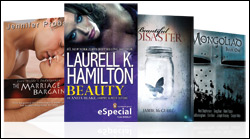
That means ebooks grab the attention of lit agents only after they start rising on the charts or generate enough word-of-mouth buzz. Currently high-charting ebooks include "Beauty" by Laurell K. Hamilton; Neal Stephenson's sword-fighting epic "Mongoliad"; romance "The Marriage Bargain" by Jennifer Probst; and "Beautiful Disaster" by Jamie McGuire -- none of which have yet been picked up. Meanwhile, E.L. James' steamy "50 Shades" continues to top the ebook chart.

The New York Times began listing bestselling ebooks in early 2011, a few months before thriller author John Locke reached 1 million in sales for his ebooks. But just like with traditional book publishing, getting discovered is a big challenge for the ebooks that aren't perched atop the bestseller list.

"The tricky thing about ebooks is that there are a lot of them out there," Fisher said, pointing out that ebooks don't get promoted the way traditional books can be. Reps often catch wind of self-published material by looking at the top-sellers lists on Amazon and iTunes.

"We follow sales by looking online, just as anybody can," said Jane Dystel, president of literary management agency Dystel & Goderich. Dystel found "On the Island" author Garvis-Graves by checking online book sales, later bringing the scribe to Fisher.

"The availability of ebooks is much greater today than it was even six months ago ... as the availability of good books increases, of course Hollywood is also going to be more interested," she said.

But because many are self-published, ebooks must also contend with the stigma that they're not the same quality as traditional novels. Most agents would rather not dig through the virtual slush pile in the hopes of finding a "50 Shades."

"I'm finding that book scouts in New York are really integral to this process even more so than they are (for) traditional books," Fisher said. "It's harder for your average ebook to separate itself from the pack, but a lot of these authors are very savvy at promoting themselves."

Case in point: Amanda Hocking, the 28-year-old self-published writer whose popular paranormal teen novels landed her a movie contract with Media Rights Capital last year. After selling more than 100,000 ebooks, Hocking landed a $2 million deal from St. Martin's Press for a four-book series, turning down a higher bid from a competitor that she felt wouldn't reach as many readers.

"Studios have signalled that they don't care whether it's an ebook or a hardbook because, ultimately, they bring the same kind of brand awareness that they so value," Fisher said.
Studios are willing to pay for that brand awareness. In a non-competitive situation, traditional book rights often fetch between $150,000 to $250,000 -- a range that now applies to popular e-fare.

While agents like Fisher may not always deal with publishers when it comes to ebooks, they rely heavily on book scouts -- filters that tend to go in and out of vogue as studios cut back budgets and depend upon junior execs to bring in material.

"In-house book scouts stopped being common when the studios determined that New York publishing was less important for movies (than) 10 to 15 years ago," Hotchkiss said.
Studios, for example, often have a book scout in-house or work with an outside company. Disney, 20th Century Fox and Sony, for example, have a scout on staff, while Warner Bros. and Universal work with outside companies on an exclusive basis.

But as hot ebooks continue to go mainstream, Hollywood will surely continue to pay attention.

"Studios and major buyers out here were taking their book scouts' calls a lot more quickly and suddenly paying attention to New York in a way that I hadn't seen in years," Fisher said of the immediate effect of the "50 Shades" sale. "I think that any qualms that buyers had about getting behind an ebook ... (are) gone."

Contact Rachel Abrams at Rachel.Abrams@variety.com

The rise of e-reading [via David Angsten]

21% of Americans have read an e-book. The increasing availability of e-content is prompting some to read more than in the past and to prefer buying books to borrowing them.


Summary of findings


One-fifth of American adults (21%) report that they have read an e-book in the past year, and this number increased following a gift-giving season that saw a spike in the ownership of both tablet computers and e-book reading devices such as the original Kindles and Nooks.1 In mid-December 2011, 17% of American adults had reported they read an e-book in the previous year; by February, 2012, the share increased to 21%.

The rise of e-books in American culture is part of a larger story about a shift from printed to digital material. Using a broader definition of e-content in a survey ending in December 2011, some 43% of Americans age 16 and older say they have either read an e-book in the past year or have read other long-form content such as magazines, journals, and news articles in digital format on an e-book reader, tablet computer, regular computer, or cell phone.

Those who have taken the plunge into reading e-books stand out in almost every way from other kinds of readers. Foremost, they are relatively avid readers of books in all formats: 88%
of those who read e-books in the past 12 months also read printed books.2 Compared with other book readers, they read more books. They read more frequently for a host of reasons: for pleasure, for research, for current events, and for work or school. They are also more likely than others to have bought their most recent book, rather than borrowed it, and they are more likely than others to say they prefer to purchase books in general, often starting their search online.

The growing popularity of e-books and the adoption of specialized e-book reading devices are documented in a series of new nationally representative surveys by the Pew Research Center’s Internet & American Life Project that look at the public’s general reading habits, their consumption of print books, e-books and audiobooks, and their attitudes about the changing ways that books are made available to the public.

Most of the findings in this report come from a survey of 2,986 Americans ages 16 and older, conducted on November 16-December 21, 2011, that extensively focused on the new terrain of e-reading and people’s habits and preferences. Other surveys were conducted between January 5-8 and January 12-15, 2012 to see the extent to which adoption of e-book reading devices (both tablets and e-readers) might have grown during the holiday gift-giving season and those growth figures are reported here. Finally, between January 20-Febuary 19, 2012, we re-asked the questions about the incidence of book reading in the previous 12 months in order to see if there had been changes because the number of device owners had risen so sharply. All data cited in this report are from the November/December survey unless we specifically cite the subsequent surveys. This work was underwritten by a grant from the Bill & Melinda Gates Foundation.

Read More

At Last, They See: E-Books 'Democratize' Publishing


Not known as a hotbed of experimentation, the world of publishing has been slow to embrace the transition from print to e-books. This past week in New York, however, the Tools of Change digital publishing conference attracted entrepreneurs and innovators who are more excited by, rather than afraid of, the future.

It was the kind of crowd where some were more inclined to say "Steal my book!" than to argue over what that e-book should cost. These are people who see digital publishing not as a threat, but as an opportunity.
Joe Wikert of O'Reilly Media, which hosted the conference, says digital publishing is in its infancy but the potential is endless.
"If you come up with something new and exciting, you can change the playing field overnight," Wikert says.

Publishing Power Transfered To Authors

Mark Coker is the founder of Smashwords, an e-book publishing and distribution platform that he introduced for the first time at this same conference four years ago.
"We make it really easy for any writer anywhere in the world to instantly publish any book," Coker says.
In its first year, Smashwords published 400 books, but that quickly increased to more than 100,000. The company's biggest competitor is the behemoth Amazon. That doesn't scare Coker, because he distributes Smashwords' books to any other e-book retailer that wants them. A writer himself, Coker believes the power base in publishing is shifting.
"The power to create great books and the power to distribute great books is transferring to the author," he says. "Just a few years ago, publishers controlled the printing press and they controlled access to retail distribution. So if you couldn't get your book printed and you couldn't get it distributed, you'd never reach readers. But today, the printing press is completely democratized."
Smashwords doesn't edit or curate its books, and Coker says the readers should decide which books will rise to the top and which will fail. And in the brave new world of digital publishing, Coker says, a book is a constant work in progress.
"In the old days, in the print-book days, books were relatively static objects. The publisher would wrap up the book, ship it out and that book would rarely change," he says. "But with e-books, they're these dynamic creatures. Authors have the ability to change anything about the book at any time."
A New Model
Why wait until a book is finished to find out what readers are thinking? Dominque Raccah, CEO and publisher of Sourcebooks, is experimenting with the "agile publishing" model — which allows authors and readers to interact as the book is still being written.
"You really are publishing into a community already," Raccah says. "So what you are going to be doing is developing that book in front of that community, having the community interact with the author to develop the book [and] provide feedback."
A lot of the digital publishing experiments that are getting under way today may not be here a few years from now, but Raccah says the experimentation is key to learning what will and won't work in the future.
Peter Meyers, author of Breaking the Page: Transforming Books and the Reading Experience, says when the dust settles, the book as we know it might be different. Digital enhancements may even make the book smarter, but the experience of reading will be fundamentally the same.
"Once we get through the next couple of years of mania, and that's where we are at ... people will take a deep breath and say, 'Ok, the book is not dying,'" Meyers says. "Is the print book diminishing in its presence? Of course, but the function of the book itself as a break and a refuge and a chance to spend immersive time with an author telling a story, I think is incredibly valuable."
Whatever the future may hold, Raccah says the present is a great time to be in the business of publishing.
"I really feel tremendously blessed that we all get to have this conversation about what the book can be in the future," she says. "What does it mean? How does it work? How do we expand the boundaries of the book? This is a conversation worth living for."
Raccah says when she first got involved in digital publishing she thought she would be developing products for her children's generation. She was wrong about that; the future, as it turns out, is now.