"The universe is made of stories, not of atoms."
—Muriel Rukeyser
____________________________
Showing posts with label meg movie. Show all posts

Director Ben Wheatley says that The Meg 2 might live up to its title in more ways than one.


The Meg 2 is a thing. Three years after the release of the original The Meg, which swallowed up an astonishing $530 million worldwide at the box office, director Ben Wheatley — fresh off his eerie new horror film In The Earth — is deep in pre-production on a sequel to the 2018 thriller that pitted puny humans against a couple of oversized prehistoric sharks.

“I’m storyboarding at the moment on Meg 2,” Wheatley says when we catch up with him for the release of In The Earth. “It’s been going on for four months, five months. It’s my happy place, I love storyboarding. So yeah, I’m cutting storyboards and watching animatics, and slowly constructing the movie. It’s really exciting. It’s just action on a massive, massive scale.”

The first film, based on the popular 1997 novel Meg by Steve Alten, reached the screen in 2018 after more than two decades of development. The property bounced from Disney to New Line Cinema, to Warner Bros., with directors like Jan de Bont (Speed) and Eli Roth (Hostel) attached at various points. Cameras finally rolled in 2016 with Jon Turteltaub (National Treasure) directing from a script by Dean Georgaris and Jon and Erich Hoeber.

The latter pair have apparently returned to pen the sequel, which Wheatley says he has had no hand in writing: “No, the script is by the Hoeber brothers that wrote the first script, so it’s kind of a continuation on from that story.”

As for whether the cast members who survived the first film — which included British action star Jason Statham, Chinese actress Li Bingbing and a handful of others — will also encore in the follow-up, Wheatley is somewhat cagier, although he does drop a tantalizing hint about the title menace. “I don’t think I can say at the moment what’s going on, the ins and outs of it,” he intones. “But guaranteed, there will be a Megalodon — maybe more than one.”

While the prospect of even more Megalodons wreaking havoc in the sequel, which is provisionally called The Meg 2: The Trench, is an exciting one, it’s all but guaranteed that Statham, who is said to be “creatively involved” with the project, will be there punching them as well.

Alten’s novel was altered significantly for the screen, becoming less of a grisly horror shocker and more of a Statham action joint. It’s worth noting that Alten’s own sequel to his novel Meg was also called The Trench, although we don’t expect a faithful adaptation this time either.

The first film’s self-awareness and somewhat jokey tone, coupled with Statham’s own dryly humorous charisma, turned The Meg into a relative rarity: a monster movie that was both fun and not afraid to poke fun at itself. That was enough to lure in those massive audiences and set the wheels of a sequel in motion.

Although Wheatley’s last outing was Netflix’s glossy adaptation of the Daphne du Maurier novel Rebecca — a bold choice since it was previously filmed by Alfred Hitchcock — he’s perhaps best known for his razor-sharp combinations of horror, crime and satire in films like Kill List, Sightseers and Free Fire. If he manages to retain the tone set by the first Meg while adding his personal touch to the proceedings, this could end up being a sequel with, dare we say it, real teeth.

As for going from the high-end esthetics of Rebecca to the guerilla filmmaking of In The Earth (more on that to come) to the presumably explosive, effects-driven action of The Meg 2, Wheatley puts it simply: “I think that’s always the hope, that they’re different [from each other]. You don’t want to end up making the same thing again and again.”


Read more 

Don Kaye

Written by

Don Kaye | 

Don Kaye is an entertainment journalist by trade and geek by natural design. Born in New York City, currently ensconced in Los Angeles, his earliest childhood memory is…


7 Ways The Meg Was Much Better Than You Expected

Jason Statham, talent from around the globe and a great big shark? Sign us up!


Jason Statham’s The Meg, like its titular megalodon, swam a little under the radar on its summer release. In these times of Sharknado after Sharknado, you’d be forgiven for thinking this was more B-movie trash.

But honestly, that does The Meg a disservice. Yes, it’s a B movie but it’s bloody proud of it. Every single person working on the movie knows they’re on a popcorn flick set, and each scene shows how much fun they’re having.

From start to finish, the film is a treat. Jumping seamlessly from laidback scenes fizzing with chemistry to bloody gore, The Meg defies expectation at every turn. Jason Statham, backed up by Rainn Wilson (The Office’s eccentric Dwight Schrute), Ruby Rose and a whole cast of diverse faces combine to make a marvellous summer movie.

Awards season is coming up, and although it’s unlikely to get the awards nod, there are a lot of reasons this film was much better than it’s given credit for.

If you still haven’t caught this future cult classic, there’s a couple of spoilers on entry number six, but the rest are safe, open waters to swim through.


Read more

Steve Alten The MEG & I: 20 Years in the Making Podcast Part 2 with Kent Hill


LISTEN HERE

I first read MEG: A Novel of Deep Terror when it arrived on the scene in the late 90’s and believed then – just as a certain movie out at the moment  has confirmed for the world – that it was/is the basis for something cinematically awesome. But that was twenty years ago, when Alten was poised to become the next Peter Benchley and have his man vs big shark, or in MEG’s case, prehistoric bad-ass shark, optioned before it hit the shelves. All of the ingredients seemed to be there. A new JAWS, it appeared, was on the cards – then, it didn’t happen.

I followed the gestation throughout the years of this mighty megalodon movie that got away. Talented filmmakers crossed its wake, and I confess, I would have liked to have seen Jan de Bont’s take on the material – this talented director of photography  that came to the director’s chair and gave us SPEED and TWISTER. I think had his next picture been MEG, we might well be talking about Jan in a different way – and it might have saved us from SPEED 2?

But they all saw MEG a different way. They didn’t see it the right way. Thus the production floundered and the seasons came and went. The MEG, all the while, lay silent in the depths of development hell.


A YEAR AGO.

I contacted Steve (https://podcastingthemsoftly.com/2017/08/02/20-years-in-the-making-an-interview-with-steve-alten-by-kent-hill/) to talk about the arduous journey his big shark book had taken to get to the screen. (A year before the worldwide press descended with the onset of the film’s success, I might add.) I was excited because, at long last, it seemed as though there was no stopping it now. A live action feature was in production and MEG, or The MEG, as it was soon to be titled, was rising and with or without the ‘The’, we who call ourselves ‘Megheads’ were about to have all we’ve ever wanted.


20 years in the making: An Interview with Steve Alten Part 1 by Kent Hill


Sometimes good things take time. Still, it is rare that Hollywood, being in possession of what it believes is such a ‘hot property’, would allow said property to languish in the depths of development hell. Especially for 20 years. But that is exactly where Steve Alten’s bestseller has been in residence. That, of course, is about to change. 

Yes ladies and gentlemen (and in case you haven’t been following the story) next year Alten’s leviathan shall rise and finally arrive at a cinema near you. I have long been fascinated with the journeys movies take on the road to the big screens on which we witness them. Some of these films never arrive, some appear in a confused and unfinished form. Others are the victims of too many cooks and most are a product of the machine. 

For the films that don’t make it, (see great documentaries like Lost in La Mancha and Jodorowsky’s Dune (though Gilliam seems to have at last remedied this)) their journey is often as intriguing, if not more so, than what the final product might have been. But with MEG, the powers that be have what is a potentially massive franchise on their hands. So, why the wait? 

The fates are strange and fickle. Steve Alten’s bestseller was optioned before it was complete, but it has taken the better part of two decades to arrive. I found this story intriguing, mainly because this was not some sort of artsy passion project or some grand tale of ridiculous hubris. No, what could have been, and what we may yet experience, might very well be the next JAWS? And while Spielberg’s film is by its nature a far more intimate piece; the shark menaces a small community and finally three men set out to kill the beast, MEG is something we are definitely going need a bigger boat for. A really BIG boat for! 

Thus Steve Alten agreed to have a chat with me about the origins of his book’s long gestation toward its screen adaptation. What he relayed I found fascinating, and still believe it could become a great extra feature or a terrific stand-alone documentary of the ride this big shark movie as taken. But, like most fans, I am just grateful that with each passing day, we finally are at last drawing closer to the MEG movie’s premiere. Of course the real relief belongs to the creator. In many ways it has been worse for him, he having served on the front lines, he having been present for each false start and each heartbreaking hurdle. I have agreed to catch up with Steve before the film’s premiere next year. As the hype builds and teasers and trailers and all the ads bombard our senses, what brings me pause and makes me smile is the thought of Steve Alten waking the red carpet, entering the theatre, taking his seat . . . and enjoying the movie… …as I hope you will enjoy this. 

THE MEG: How Imageworks Helped Make a Massive Megalodon


By IAN FAILES

Visual effects studios are constantly being asked to deliver more shots more quickly than ever before. It can be a major challenge to get effects out the door for review, work to final them, and then deal with inevitable changes. Which is why Sony Pictures Imageworks Visual Effects Supervisor Sue Rowe decided to tackle things slightly differently when she took on the challenge of helping to craft the third act of Jon Turteltaub’s The Meg, the tale of a previously undiscovered prehistoric giant shark, or megalodon.

“When the Production Supervisor Adrian De Wet and Visual Effects Producer Steve Garrad came to us, they knew this third act was going to be tricky because story points in the climax of a film are always developing, and they knew they would need a really powerful engine behind them to get that work done,” Rowe tells VFX Voice.

“So the deal we entered into at the beginning was, ‘Hey, we’re going to give you perhaps 400 shots, and we want you to turn them around really fast and then give them to editorial, and then we’re going to hone it down from there.’”

Shark 2.0

To enable Imageworks to turn around so many shots for the third act of The Meg so quickly, Rowe employed several new methods. The first was to rely on Maya’s Viewport 2.0 to work on high-quality but still early versions of the shots directly in the viewport without the need to render.

“The reason I really liked it is that it was super fast,” states Rowe. “You can add fog as depth and you can put spotlights in. You see, when you distill everything down that you need for an underwater movie, it’s pretty much about bubbles and particulates.”

By using Viewport 2.0, Imageworks could turn around versions quickly in a kind of ‘post-vis’ workflow. This included shots that ultimately did not make the final cut of the film. Artists would quickly roto and matchmove plate photography of the actors filmed in a water tank (against an underwater bluescreen) and then hand that over to animation and layout. There was no lighting or compositing done for these early deliveries, but the results were more than good enough for the filmmakers to review shots, after which Imageworks could move onto generating finals with more precision through its traditional pipeline.


 Imageworks provided quick versions of the shots using Viewport 2.0 to get sign-off before continuing.

 Water cavitation effects played a big role in selling the final shots.

The final frame.

    “This is what I always say to people who start out in the industry – the computer might solve it in a certain way, but if it doesn’t look how the director ultimately wants it to look, then we just have to make sure it fits into the movie.”

    —Sue Rowe, Visual Effects Supervisor


Real muscle

Another weapon in Imageworks’ arsenal was Ziva Dynamics’ muscle- and skin-simulation plugin, Ziva VFX. The software takes a physically-based approached, which means more accurate looking skin sliding and movement straight out of the plugin.

“If you build your skeleton accurately, that’s the starting point,” says Rowe. “The system the guys have written will then make the muscles and skin move in the correct way so you don’t have any intersections and it won’t fold in on itself. What was interesting was, it’s also flexible. So if I wanted to have the shoulder of the shark shudder, but in a really extreme way, we could push it to that if we wanted.

“The idea that we employed for Meg was,” adds Rowe, “if you ever look at a thoroughbred horse and how their muscle shakes, it ripples down their body. And from that you know that this is a really muscular, powerful character. So we said, let’s do the same for the Meg. You’ll see a little twitch in the muscle or the gills. We definitely amplified those things using Ziva.”
Lots of coral, super-fast

In addition to the shark itself, Imageworks had to imagine an underwater environment, parts of which required vast amounts of coral. The studio had developed a scattering tool for plant life on Kingsman: The Golden Circle called Sprout, and this was also employed on The Meg for the underwater coral.


Imageworks’ animation pass for a scene involving the underwater glider and the Meg.

Lighting pass.

Final composite with effects and lighting.

    “We built multiple types of coral, different types of rock and sand, and we had some fish in there as well. And then we clustered them altogether and covered it in coral with Sprout. The cool thing about it was, I’d sit down with my effects artist, and they would show me a first pass of it all being laid out, and we were able to interact with the coral, scale them up, scale them down and move things about. It’s a really cool tool.”

    —Sue Rowe, Visual Effects Supervisor


“It’s a way of building indices or replicas of objects very quickly,” explains Rowe. “We built multiple types of coral, different types of rock and sand, and we had some fish in there as well. And then we clustered them altogether and covered it in coral with Sprout. The cool thing about it was, I’d sit down with my effects artist, and they would show me a first pass of it all being laid out, and we were able to interact with the coral, scale them up, scale them down and move things about. It’s a really cool tool.”

Bubbles!

Imageworks had been able to craft a realistic shark and a realistic underwater environment, but there was still another element that was needed to help sell the shots: bubbles. More specifically, it was the cavitation of bubbles around submarines, propellers, and even the Meg itself.

Rowe and her team looked at a multitude of cavitation reference (cavitation actually occurs when the propellers cause the water to boil and get ejected out the back). Noticing that the cavitation trail tends to be quite elongated, this was how Imageworks originally approached simulations in Houdini. However, at some point, notes Rowe, “the director saw a few shots where the cavitation actually rose up, rather than shoot out straight. He really liked this look, even though it wasn’t necessarily physically correct.”

Animation pass for a scene in which the Meg breaches the water surface.

Muscle-simulation pass.


Final shot.

    “If you build your skeleton accurately, that’s the starting point. The system the guys have written will then make the muscles and skin move in the correct way so you don’t have any intersections and it won’t fold in on itself. What was interesting was, it’s also flexible. So if I wanted to have the shoulder of the shark shudder, but in a really extreme way, we could push it to that if we wanted.”

    —Sue Rowe, Visual Effects Supervisor


That meant Imageworks had to re-do several of its original bubble and cavitation simulations. Rowe thinks the ultimate result was much more engaging. “This is what I always say to people who start out in the industry – the computer might solve it in a certain way, but if it doesn’t look how the director ultimately wants it to look, then we just have to make sure it fits into the movie.”

Similarly, there were moments when the filmmakers felt that some underwater shots were still missing something. Rowe realized the ‘secret source’ were things she called ‘streams’ – bubbles that matched the tail movement of the Meg, or even crept out of the creature’s nose. “It just created this slight sense of movement underwater that we really needed,” says Rowe. “I remember sitting in dailies and going, ‘Give me more bubbles, give me more, more, more, more bubbles!’”

Read more


Steve Alten Meg's Writer Explains Where The Meg 2 Could Go


The Meg has become a somewhat unlikely global hit, which, of course, creates the inevitable question, could there be a sequel? Well, since The Meg is based on a novel, which itself has several sequels, there's plenty of material to draw from for future Meg movies. The author of the original book, Steve Alten, thinks that there is plenty of stuff in the follow-up books that would make for great follow-up movies. Now that the first movie has introduced the idea of prehistoric creatures being alive today, sequels can have fun with different monsters just the way the books have. According to Alten...
The thing about the book series is, I just finished book 6, Meg: Generation, and each book ups the ante a little bit more. So if the producers, and [producer] Belle Avery especially I know she will follow the sequels. If they follow the sequels then they won't have to reinvent the wheel. Because it takes it to new places and introduces new monsters. A lot of people like dinosaurs, and I did, too, growing up. But the sea creature monsters and dinosaurs are much more fearsome than the land creatures. There's the T-Rex, but that is pretty much all you really have on the land. In the ocean you have some amazing sea creatures, and I'd love to see them all brought back to life.
The Meg is the most recent in a film tradition of giant monster movies, and when previous films in the genre became successful sequels frequently happened. When they did, there were some obvious ways for them to work. One was to create more monsters, the other was to create bigger monsters. The book sequels to The Meg do both of these things and Steve Alten tells Metro there's no reason the movies can't follow suit.


Read more

‘The Meg’ Director Jon Turteltaub on the Rating, Test Screenings, and Not Pandering to Audiences


ColliderVideo on Vimeo.


Jon Turteltaub in this exclusive interview and wide-ranging conversation talks about making The Meg, wanting to push harder for an R rating, what they wanted to accomplish with the film, why it took so long from filming to reach theaters, what he learned from test screenings, why he thinks audiences sees a sequel, how the Asian marketplace for movies impacted making The Meg, and more. In addition, he talked about the status of National Treasure 3, how his first cut of National Treasure was close to four hours, and more.

New York Times Anatomy of a Scene: How Jason Statham Proves to Be a Strong Swimmer in ‘The Meg’

Director Jon Turteltaub narrates a sequence on the water with Statham going up against one very big shark. 


In “Anatomy of a Scene,” we ask directors to reveal the secrets that go into making key scenes in their movies. See new episodes in the series each Friday. You can also watch our collection of more than 150 videos on YouTube and subscribe to our YouTube channel. 

“Just keep swimming, just keep swimming.” The director Jon Turteltaub borrows this line from “Finding Nemo” and gives it to Jason Statham for a tense scene in the giant-shark thriller “The Meg.” It’s one of a few surprising moments in this sequence, narrated by Mr. Turteltaub. 

For a moment when Mr. Statham bobs in and out of the water looking for the menacing Megalodon of the title, Mr. Turteltaub was inspired by GoPro footage on YouTube of divers doing the same in shark-filled waters. This wild sequence is a mixture of footage shot on location, in water tanks and on a soundstage, then blended using digital effects. “It’s a lot,” Mr. Turteltaub says. 

Read more
 

The Meg shocks box office analysts with a huge opening weekend


The Meg, a movie about a ginormous shark menacing Jason Statham and a bunch of scientists in the deep ocean, has wildly outperformed box office expectations, raking $44 million domestically and another $97 million overseas, according to Box Office Mojo, to give Warner Bros. a surprise hit late in the summer moviegoing season.

The monster movie is the week’s biggest grossing flick in North America, surpassing the third weekend of Mission Impossible — Fallout, the sixth installation of Paramount’s popcorn-movie franchise. That now stands at $161 million (estimated) domestically.

The Meg is Warner Bros.’ best weekend debut of the year, even over bigger-name and bigger-publicized films like Ready Player One and Ocean’s 8, both of which took in $41 million in their March and June openings, respectively.

Mission: Impossible held the top slot at the box office from its July 27 premiere date until Aug. 9, with The Meg taking over from its Aug. 10 debut to now.


Read more

The Meg Opens Wider in RealD 3D Theatres, Friday!

“Everything comes to life in RealD 3D. It really is a completely different experience.” 

– Director, ~Jon Turteltaub 

Witness the largest prehistoric shark in history. 


INTERVIEW: Li Bingbing battles massive shark in new Hollywood movie The Meg


After battling zombies and giant robots in Hollywood blockbusters like Resident Evil: Retribution (2012) and Transformers: Age Of Extinction (2014), Chinese actress Li Bingbing, 45, now takes on a 75-foot-long shark known as the Megalodon alongside English actor Jason Statham in The Meg.

The sci-fi action thriller directed by Jon Turteltaub.

When a deep-sea submersible that is part of an international undersea observation programme is attacked by a creature and lies disabled at the bottom of the deepest part of the Pacific Ocean, a former deep-sea rescue diver (Statham) joins forces with the daughter (Li) of a visionary Chinese oceanographer to save the trapped crew.

What attracted you to The Meg?

It was a total challenge for me. It challenged my mind, my body and my fears...And I love the adrenaline rush. But the real reason is that I got the chance to pilot a glider for the first time.
The title creature is a mammoth prehistoric shark that threatens the crew aboard an oceanic research vessel.

How do you feel about sharks?

Sharks have lived on Earth over 500 million years. Before beginning work on The Meg, I thought that sharks ate humans. But I learnt that sharks eat only invertebrates and fish.

What kind of training did you do for the film?

I did a lot of research on shark habits. I also trained in scuba diving.

What was it like being in the water - or underwater - for such a long time?

Performing underwater wasn't easy. Sometimes, I had to hold my breath for a long time, which was hard. During a scene... I was wearing diving equipment inside a very small shark cage. The shark was attacking the cage and the cage kept moving. I almost ran out of oxygen. I was exhausted when I got out of the water.

What was it like working opposite Jason Statham?

Working with Jason was amazing and a lot of fun... Jason is very different from the characters he plays. When he smiled, I thought "Oh, he has the nicest teeth!" because I had never seen Jason smile in his films.

Later, I told him that I am not a native English speaker, so I needed to rehearse many times before we filmed our scenes. He was so sweet and supportive, and kept saying there was no way he could have done this film in Chinese.


Read more

'The Meg' Director "Set Out to Make the Second Best Shark Movie of All Time"

 
Turteltaub was photographed July 25 in his Malibu home office.


Ahead of his first international co-production, set to hit theaters Aug. 10, Jon Turteltaub talks tackling the marine predator genre, working with China and why Jerry Bruckheimer said "undersea movies are boring and don't work."

Director Jon Turteltaub knew he was gonna need a bigger shark. After all, if you're going to tackle the genre these days, you'd better bring something new to the table, since the undersea apex predator has been reimagined in countless forms, from flying sharks to robot sharks and, yes, even zombie sharks.

So, for his waterborne action thriller The Meg, the 54-year-old director, whose career has bounced between smaller fare like 1993's Cool Runnings and 
big-budget studio spectacles like 
the National Treasure franchise, decided the best course of 
action was to go big — really big. Arriving in theaters Aug. 10 from Warner Bros., The Meg pits action star Jason Statham against a giant prehistoric shark called a megalodon. Lured to the project by producer Lorenzo di Bonaventura, Turteltaub finished principal photography in December 2016, with the film's hefty budget (studio insiders say $130 million, but sources peg it as high as $150 million) ensuring that the 90-foot-long beast didn't look, as he puts it, "really stupid."

The Meg also marks Turteltaub's first international co-production; the movie was co-financed and co-produced by Gravity Pictures, the film studio of entertainment conglomerate China Media Capital, which recently raised $1.5 billion. "A strong, healthy Chinese film industry is going to teach us more about China than CNN is," says the L.A. native. Set against the thematically appropriate backdrop of the Pacific, Turteltaub sat down with THR at the Malibu home he shares with his wife, producer and philanthropist Amy Eldon, and their three children, to discuss the anxieties of making a big-budget studio movie and the advice from Jerry Bruckheimer that he didn't heed.

A note from President Barack Obama to Turteltaub’s sons Jack, now 10, and Daniel, now 8. He also has a daughter, Arabella, 3.
Eric Ryan Anderson
A note from President Barack Obama to Turteltaub’s sons Jack, now 10, and Daniel, now 8. He also has a daughter, Arabella, 3.

Turteltaub and Eldon at their wedding. Eldon is co-founder of the nonprofit Creative Visions Foundation.
Eric Ryan Anderson
Turteltaub and Eldon at their wedding. Eldon is co-founder of the nonprofit Creative Visions Foundation.
How do you make a modern shark movie in Hollywood?
I get asked the shark-movie question a lot. I'm not totally sure there is such a thing as a "shark movie." After Jaws, the shark movie became a thing, but it also became a pretty pointless thing compared to Jaws. So how do you exploit what Jaws got everyone interested in, knowing you'll never be that good? I remember when I was making Cool Runnings and someone saw an early cut and they said, "It's pretty good." And I said, "What do you mean pretty good? Isn't it awesome?" — as a joke. And they said, "Well, it's not like you set out to make the greatest movie ever." And I realized, yes, actually, I did. Every director on every movie sets out to make the greatest movie of all time. And along the way, you have realizations that that's not going to happen and you're just trying to make the best movie you can. I probably wanted to be a moviemaker because of Jaws, so truthfully, I set out to make the second best shark movie of all time. And I hope we did it.

What is it like making a blockbuster that isn't based on a well-known IP?
These days it's scary. My job is to just make that movie, but I'm fully aware that in the marketplace, in spite of the public complaining that everything is 
a sequel or a superhero, they're not living up to their complaints with the tickets they buy. It does give you plausible deniability for your lack of success. (Laughs.)

What did you take away from making a Chinese co-production?
When you enter the film business, it doesn't take long to realize that once a film starts shooting, it is a train wreck that you cannot stop. In development and in postproduction, you can maybe get more involved [as a financier]. And they did. That's normal. [But] in this case, it's hard to anticipate the needs because you don't know what their cinematic sensibility is and you don't know what their system requirements are. There's a lot to be said, written and studied about the Hollywood-China relationship that's probably best done in a book and not by somebody about to release a movie.

How have you seen studio franchise filmmaking change since the '90s and 2000s?
I've been through eras where 
the studios want to make as many movies as possible and as few movies as possible, as expensive as they can be and as inexpensive as they can be. If you look at an action film from 25 years ago, there were two action scenes, right? Now they have two nonaction scenes. The audience just wants more and more and more. They want lots of cool shit. [But] if [audiences] don't give a shit about the people in the movie and the characters, then they don't go. It's awesome to watch Iron Man blow shit up, but you go to see Tony Stark be the smartest guy in the room. That said, if the effects in a Marvel movie stunk, people would be pissed. So they didn't get any cheaper. On every single movie, either the visual effects house is getting ripped off or the studio's getting ripped off. [That's why] we have these companies going into and out of business. We haven't figured out how to make that system fair and consistent.

This vintage elevator pointer hung outside his Disney office. “Everyone thought my door was the elevator and would stand there, waiting.”
Eric Ryan Anderson
This vintage elevator pointer hung outside his Disney office. “Everyone thought my door was the elevator and would stand there, waiting.”
What's the "cool shit" in The Meg?
Because it's a first movie, not a sequel, you can't just throw money at stuff. You've got to be smart and pick your spots. And our spot we picked was the shark. Jerry Bruckheimer always warned me and said, "Undersea movies are boring and don't work." Because everything is slow and it doesn't feel real. And I realized how right he was when I suddenly found myself making a Jason Statham action film without gunfights, without fistfights and without car chases. What's left? There was a lot of pressure on us to show the shark early and often because today's audiences want to see it a lot. Here was the other big challenge: When you have a giant version of an animal, it immediately can look stupid and weird and "movie fake." But you can tolerate a lot more when it has a face. King Kong is a brilliant movie character because you spend the whole movie fearing him and the last 10 minutes 
in love with him. You cannot fall in love with a shark face. They have no eyebrows, they don't smile or frown, their eyes — you can never see the two eyes at the same time. It's just the antithesis of what humans have affection for. And that limits you as a director. I want people to fear the Meg, but I don't want them to hate it.

What would a National 
Treasure movie look like in 
today's political climate?
It is amazing how many people in Washington assumed I was a Republican because the movie is patriotic. I think today the movie would do just as well and is even more needed. The National Treasure movies stay away from politics, but they stay true to political idealism. And it bugged me that conservatives thought that these are only conservative ideas. The ideas in National Treasure are all of us, neither conservative nor liberal.

Do you think there is room for 
a third National Treasure movie?
Every person I know wants to make National Treasure III, 
with the exception of the people who are in charge at Disney. 
They don't feel it needs to be made. But Jerry and Nic [Cage] and I — Jon Voight and Helen Mirren and everybody else — we're ready to go.


A note from <em>Last Vegas</em> star Michael Douglas. “When you get a compliment from someone you idolize, it will be your best compliment,” says Turteltaub.
Eric Ryan Anderson
A note from Last Vegas star Michael Douglas. “When you get a compliment from someone you idolize, it will be your best compliment,” says Turteltaub.
How do you think the Disney-Fox deal and other studio mergers will affect filmmakers?
Certainly the lack of variety of studios can easily make for a lack of variety of films. It's hard to say what's more significant, the fact that there aren't as many studios as there used to be, or the fact that one studio has six studios inside it. Disney's pulled these things together in a very smart way so that the people who are best at something focus on that thing. As a director, though, it might make the world a little cliquey. It gives you the advantage of being on the inside when you're on the inside, but it also puts you on the outside, and [it's] hard to break in. But I will say that with all the changes that have taken place over the years, it's hard to put your finger on anything that has made movies better or worse. Movies are either good or bad for their own reasons. Whether you're competing with TV, whether you're doing it with black and white or color, whether you're just making superheroes or just making romantic comedies, they find their way to suck all on their own.

Read more

The Long Journey from Book to Film for Steve Alten’s Shark Thriller Meg


“The Meg” © Warner Bros. 2018

Peter Benchley’s 1974 novel Jaws did more than frighten and fascinate a generation of swimmers. It also inspired a young Steve Alten to research stories about great white sharks and their ancestors.

Alten’s take on the mother of all great whites — a prehistoric shark called a megalodon — comes to the big screen next month in “The Meg,” an adaptation of his 1997 novel MEG: A Novel of Deep Terror. Directed by Jon Turteltaub (the “National Treasure” films), “The Meg” stars Jason Statham (“The Fate of the Furious”) as U.S. Navy diver Jonas Taylor, who encounters a megalodon weighing about twenty tons in the deepest part of the Pacific Ocean. Ruby Rose (“John Wick: Chapter 2”) and Rainn Wilson (“Star Trek: Discovery”) costar.

The film’s advertising mixes plenty of teeth and the promise of terror with campy touches. Bobby Darin’s song “Beyond the Sea” plays in the trailer while swimmers and surfers flee. The posters feature taglines such as “Chomp on this” and “Pleased to eat you.”

For Alten, who turns fifty-fine in August, “The Meg” caps a long journey that began in the library when he was a Philadelphia teen, inspired by a love of Jaws. “I went straight to the library and checked out every true-life great white shark attack story,” he said in an interview earlier this year. “In the process, I came across little blurbs about megalodon, the prehistoric cousin of the great white, usually accompanied by a black-and-white photo of six scientists seated in a [megalodon] jaw.”

The megalodon grew to about 60 feet long and weighed up to 77 tons, according to the National Aquarium in Baltimore, which displays a massive replica of its jaw. People have recovered fossilized megalodon teeth that are as big as their hands at Sharktooth Hill in California, the aquarium says.

No wonder the meg never left Alten’s mind. He earned a master’s degree in sports medicine from the University of Delaware and a doctorate of education at Temple University, but as a married father of five, he struggled to make ends meet. In 1995, he saw an article in TIME magazine about deep water hydrothermal vents in the Mariana Trench in the Pacific and wondered “if that big shark was still alive down there.”

Alten returned to the library to research his idea, then wrote three to four pages a day from about 11 p.m. to 3 a.m. About six months later, the manuscript of MEG was born.

Alten, Ken Atchity, Joel McKuin
Following a guide about how to get published, he sent out about seventy query letters to literary agents. Only one, Ken Atchity at AEI, liked the manuscript, and connected Alten with an editor for a rewrite. Writing a book, Atchity told him, “is like preparing a fish to cook — you cut off the head and tail and start with the meat in the middle.”

The revision turned out to be fortuitous. Alten lost his job as a sales manager for a wholesale meat company, but MEG was published, even landing on the New York Times bestseller list.

Hollywood was interested, too, but changes in industry personnel among other issues meant a lot of stops and starts before the film finally came to fruition. In the meantime, Alten kept writing, producing six more books in the MEG series: The Trench, MEG: Primal Waters, MEG: Hell’s Aquarium, MEG: Origins, MEG: Nightstalkers, and MEG: Generations. His protagonist, Taylor, appears in all of them, sometimes with his older children — and the offspring of the prehistoric shark.

He’s also written about a dozen other books in the science- and speculative fiction genre, including Domain, Goliath, The Loch, The Omega Project, and Undisclosed. In addition, Alten launched Adopt-An-Author, a nationwide nonprofit program that provides books and materials for teachers to encourage reluctant teens to read.

Although some “MEGheads” (his loyal fan base) balked at images in the initial trailer — the shark not being albino, for instance — Alten is happy with the end result. He’s lived with Parkinson’s disease since 2006 and said in an open letter to fans online that he’s honored a studio wanted to buy his work. He’s also thankful to everyone over the years who has kept “this dream and career alive. …. what would I do without you?”


In honor of the film, MEG will be released in August as a graphic novel adapted by J.S. Earls and artist Mike S. Miller (The Hedge Knight, Injustice).

Read more


Jason Statham Goes Deep About The Meg with Total Film!


With the summer movie season in full swing, The Meg is about to arrive with the aim of taking a chomp out of the competition. With a high-concept premise that can be most simply summed up as Jason Statham Vs a giant prehistoric shark (or “Jurassic Shark” as Statham himself puts it), it offers the promise of the kind of knowingly OTT blockbuster we see all too rarely these days.

Statham stars as Jonas Taylor, a diver who has had a previous run-in with the toothy beast of the title. The Meg – or Megalodon, to give it its full name – is a supersized shark that has emerged from the deep with an appetite, so it’s down to Jonas and crew to put a stop to the monster’s feeding frenzy.

You can take a look at Statham heading underwater in this exclusive image, courtesy of our sister publication Total Film magazine, which sees Jonas going below the surface with another crew member on the look out for the Meg.


Jason Statham goes underwater in The Meg

Directed by Jon Turteltaub (National Treasure), The Meg is aiming to deliver suspenseful set pieces and monster-movie thrills, but it’s also going to have fun with the formula, while trying not to veer into Sharknado territory. “This is a much more legit, holy-crap-that’s-a-big-shark movie,” says the director. It’s based on really good science and really good filmmaking. We’re not making fun of shark movies, we’re celebrating them.

“It is, first and foremost, a big, scary, monster movie,” he adds. “But I kept saying, instead of running from the cliches, let’s lean into them. That helps with the humour. These characters will have seen Jaws… But that’s not the same as making a movie campy or satirical.”


As star Statham explains to TF, “It’s Jurassic Park meets Jaws. Everyone likes to say, ‘Jurassic Shark’. If you look at the poster, look at the creature, you know what you’re going to spend your money on. This is a film where people can sit down and get the popcorn out.”

For much more on The Meg and bunch more upcoming monster movies, you can pick up this month’s Total Film magazine, which hits shelves this Friday, July 27. Better yet, why not subscribe so that you never miss an issue?

That way, you’ll bag an exclusive, not-available-in-stores subscriber’s cover (as seen below), and My Favourite Magazines will deliver each new issue through your letterbox every month *and* save you money on the cover price. And if that’s not tempting enough, we’re currently running a promotion where new UK subscribers will get two Jurassic World Funko Pop! Vinyl figures when they sign up. What are you waiting for?


Read more


Molly Wood Interviews Steve Alten On Pittsburgh's NPR

So long as sharks are terrifying, there will be shark content
 

In 1975, "Jaws" became the first movie to gross over $100 million. Its success made it the first summer blockbuster. This summer's shark offering is "The Meg," a story about Carcharodon megalodon, the largest shark that ever lived. The movie is based on a novel written by Steve Alten, who saw "Jaws" when it came out and became obsessed with sharks. It turned out to be a lucrative obsession — sharks are a moneymaker. See: "Jaws." And also Shark Week, starting up again this weekend, which launched in 1988 and is arguably the Discovery Channel's most lucrative annual event. Plus, there's a sixth "Sharknado" movie coming on Syfy in August. Alten's written six books on the meg — the latest drops this week on his website — and he talked to Marketplace host Molly Wood about his relationship to the giant, extinct shark. The following is an edited transcript of their conversation.

Molly Wood: So you have essentially made an entire career out of shark stuff, so to speak. What is it about sharks that captivated you? What's your personal connection to the Megalodon story?

Steve Alten: Well, it sort of started when I was 15 and saw "Jaws" in theaters. And that got me to read Peter Benchley's book, and then I started reading everything I could find on great whites, true-life attack stories ... and there was always a little blurb about Carcharocles megalodon, the prehistoric cousin of the great white. Well, flash ahead 20 years and I'm 35 years old, struggling to support a family of five, and I happened to pick up a Time magazine article in August of '95 that featured the Mariana Trench, [once] the deepest part [of] the ocean. And the article talked about hydrothermal vents and life at the bottom of the ocean. And I thought, "You know, this would be a pretty cool place for that shark that I read about when I was younger to be hanging out. I wonder if it would be scientifically feasible." So I went to the library and did some research — because there was no internet back then — and found out that it was feasible and that there was a big mystery about how these sharks disappeared. And I thought, "You know, I think I'm going to write the book."

Wood: Why do you think that shark material, you know, from "Jaws" to Shark Week, now likely to this franchise, why is it such a consistent moneymaker?

Alten: Well, I mean, people like to be scared in the movies. And sharks are scary creatures, and great whites are the scariest of them all. Except for the megalodon, the big great white. So I think this movie is going to up the ante on it. But if it's done well, then it can make for a movie that people want to see over and over again.

Wood: You mention the science aspect and that you did the research to see if it would actually be possible. Which, thank you for verifying my absolute worst fear: that the megalodon might be down there.

Alten: Well, are you planning a trip to the Mariana Trench anytime soon?

Wood: It's going to come out! I already saw it in the trailer. So you mentioned the scientific aspect. A lot of criticism even of, for example, Shark Week and "Jaws" is that it's not always very scientifically based and ends up demonizing sharks. Do you worry about that? Or does this have an answer to that?

Alten: Well, if you read the books, you'll see that I'm very much into the ecology of the ocean and protecting sharks, and, in fact, in the book, they're trying to capture it, not trying to kill it. But, you know, back when Benchley wrote "Jaws," he got a lot of grief and felt horrible because sharks were being killed, you know, after "Jaws." I think we've woken up to the fact that sharks are an integral part of the ocean's ecology and health. And this ridiculous practice of killing these sharks for their fins to make soup, it's just got to stop. And I will assure you that no megalodons were hurt in the filming of this movie.


Read more  


‘The Meg’ – An outrageously fun, pulse-pounding thrill ride


Something very big is about to rise from the ocean’s unfathomable depths to seriously rock Warner Bros. Pictures’ new sci-fi action thriller “The Meg.”

That very big something is the titular creature – a 75-foot-long prehistoric shark – in “The Meg,” a pulse-pounding thrill ride and outrageously fun movie event that combines action and humor and pits action superstar Jason Statham in a head-to-head battle with a mammoth megalodon.

Large-scale action is familiar territory to director Jon Turteltaub, who previously helmed blockbuster adventures like “National Treasure” and “The Sorcerer’s Apprentice.”

The Meg — or, to give it its full name, Carcharocles megalodon — was a species of shark that lived on seals, giant turtles and whales until its extinction around 2.6 million years ago. It was a true monster, so huge it would have made the great white in Steven Spielberg’s seminal summer movie “Jaws” look like a minnow. It certainly captured the imagination of author Steve Alten, who wrote a science-fiction novel that envisioned the return of such a creature to modern-day waters, published in July 1997 as Meg: A Novel of Deep Terror. It was a success, and five sequels followed.

Instrumental in getting “The Meg” made into an event motion picture was producer Belle Avery, who after reading the novel instantly thought: “This is a great popcorn movie. People like to go see monster movies, but if those monsters are real creatures that actually existed, I think you’re much more ahead of the game, because people want to go and see what they looked like.”

Deciding what the Meg looked like was not quite as straightforward as you might imagine. “One school of thought was to make it look like a 75-foot-long great white,” says Turteltaub. “Because when you look at a great white, an audience instantly goes, ‘Uh oh!’ And a 75-foot ‘Uh oh!’ is pretty scary. But, I wanted to create a shark that was a little less developed, a little less perfect, a little uglier and more specific to what life might have been like deep in the ocean three million years ago.”

The novel theorized that megalodons could have survived extinction by moving to the warmer, high-pressure depths of ocean-floor ravines like the Mariana Trench. And in this movie, it is in such an abyss that the terrifying Meg is discovered by a high-tech Chinese deep-sea exploration operation named Zhang Oceanic, overseen by Li Bingbing’s character, Suyin. It won’t be long before the Meg finds its way back up to the surface waters, which are now filled with a tasty new snack: humanity.

For Turteltaub, the appeal was to sink his teeth into “an entire movie genre I’d never worked in. I get to play in a whole new sandbox, so to speak, with a whole bunch of different movie rules. I like the pure fun of it. And I also like the challenge of making a Jason Statham action movie with no car chases, no fist fights or guns,” he adds with a laugh.

“Jerry Bruckheimer warned me about making undersea movies,” says Turteltaub, referring to his producer on the “National Treasure” movies and “The Sorcerer’s Apprentice,” who had plenty experience of his own filming on water with the “Pirates of The Caribbean” movies. “As soon as you go underwater, everything moves very slowly and is not conducive to action. I’ve had Jerry’s voice in my head the whole time, ready to say, ‘I told you so’. So, we had to work out how to keep things exciting with that challenge. And the way to do that was to mix up what’s underwater and what isn’t, while also building on the element of surprise and playing on what you can’t see. At any moment something really, really scary can happen. And that keeps the audience on edge.”

Diving into Philippine cinemas nationwide August 8, The Meg will be released in 2D, 3D and 4D in select theaters, as well as in IMAX, Dolby Cinema, and other large premium formats. The film is distributed by Warner Bros. Pictures, a Warner Entertainment Company.

About “The Meg”

In the film, a deep-sea submersible—part of an international undersea observation program—has been attacked by a massive creature, previously thought to be extinct, and now lies disabled at the bottom of the deepest trench in the Pacific…with its crew trapped inside. With time running out, expert deep sea rescue diver Jonas Taylor (Jason Statham) is recruited by a visionary Chinese oceanographer (Winston Chao), against the wishes of his daughter Suyin (Li Bingbing), to save the crew—and the ocean itself—from this unstoppable threat: a pre-historic 75-foot-long shark known as the Megalodon. What no one could have imagined is that, years before, Taylor had encountered this same terrifying creature. Now, teamed with Suyin, he must confront his fears and risk his own life to save everyone trapped below…bringing him face to face once more with the greatest and largest predator of all time.

Rounding out the international main cast of “The Meg” are Rainn Wilson, Ruby Rose, Winston Chao, Page Kennedy, Jessica McNamee, Ólafur Darri Ólafsson, Robert Taylor, Sophia Shuya Cai, Masi Oka and Cliff Curtis.


Read more


The Conversation: Hollywood’s mega-monsters head back east


Jurassic World: Fallen Kingdom, Hollywood’s most recent creature feature, has taken more than US $900m at the global box office in just a few weeks. August sees The Meg unleashed – based on Steve Alten’s novel, it’s a big-budget mega-Jaws featuring Jason Statham battling a 75ft megalodon. And from Pacific Rim (2013) to Godzilla (2014) and Rampage (2018), these monster blockbusters can tell us a story about how Hollywood sits in global cinema, especially its power relationships with Asia.

It is widely believed that the giant monster movie is an import from Japan – often referred to by its Japanese name, kaiju eiga (literally, strange beast films). In 1954, Gojira (Godzilla in English), in which a huge mutant dinosaur, awoken by nuclear tests, devastates Tokyo, set the template for films that manifest the devastating effects of humanity’s destructive excesses in the form of giant city-smashing monsters.
This sci-fi sub-genre emerged from processes of cultural exchange, which helps us to see how one culture borrows or recycles material from another. Gojira borrowed aspects from two key American films: King Kong (1933) and The Beast from 20,000 Fathoms (1953), both released in Japan not long before Gojira’s conception. Gojira’s name is a combination of the transliteration of gorilla, and the Japanese word for whale, kujira. The producer’s working title was even The Giant Monster from 20,000 Leagues under the Sea.


Combined with the influence of an incident in which the Fukuryu Maru fishing boat was caught up in radiation from the Castle Bravo nuclear tests, we see a powerful demonstration of cultural exchange, where local and global ideas came together.

Cultural exchanges have continued for a long time in this genre. American companies worked with Japanese studios to produce new versions of Godzilla and other kaiju movies. Collaboration with Japanese producers helped guarantee a steady supply of content for exploitation cinemas, drive-ins and later television, including Frankenstein Conquers the World (1965), King Kong Escapes (1967) and Yog: Monster from Space (1970).

Kaiju eiga were also produced across Asia, including Hong Kong, and South Korea. The most notorious example is North Korea’s Pulgasari (1985), produced by Kim Jong-il and directed by Shin Sang-ok, once South Korea’s most successful film producer, who was kidnapped by the regime and forced to improve their cinema.
Hollywood’s recycling habit

In Hollywood, global tropes are adopted and reworked – and their nostalgic (sometimes fetishised) referencing is rife at the moment. Pacific Rim called its monsters kaiju in homage to the genre’s Japanese roots – and its sequel’s climactic showdown occurs in Tokyo. Steven Spielberg’s Ready Player One (2018) depicts a future dystopia where the populace has retreated into a pop culture saturated VR game. When one of its protagonists fights the evil corporate executive trying to take over the game, they take the forms, respectively, of anime robot Gundam and 1970s Godzilla enemy, MechaGodzilla, both icons of Japanese popular culture.

Rampage is an adaptation of a 1980s video game in which giant monsters smash up cities. The largely plotless game spawned a film that critiques the dangers of genetic experimentation. Godzilla (2014) and Kong: Skull Island (2017) initiated a Marvel-style shared MonsterVerse. Godzilla: King of the Monsters was teased in the end credits of Kong, and the two kaiju will face off in 2019.
Eastern appeal

The Jurassic World films challenge similar cultural and political ideas. As cinema becomes more transnational, cultural exchange and a changing global marketplace challenge our understanding of traditional power relationships. Hence, there is a different reason why we should consider Jurassic World a kaiju movie: the ownership of its producers.

If you’ve been watching the World Cup, you’ll have seen hoardings advertising the Chinese company Dalian Wanda, one of China’s biggest conglomerates, who operate the world’s largest cinema holdings. In 2016, it paid US$3.5 billion for Legendary Entertainment, the production company behind the Jurassic World, Pacific Rim and Godzilla series.

An earlier deal with state-run China Film Group had granted Legendary Entertainment unparalleled access to the Chinese market through co-production deals. The Meg is also a Chinese co-production.

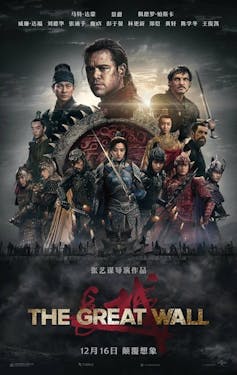
Localised strategies have also appealed to Chinese audiences. Chinese star Jing Tian has appeared in several Legendary monster films – as a military leader in kaiju martial arts spectacular The Great Wall (2016), a biologist in Kong: Skull Island and a famous scientist in Pacific Rim: Uprising. Star casting has long been one of the key techniques used by Hollywood to appeal to local markets. Locations are also important – the action in The Meg has been relocated from Maui in the novel, to China. Its cast also includes Li Bingbing, a Chinese star who also appeared in the most recent Transformers movie.


Legendary’s films demonstrate the mixture of local and global features at work. Legendary East and China Film Group

Several monster movies have recently grossed more in China than
domestically in the US. Pacific Rim: Uprising grossed almost twice as much, and Rampage over 50% more. By contrast, Star Wars films make negligible impact at the Chinese box office – clearly monster content is more appealing to Chinese audiences.

This cycle of giant monster movies is currently the most prominent example of Hollywood’s globalised business. Its embrace of international material, familiar recycling and relationships with Asia are most strongly evidenced in these films. That’s not to say that all of this is new or one-way traffic: Legendary’s success with Godzilla inspired Toho studios to develop not one but two new series with the beloved national icon.


Read more