A powerful essay by playwright Arthur Miller about tragedy and the common man. Maybe more relevant now than when it was written decades ago.


“Art is everywhere, except it has to pass through a creative mind.”
-Louise Nevelson

I have always been struck by this line from Worstward Ho, Samuel Beckett’s 1983 novella: “Ever tried. Ever failed. No matter. Try again. Fail again. Fail better.”
As a therapist and writer, I believe the wording sums up accurately both the clinician’s and the artist’s experience. It captures the struggles, uncertainty, and much-needed indefatigability of both professions.
Perhaps, more prosaically, this same sentiment was expressed by Albert Einstein. Once, when asked how he worked, he replied, “I grope.”
As I acknowledged in my book, Writing From the Inside Out, “Not an attractive word, grope. Sounds too much like lope, or dope, or mope. As an image, groping has associations with unpleasant activities like stumbling around in the dark, feeling blindly with your fingers, or enduring a series of false starts and wrong turns. It sounds unprofessional, almost haphazard, and too susceptible to the whims of luck and circumstance.”
I have taken the liberty of quoting from a book of mine, as well as from Einstein and Beckett, to preface my discussion of an issue that sometimes confronts clinicians treating a creative patient. Ensnared by anxiety while working on a difficult project, the patient often asks their clinician—sometimes only implicitly—for guidelines or a technique for addressing the new work’s problems, and so quelling the doubts and fears it has birthed. In my experience, such patients are not only looking for pragmatic suggestions for alleviating their concerns but need help coping with the shame they associate with having such difficulties.
In other words, and in the minds of many creative patients, real artists do not grope. They plan, reflect, ponder, conceptualize, synthesize, outline, embellish… create. Their work is the result of craft, inspiration, thought, and insight. To be blunt, a real artist knows what the hell they are doing.
This gnawing belief holds true for many creatives, whether writers, painters, musicians, or designers. It also holds true for many clinicians, whether therapists, psychologists, psychiatrists, or social workers.
In a previous column, I suggested that 1 of the root causes of procrastination is a fear of shameful self-exposure. In my view, a creative patient’s difficulties with a project, and their belief that there is some technique that offers a solution, evokes a similar shame. There must be a way to solve these problems, they think, and if I were a true artist, a real professional, I would know what that way is.
So much for, “Try again. Fail again. Fail better.”
I recall a session some years back with a writer patient struggling with the plot details of his first novel. He had published a few essays and a number of short stories, but working out the narrative issues of this complicated novel was seemingly beyond him.
“There must be some technique that every novelist knows,” he said plaintively. “Some rule. I guess I just don’t know what it is.”
Based on what we had explored previously about his childhood experience with a demanding and pedantic father, knowing (and the rules, facts, andexperience this knowledge was built on)was acore value in defining one’s worth—and thus one’s worthiness to be loved. (Reminding me of something I had heard during my years as a Hollywood screenwriter, concerning the actor Steve McQueen’s description of the only type of character he would play: “I’m not the guy that learns; I’m the guy that knows.”)
Given the similar ethos fueling my patient’s shame, my mentioning Einstein’s quote about groping did not do much to allay his concerns. So I tried to elaborate.
“I think what the quote suggests is that a professional person’s view of their work include in it the reality that all artistic effort, in a sense, is a groping toward something.”
“What the hell does that mean?”
“Let me put it this way: A writer like yourself, a real craftsperson, should know that the tools of creative preparation—plot construction, reflection on theme and content, an understanding of how to devise realistic characters—these tools have been developed for one reason only: to enable them to grope.”
I spread my hands, in an attempt to come off as less pedantic myself. “It’s only logical, right? The higher your skill level and experience, the more likely you are to break away from the known way of doing things. That kind of exploration has uncertainty built into it.”
My patient nodded. “That reminds me of something I read. What the cellist Pablo Casals said. ‘Learn the notes and forget about them.’ Are you talking about something like that?”
“Pretty much. It’s only when you reach a high level of competence that you’re finally able to grope. Like where you are with your novel. Given your past experience and talent, a new project like that only gets harder, not easier. You find that you’re demanding even more of yourself.”
“Lucky me.” He gave me a wry grin. “Well, shit, if it was good enough for Einstein…”
Sessions like these reveal how often creative patients fear Beckett’s notion of “failing better,” and yearn for models or guidelines, not merely to quell their anxiety but to counter the shame underlying it. Even veteran artists need the validation that confirms they “know what they are doing,” though the wisest among them know that is not the sole prerequisite for doing good work. That happy outcome requires risk, accident. As an actor patient once explained it to me, “Rehearse like crazy, then wait for the mistakes.”
In my 30+ years of practice, I have come to believe that what is true for my creative patients is true for clinicians. Too often we adhere to conventional dogma when it comes to treating patients, relying too readily on the dictums of diagnostic categories or the claims of personality theory. Knowledge of these things is crucial, of course, but since I feel that therapeutic work is both a science and an art, we have to be careful not to rely so much on the profession’s orthodoxy that we are blinded to the wisdom of our own instincts, the potential for our own unique approach to a patient’s issues. Which inevitably entails risk.
A book that had a profound influence on my thinking in this regard, written many years ago by philosopher William Barrett, was The Illusion of Technique. As the title infers, it is a ringing defense of creativity as a spontaneous reaction against the false sense of security promised by reliance on rigid structures, belief systems, and techniques.
In other words, a closed system of thought is a dead system. Equally true, I believe, for both creative patients and their therapists.
Again, an anecdote from Einstein’s life: when a student complained about his difficulties with math, Einstein replied, “Don’t worry about your troubles with mathematics. I can assure you mine are far worse.”
Another allusion, no doubt, to the reality of struggle, uncertainty—groping, if you will—as the price of any worthy creative endeavor. After all, as my author patient said, if it was good enough for Einstein…
Dennis Palumbo, M.A., MFT is a writer and licensed psychotherapist in private practice, specializing in creative issues, primarily in the entertainment industry. His award-winning series of mystery thrillers—Mirror Image, Fever Dream, Night Terrors, Phantom Limb, Head Wounds and the latest, Panic Attack—feature psychologist and trauma expert Daniel Rinaldi. He’s also the author of Writing From the Inside Out, as well as a collection of mystery short stories, From Crime to Crime. Recently he served as Consulting Producer on the Hulu limited series The Patient, and here (in an article first published in the journal Capital Psychiatry) he tells us about how the play out of the television crime drama affected his real-life patients.

After seventeen years as a Hollywood screenwriter (the film My Favorite Year; the sitcom Welcome Back, Kotter, etc.), I retired from show business and have been a licensed psychotherapist in private practice for over thirty years. During this time, my writing has been confined to articles and reviews, as well as a series of mystery novels whose protagonist is a psychologist. My point is, it’s been so long since I was a dues-paying member of the Hollywood industry that I was quite surprised to hear from the team of Joel Fields and Joe Weisberg. Writers of the award-winning TV series The Americans, they’d reached out to me to act as advisor on a new show they were developing. Called The Patient, it was about a serial killer who kidnaps and holds hostage a well-known therapist, in hopes that he can “cure” the killer of his homicidal urges.
Apparently, my former career as a script writer and my current one as a therapist prompted them to see me as a reasonable person to act as consultant on the new series. Essentially, what they wanted was for me to vet each episode’s scripts for clinical accuracy and to “make sure the therapist sounded like a therapist”—or as much like one as possible given the bizarre circumstances of the show’s premise.
Over the coming months, I did my best to keep the narrative within the range of plausibility, including suggesting the occasional line of dialogue or therapeutic interpretation. Just as we were finishing the script for the last episode, it was announced that Steve Carell had been cast as the therapist. A wonderful actor, he’d been given a salt-and-pepper beard and glasses. Whether or not it was conscious on the writers’ part, he looked somewhat like me. Which, at the time, I just found amusing.
My working relationship with Fields and Weisberg was one of the most pleasant professional experiences of my life. Moreover, the two writers were very gracious about my contribution when doing PR interviews leading up to the series premiere. During one such interview, when writing up the story for Newsweek, the reporter off-handedly mentioned that Carell’s character looked like me.
It wasn’t until the series began airing on Hulu that the ramifications of this became apparent in my therapy practice. A number of patients who’d begun watching the show pointed out that Carell’s therapist character looked a lot like me, and on occasion even sounded like me. (No surprise, since I’d suggested some of the therapeutic comments the therapist made.) Naturally, I had to process this with these patients, some of whom were quite upset at seeing the therapist chained to a bed, helpless. More than one half-jokingly worried that the series’ premise would give “some crazy person” the idea of kidnapping me. Did I feel I was in danger? they asked. I answered honestly that I didn’t, while privately wondering why I’d never even entertained that idea when working on the show.
Moreover, had I been unforgivably clueless in not anticipating this reaction from my patients? I reminded myself that Steve Carell hadn’t been cast until the series’ scripts were almost finished, that I had no idea he’d be playing the therapist, and certainly no idea how they were going to make him look. Yet I still felt pangs of remorse for the distress the show’s depiction of the therapist was causing for some of my patients.
As the weeks went on, and episode after episode aired, it became obvious that seeing an avatar of their therapist was upsetting to a number of my patients. Of equal interest during sessions was the reaction of those patients who found the whole thing amusing, or at least presented it as such. They even joked with me about the series’ story-telling: why didn’t the therapist try harder to escape? Why didn’t he just refuse to talk to the serial killer? Is this how you would react in this situation, Dennis?
Of course, the narrative choices displayed on-screen were made by the show’s writers, not me. I was merely the consultant. But this didn’t matter. What did matter, and what ended up being of real clinical interest (and value) was what some patients’ transferential connection to the therapist character and the story revealed about both their own core issues and their relationship with me. As Robert Stolorow has reiterated, there is only subjectivity and context; in this unusual situation, there was a patient’s subjective experience of me in the context of our therapeutic relationship, and then a kind of meta-subjectivity/context experience through the narrative of a TV series.
(SPOILER ALERT: I’m going to discuss the series’ final episode)
For a select few of my patients, as I’d expected, it was the series’ final episode that elicited the strongest reaction. Not only does the therapist fail to escape, he’s strangled to death on-screen by the serial-killer patient. This horrible murder is hardly ameliorated by the killer’s decision to send an anonymous letter to the therapist’s family, telling them where they can find the body so it can have a proper funeral. The last time we see the serial killer, he’s the one chained to the bed, his mother holding the key to the chain’s lock. Since she’s known all along about her son’s activities, we’re left to wonder if/when she’ll release him to potentially kill again.
A couple patients revealed that they’d cried at the end, one of them pointing an accusing finger at me and saying, “You better not fucking die!” Again, said half-jokingly. And yet, not. The few others who’d stayed with the show all the way to the end were angry at both the series’ writers and at me. Their reactions ranged from disbelief (“How could they end a show like that? How come the killer gets away with it?”) to frustration (“That’s not fair to the viewers. We deserved a better ending.”) to simple creative criticism (“I hate ambiguous endings.”).
As difficult as the sessions were with these patients over the course of the series’ run (including my own guilt at having put them through it), some of the clinical work that arose from our discussions was quite beneficial. A greater understanding of the contextual nature of our therapist/patient relationship undoubtably occurred. Moreover, we often reached a deeper understanding of the dependency/resentment dynamic at work in the therapeutic dyad. And, in one or two cases, the discussion regarding the show was a springboard to a more energized, proactive engagement on the patient’s part.
Still, I have somewhat mixed feelings about my participation in the series. It was often an exhilarating experience, due primarily to the talent, receptivity and warmth of both Joel Fields and Joe Weisberg. And while I regret the distress that the lead character’s words and looks evoked in a few of my patients, I also felt this similarity led to real forward progress in our work together. A potential disjunction becoming a fruitful conjunction.
That said, if I’m ever asked to consult on another series, my only hope is that the lead character looks like someone else.
Dennis discusses his role as Consulting Producer on the recent Hulu TV series, THE PATIENT, and how the fact that the therapist character (played by Steve Carell) looked somewhat like him.
This essay details the impact---some of it quite surprising---that this had on his therapy patients.
DENNIS PALUMBO, MA, MFT, is a licensed psychotherapist in private practice, specializing in creative issues. He co-wrote the screenplay for the award-winning My Favorite Year and other films, numerous TV episodes and pilots, and the novel City Wars.


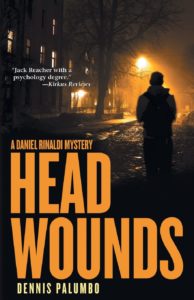
Formerly a Hollywood screenwriter (of My Favorite Year, Welcome Back, Kotter, and more), Dennis Palumbo is a licensed psychotherapist and author. His mystery fiction has appeared in Ellery Queen’s Mystery Magazine, The Strand and elsewhere, and is collected in From Crime to Crime (Tallfellow Press). His series of mystery thrillers (Mirror Image, Fever Dream, Night Terrors, Phantom Limb, and the latest — excerpted on Littsburgh! — Head Wounds) all feature Daniel Rinaldi, a psychologist and trauma expert who consults with the Pittsburgh Police.Praise for Dennis Palumbo’s Daniel Rinaldi Series:“Accomplished writer Dennis Palumbo calls his latest novel Head Wounds and the grim title should serve as a warning. This psychological thriller has some fine language and a strong narrative pull that keeps the pages turning, but the series of crimes that occur are unnerving…People in the story wear Pitt Panthers and Steelers sweatshirts, drive on the parkway, and get their news from KDKA. Mr. Palumbo often does more than just mention Pittsburgh landmarks; he characterizes the city in both positive and negative ways…As Head Wounds rolls to its clever, crazy gothic conclusion, no one could accuse Mr. Palumbo of being flat. This is the fifth book in his Daniel Rinaldi series and most readers will hope Dan lives to see a sixth.”
— Pittsburgh Post-Gazette“Head Wounds delivers relentless action toward a climax as vivid and harrowing as anything I’ve ever read.”
— Joseph Finder, New York Times best-selling author of The Switch“The character of psychologist and trauma expert Daniel Rinaldi gives great heart to this story and elevates it to novelistic heights.”
— John Lescroart, New York Times best-selling author of Damage“Lovers of noir will enjoy Dan Rinaldi’s fast-paced adventures. Rinaldi, an empathic therapist, is on call to the Pittsburgh police. He needs every ounce of his Golden Glove skills to survive the violent world of Pennsylvania politics.”
— Sara Paretsky, Mystery Writers of America Grand Master, author, V.I. Warshawski novels“A gripping thriller, chock full of the desired twists and cliffhangers, with the added layer and intriguing access of a therapist narrator/detective. A page turner!”
— Aimee Bender, New York Times best-selling author of An Invisible Sign of My Own
 What do the recent films Unstoppable, The Dark Knight Rises, and Jack Reacher — as well as popular TV series like This is Usand Mindhunter — have in common? They were all shot in Pittsburgh, Pennsylvania and the surrounding areas.
 But not just for nostalgia’s sake.


